Africa-Press – Angola. Lately, the whole world has seen a notable growth in the protest movement against the so-called state violence, embodied by ‘police brutality’, in its most visible form, during demonstrations.
For some time now, human rights activists have launched initiatives in several countries, including Angola, ranging from awareness campaigns to interventions or interpellations against the repression of street demonstrations.
Specifically, they call for an end to the use by States of “excessive, disproportionate and lethal force” against their citizens in the exercise of freedom of expression and assembly.
Petitions with this content have already been sent to countries like France and the United States, the world’s main democratic references, and, more recently, to African nations like Senegal, Kenya, Angola, among others.
In the case of Angola, such interpellations are led by Amnesty International Portugal (AIP), from Lisbon, and the last petition dates from the 11th of this month.
In their reactions, targeted states have invariably complained against what they see as the “reductive approach” of human rights activists, who turn a blind eye to the paradox of the extremely violent nature of “peaceful demonstrations”.
The same States warn that, by making a “blank slate” to the violent contours of some demonstrations, ignoring the economic impacts of the resulting damage, such initiatives also encourage the use of street protests as a pretext for the usual criminal practices that end up in the courts. .
They denounce the behavior of demonstrators who, in some cases, are the first to attack the forces of order and other actors, including journalists, thus supporting the contested use of excessive police force.
According to this narrative, there are protesters who abuse their right to demonstrate, to harm or sacrifice the rights of others, including their own right to life and the right to property, resulting in the death of innocent people and the destruction or looting of public and private property.
Therefore, the intellectual honesty of those who celebrate tragedies or episodes as heroic acts is questioned in which, under the pretext of honoring a life or demanding a right, other lives are attacked and an entire collective or collective heritage is deliberately destroyed. particular.
It is also questioned whether one can speak of a “peaceful demonstration”, when its protagonists set fire to movable and immovable property, destroy schools, loot stores, rob banks and orchestrate assassination plans against administrative or other figures.
If, on the one hand, it is denied that excessive police force is justified, it is understood, on the other hand, that the right to freedom of expression and assembly does not authorize the vandalism of public and private property, the final bill of which falls on the shoulders of taxpayers when it comes to repairing the damage caused by the demonstrators.
Added to this is the fact that such invoices, almost always in millions, cover damages that are unnecessarily and unlawfully caused in the legal sphere, even to people without direct or indirect ties to the State.
In another aspect, analogies are also established with cases of authentic private justice or by one’s own hands, by way of revenge, when it is known, as in Paris, for example, that the policeman who fired the shot at the origin of the demonstration was already competently detained .
In the antithesis of this argument, however, there are the most varied conspiracy theories that favor the benefit of the doubt for the thesis of infiltration of the demonstrations by the States themselves with agents deliberately prepared to provoke disturbances.
For some analysts, the option between purely and simply admitting or refuting such an eventuality also has its risks, judging by the difficulty of envisioning the possible gains that such States would obtain with such irresponsibility, which ends up burdening their coffers.
But, in the perception of its supporters, the conspiracy thesis is based on the generalized fear that the States would have to see their authority challenged in the street, with the risk of degenerating into a real threat to palace power.
It is, moreover, a hypothesis that tends to be remote, at least in advanced societies, since the criticisms of human rights activists are not limited to countries without a consolidated democratic tradition, but also, above all, to the great democracies.
France says “enough”
The birthplace of the Universal Declaration of Human Rights, France is among the European powers most pressured by the ‘street’ in recent years, and is therefore at the center of attention in the fight against police cruelty.
Undoubtedly, Molière’s Nation stands out among the most recent cases that have shocked humanity, due to the intensity of police intervention and the scale of the damage and seriousness of the crimes caused by the protesters’ attacks.
The last episode of urban violence in the country dates back to the end of June 2023, when the death of a teenager, by a Paris policeman, became a national tragedy, resulting from the confrontation between the forces of order and ‘peaceful demonstrators’.
The outcome was so catastrophic and unprecedented that the French Government almost confessed to having reached the “end” of its patience when it promised that it would no longer tolerate things going on as they were.
With the warning, the Executive of President Emmanuel Macron hinted at a profound review of the State’s rules of action in situations of this kind.
Three dead, thousands of people arrested and a large number of commercial establishments, bank branches, as well as public and private buildings burned, destroyed or looted was the result of the tragedy whose property damage is around one billion euros.
The numbers point to more than 12,000 vehicles burned down, close to 400 bank branches and 1,600 commercial establishments degraded, looted or completely destroyed, 269 police stations robbed, 263 schools deteriorated, among other damages.
For the French authorities, it was proven that there was an “instrumentalization” of the condemnable death of a young teenager to execute agendas that were foreign to the concept of “peaceful demonstration” and its derivative right to freedom of expression and demonstration.
More precisely, they explain, the death of young Nahell Merzouk, aged 17, was “a pretext for an explosion of absolutely unforgivable hatred and violence”, jeopardizing “adherence to republican values, with attacks on the symbols of the Republic (…) , which the State is responsible for defending”.
For the French State, the criminal use of the protests in question was proven with the criminal proceedings tried in competent courts, following the arrests made during the uprising, for the commission of various crimes, including attempted murder.
Indeed, 480 of the total of 3,625 detained demonstrators were judged, of which 380 were sentenced to prison terms, while others are awaiting trial.
Before the events of June 2023, France was already in the sights of human rights organizations of the United Nations and the European Council, who accuse it of doing nothing to curb police brutality, especially during previous violent protests.
On November 17, 2018, what would come to be known as the ‘Yellow Vest Movement’ erupted in the country, a protest demonstration against the cost of living and for the reduction of taxes on fuel.
Very soon, the protest movement turned into an authentic insurrection, mobilizing more than three million people across the country, with blocked roads, fires, riots and looting in the mix, forcing a muscular intervention by the Police.
It ended, in March 2019, before the country faced, four years later, a new wave of violence with almost the same characteristics, but this time, to protest against the reform of the social security system, which increased from 62 to 64 years retirement age.
Since then, the United Nations High Commissioner for Human Rights (OHCHR) and the Commission of the European Council for Human Rights (CCEDH) have maintained pressure on the French Government to guarantee the effective exercise of freedom of demonstration.
The two organizations understand that it is the State’s obligation to protect demonstrators and journalists against police violence and against “violent individuals who act inside or on the margins of processions”.
They consider that the “sporadic” acts of violence by some demonstrators or other reprehensible acts committed by other people during the demonstration “cannot justify the excessive use of force by State agents”, much less suffice “to deprive peaceful demonstrators of enjoying the right to freedom of assembly”.
In its response, Paris justified the use of force due to the “particularly difficult” conditions for maintaining order that require the use of “all means of intermediate force”, capable of allowing “a distance that guarantees maximum security, both for the forces of order, as well as for the people who face them”.
According to the French authorities, at no time are Defense Bullet Launchers (LBD) used against demonstrators, “if they do not commit acts of physical violence, in particular against the forces of order”.
In other words, French police officers only resort to LBD “when it proves necessary to deter or stop a violent or dangerous person”, situations in which the applicable legal framework ceases to be that of demonstrations and passes to that of “gatherings”.
They were demonstrations marked by “serious acts of violence” committed by some demonstrators against the forces of order, the journalists present at the scene and other people, said the French Government in its 21-page response sent to the European Council.
The document also explains that, in these cases, “these are no longer demonstrators, but participants in violent and illegal gatherings”, aggravated by the finding of racist, anti-Semitic or homophobic statements, inscriptions or aggressions during the mobilization.
Angola and other African cases
Angola, along with Senegal and Kenya, registered the most recent cases of violent demonstrations that shook the African continent, with different motivations, leaving behind human victims and massive material damage.
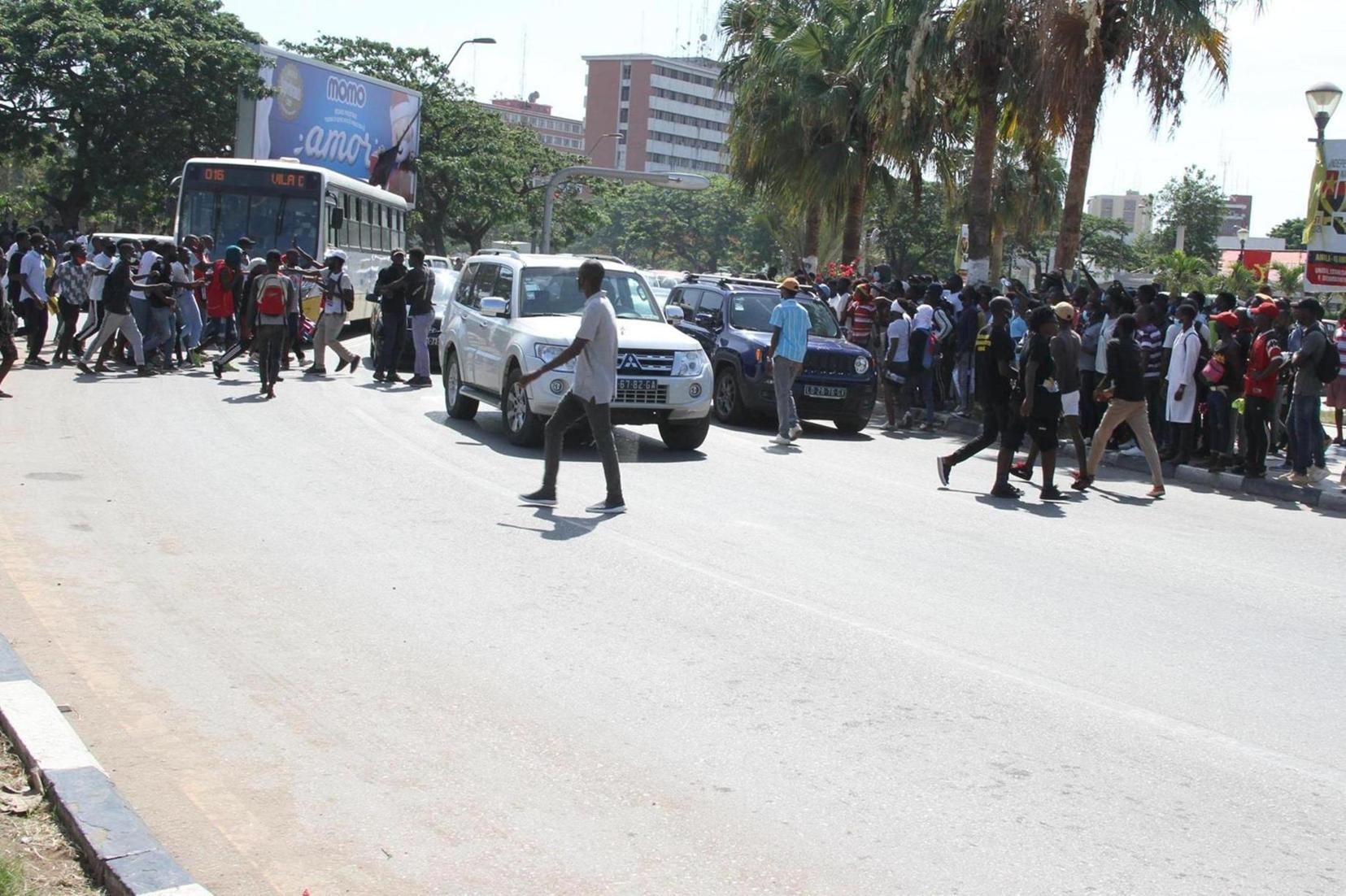
The last serious incident in the country also took place last June, in Huambo province, when dozens of motorcycle taxi drivers took to the streets to protest against the increase in gasoline prices.
The episode occurred about 18 months after another scenario of urban violence, which emerged on January 10, 2022, in Luanda, in a movement initially called as a taxi drivers’ strike, which resulted in acts of vandalism and looting.
Similar to the approach adopted by Paris, the authorities in Luanda state, in their defence, that the use of force in demonstrations “only happens in situations of disturbance of public order through the violation of other fundamental rights”.
In other words, the common starting point has been the principle that defense and security forces have a legal obligation to restore public order, in case of disturbance, in fulfillment of their general duty to “protect people, their assets and the rule of law and democracy”.
The same arguments can be found in Senegal, one of the greatest references of African democracy, where the Government prefers, rather, to classify the latest events in the country as “acts of banditry”, than to recognize their nature as “peaceful demonstrations”.
Last June, the Senegalese police confronted demonstrators who were protesting against the judicial conviction of the opposition leader, Ousmane Sonko, for ‘criminal practices’ in the middle of the pre-election period.
The final balance was 16 deaths accounted for in three days and more than 400 injured among the demonstrators, 36 among the forces of order and substantial material damage with the burning or destruction of vehicles and buildings, as well as looting of stores and other places, in the hardest hit cities.
With more than 500 arrests, the episode described as the most violent in recent decades in the country was more concentrated in the capital, Dakar, and in the city of Ziguinchor, headquarters of the South, on the border with Guinea-Bissau.
For its part, Kenya lost seven people in a single day, while 312 individuals, including an MP, were arrested during street demonstrations in several cities in the country, when protesting against new taxes.
The protests, initially ‘peaceful’, degenerated into violent confrontations resulting from the throwing of stones, by the demonstrators, against the forces of order, who fought back with tear gas and live bullets.
The Kenyan authorities declared that the 312 people arrested, including a deputy, will respond in court for evidence of committing “various crimes, because they planned, orchestrated or financed, directly or indirectly, “violent protests and acts of illegality”.
In the face of all this evidence, it is clear that the so-called ‘excesses’ of Angola’s defense and security forces, pointed out by Amnesty International Portugal, are not exactly an exclusive reality of Angolans and are, as a general rule, motivated by the replacement of order and legality.
Angola is a Democratic State based on the rule of law that respects the right to demonstrate and assemble, enshrined in the Constitution, as long as they are peaceful, orderly and do not violate, under any circumstances, the rights of third parties.
Angop
For More News And Analysis About Angola Follow Africa-Press