Africa-Press – Angola. A beam of sunbeams poured over Dakar last Sunday morning, as if to dry up the rainwater that had fallen on the city the day before and whose remains, still on the ground, survived the night.
When we left the dirt streets, in the Amitié 3 neighborhood, and went to the side of the Avenue, which celebrates the life and political trajectory of the Tunisian Habib Borguiba (1903-2000), we thought that we would be there for a long time, drying up like the trunks of trees.
It wasn’t like that: a yellow and black taxi passed and, at the first wave, stopped. We approached the city quickly, seeing the waters of the Atlantic crash on the “plateau” and arrived at the doors of the Museum of Black Civilizations, as if we had arrived at a place of respect, which perhaps, one day, will also become a place of worship: It is said that at the base of its creation is a dream of Léopold Sédar Senghor, announced at the 1st World Festival of Black Arts, in 1966.
From dream to reality, the project had several phases, namely: the announcement of construction, by President Abdoulaye Wade, in 2009; the laying of the first stone, in 2011; the beginning and end of the works, between 2013 and 2015; the handing over of the keys in 2016 and the official inauguration by President Macky Sall on 6 December 2018.
That Sunday morning, all I had to do was get out of the taxi to get anxious, a feeling I kept to the letter for weeks, days and hours, including on the long flight from Luanda to Dakar, passing through Addis Ababa and Ougadougou.
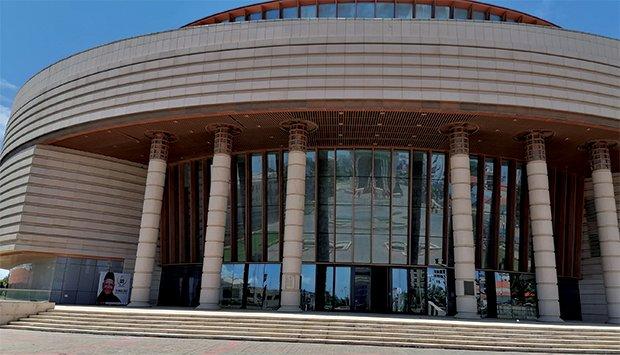
About a hundred meters from the museum, the base of my feet shook after I saw the impotence of the building inspired by the “cases à impluvium”, characteristic of the Diolas, in the Senegalese region of Casamansa.
As we arrived early at the place, we had time to enjoy the surroundings and walk through those spaces, between the gardens and the square that separate it from the Doudou Ndiaye Coumba Rosa National Theater and at the back, close to the beautiful Dakar Train Station, a newly -rehabilitated.
The Museum of Black Civilizations was built in an open space: its giant columns and compact base, on which a circular roof rests, help to highlight the monumentality of the building, which, together with the surrounding areas, covers almost 14 thousand meters. squares.
When we entered the museum, we were impressed by the hall. However, it also has a conference room, an auditorium with 150 seats, administrative spaces, a workshop for exhibitions and different multipurpose spaces, in addition to warehouses.
Once inside, we soon realized that we were going to see three exhibitions, entitled “Africa, Cradle of Humanity”, “Continental African Civilizations” and “African Women and Political Leadership”.
An Exhibition Of The Continent In Artistic Retrospectives
“Africa, Cradle of Humanity ” is an exhibition on the origins of humanity and scientific development, from mathematics to iron smelting, compiling the most relevant discoveries in the field of archeology and anthropology.
“Continental African Civilizations” is a sample of the main cultures of the continent, seen from the material productions, objects of worship and artistic and aesthetic creations, in which we can see from the Nok terracotta, from Nigeria, to the Nkisi Konde, from the region of Maiombe, in the Democratic Republic of Kongo, passing through a bouquet of other diverse cultures.
“African Women and Political Leadership” is a simple tribute to the place of women in the history of the continent’s political life, – so it does not forget to include Queen Njinga Mbandi, among the precursors -, an objective that is very clear to the spectator, seeing highlighted the five women who became President, in their respective countries, namely: Ameenah Gurib-Fakim (1959), in Mauritius, Joyce Banda (1950), in Malawi, Catherine Samba-Panza (1954) ), in the Central African Republic, Ellen Johnson Sirleaf (1950), in Liberia, and Sahle-Work Zewde (1950), in Ethiopia.
Achieved that, in part, are the political and cultural objectives that were in the dream and the basis of its creation, at this moment the important thing is that the Museum of Black Civilizations exists, to the pride of all Africans and the diasporas.
We spoke to Hamady Bocoum, its general manager, about the underlying reasons that explain its conceptual basis.
Of one thing, we are certain, Africans and all the heirs in the diasporas will continue to come to Dakar like the beam of the sun’s rays that always ends up falling on the city and its citizens capable of rising forever necessary, to glorify the most virtuous and successful manifestations of art, culture and politics in Africa.
For More News And Analysis About Angola Follow Africa-Press