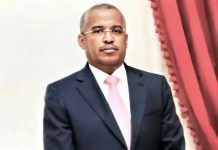
Africa-Press – Angola. The director general of the Angolan Public Debt Management Unit (UGD), Dorivaldo Teixeira, highlighted, on Tuesday, in Luanda, the significant reduction in the perception of risk about Angola among international creditors, as a result of the reinforcement of the transparent management of the country’s debt in recent years.
In an interview with Public Television of Angola (TPA), the manager assured that Angolan public debt is following a normalization path, with a reduction in the level of debt concentration with China and exposure in hard currency.
He recalled that in the last five years the debt with China went from US$16.3 billion to US$7.7 billion, while the country’s debt exposure in hard currency went from 48% to 27% in the same period.
For him, this reduction demonstrates resilience in the debt portfolio, an aspect he considered fundamental for promoting the stability of macro-economic indicators.
During the interview, he pointed out that the internal debt is currently US$18.40 billion, the external market debt is US$47.4 billion, while Eurobonds represent US$9 billion.
Focusing on the pillars of the National Debt Strategy, he highlighted the continuity of initiatives that aim to change the debt profile, making it less risky and ensuring better functioning of the domestic market.
He added that, within the scope of this pillar, the Investor Portal is expected to resume in the coming days, with a view to allowing citizens to subscribe to public securities and pay them via the Multicaixa network or internet banking.
He also recalled that for this year, the country plans to raise 15 trillion kwanzas (approximately 15.96 billion dollars), with a view to ensuring the management of the current economic year.
Of this amount, around 8 billion will be mobilized on the domestic market and the remainder on the foreign market.
It should be remembered that the Medium-Term Debt Strategy 2026-2028, recently presented in Luanda, is based on axes such as improving the contracting methodology, promoting sustainable financing, not using collateralization in “commodities”, changing the debt maturity profile, among others.
For More News And Analysis About Angola Follow Africa-Press