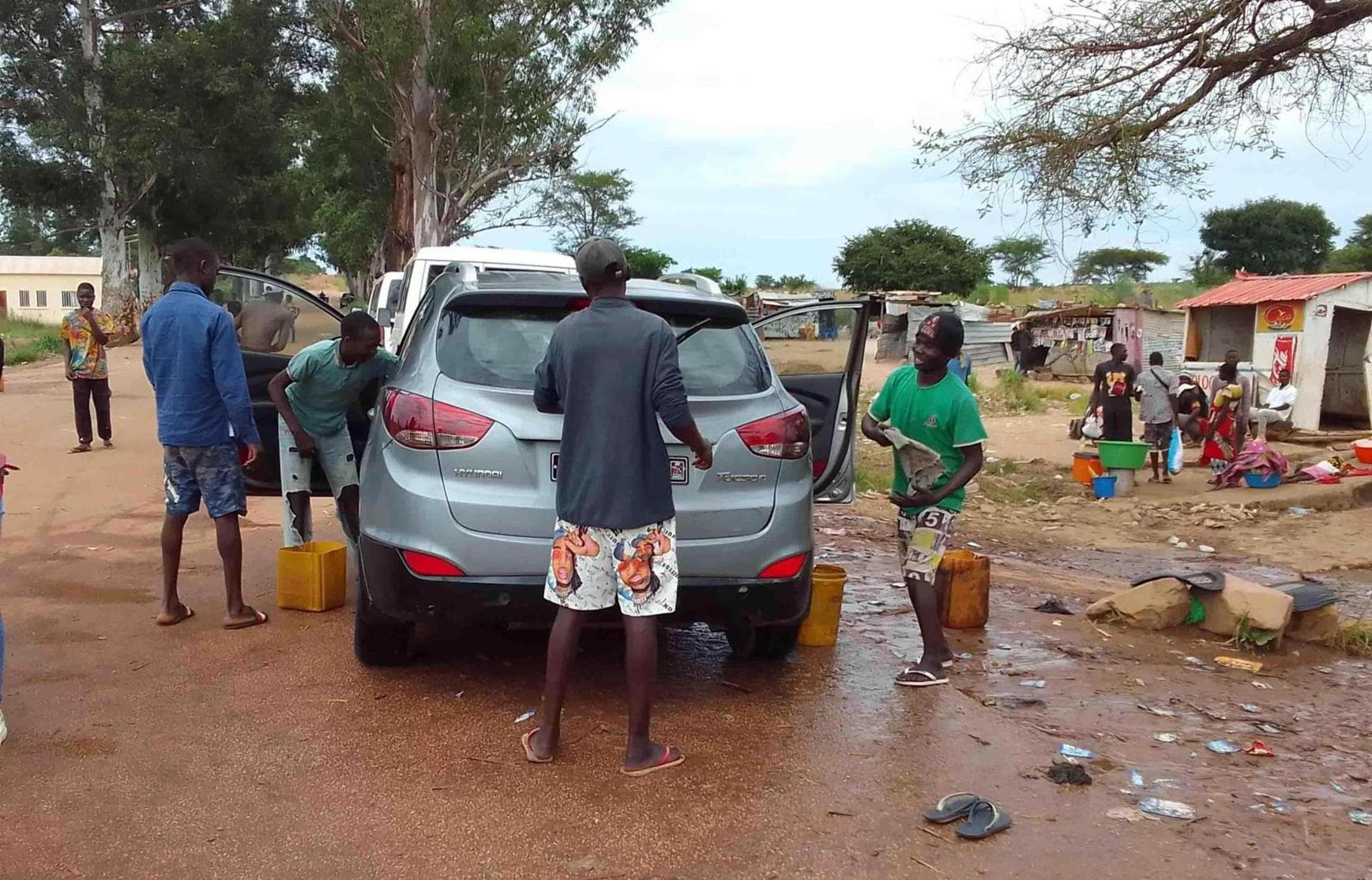
Africa-Press – Angola. More than 100 young people from the capital of Cuando Cubango, Menongue, chose to wash cars as a bet on self-employment to guarantee the livelihood of their families.
In a tour carried in places of greatest demand such as riverbanks and bridges, it was noted that car washing in the capital of Cuando Cubango began to gain space in recent years.
It all started when a small group of teenagers who carried out this activity, carried out along the banks of the Cuebe and Luahuca rivers, discovered that it was used to earn a daily living and help some families.
The initiative led to the emergence of other car washing places, such as the Cambumbe dam, considered one of the renowned tourist attractions in the city of Menongue, but which is now abandoned.
Over time, the washing point next to the Cambumbe dam gained greater prominence, with more customers joining, relegating the service stations controlled by the Menongue municipal administration to the background.
Press found that they are mostly young people aged between 17 and 30, who from the early hours of the day are present on the banks of the rivers to carry out their activities due to the lack of jobs to support their families.
Daily income for sustainability
Manuel Ndala Adriano, 28 years old and a 11th grade human sciences student, has been working in this activity for two years and earns 4,000 to 5,000 thousand kwanzas daily, as a car washer at the Cambumbe dam.
With the dream of being a national police officer, he said that, with the little he earns daily, he can support his family and his studies.
He made it known that many of his colleagues found the opportunity to give up drugs there, opting for entrepreneurship in the sale of ice cream, drinking water, powdered detergents, sweets, among others.
This is the case of young João Paulino, 23 years old, who, due to a lack of financial means, to continue his studies and not enter the world of crime, decided to wash cars to support his family and beyond.
In terms of charges, for a light vehicle it ranges from 1,500 to 2,000 kwanzas, for each motorbike 500 to 1,000 kwanzas, while for a truck it varies between 7,000 to 10,000 kwanzas.
Because it’s team work, you can take home five to six thousand kwanzas, with daily income varying depending on the influx of customers.
He considered the relationship he maintains with his colleagues when providing this service to be positive, depending on their degree of kinship or the fact that they are fellow countrymen.
Manuel Fernando said that the creation of contact and neighborhood networks, based on kinship, with people from the same sociocultural space, maintenance of eating habits, and speaking the language of the ethnolinguistic group of origin are the most evident forms of manifestation of ties.
Young Paulo Cambinda, another washer, considered meal times to be a good opportunity to expand ties, as it is generally carried out collectively, but always between members of the same group.
He highlighted that it is in these circumstances that cooperation, collaboration, solidarity and mutual responsibility among colleagues on the “board” as they call it, often stand out.
During the round carried out, it was clear that meals take place in places unsuitable for the consumption of food, in places where there are few sanitary conditions, surrounded by rubbish or dust, which in most cases is produced by them.
Most profitable methods
Despite the existence of places identified for car washing, many young people, attracted by the profession and in the desire to earn money, seek to establish contracts with the owners of the vehicles, in order to be paid at the end of the month.
Others prefer to offer their services, even to be paid for at the moment, in the car parking lot, in this particular case in the “Messi” building, a former Armed Forces warehouse, today called “Prédio Caído”.
Customer opinion
The price charged by informal washers, in places identified above, attracts clientele, where it was found that several motorists refuse to go to a service station, due to the high costs.
At service stations, owners are charged five thousand kwanzas onwards, at the expense of complete work and the size of the vehicle.
Ângelo Próspero, owner of a vehicle, recognized the quality of the washing carried out by young people in different parts of the city of Menongue, which leaves nothing to be desired compared to that carried out at service stations.
He recognized that young people are good, they have done a good job, which makes motorists happy, hence the continued preference.
For citizen Júlio Maliti, the work that these young people dedicate themselves to deserves respect and motivation, in order to justify the young people’s permanence in this activity, due to the fact that they have a guarantee for their livelihood and that of their family.
“For them, the advantage of this activity is restricted to freedom at work, autonomy, permanent contact with nature and the fact that they have guaranteed work”, he concluded.
Biggest concerns raised by young people
The biggest concern among young people was the lack of materials (electric pumps, the construction of ramps, buckets, hoses, mosquito nets, brushes, among other materials, along with training in ways to help them lean towards entrepreneurship and be able to generate employment.
Vision of the youth secretariat
The secretary of the Provincial Youth Council (CPJ), Miguel Tchissingui Américo, advised young people to organize themselves into car wash associations or cooperatives, to legalize the activity.
He added that, within the policies that the government has been developing in favor of youth, the institution will be able, in the coming days, to train young street car washers for training on entrepreneurship, to encourage the self-discovery of each young person and allow them to opening a business in the commercial or service provision area.
He pointed out the extreme poverty within many families as the main cause behind the increase in this work by young people, in which many parents and guardians sacrifice their own children, from a young age, for street vending, livestock, car washing and beggars.
Importance in family income
In this group of young people, there were frequent cases of orphans and children from low-income families, which in a way justifies their levels of education and professional preparation.
A considerable number of those interviewed have only completed the first cycle and no longer attend school, and it is very rare to see cases where it is possible to combine work and studies.
When asked about the motivations behind the car wash activity, the concise response expressed by the people involved in car washing is definitely due to the situation of poverty, unemployment and the lack of institutional support, with the activity being operated as a daily survival strategy, in order to overcome the social adversities they experience.
Sociologist’s opinion
Sociologist Conceição Armando points to poverty and the scarcity of work in the formal market in Menongue, the lack of programs and public policies capable of absorbing a large number of young people of working age in the short or medium term, as the main indicators of the situation in question.
As I said, the lack of formal jobs leads to numerous social problems, among which juvenile delinquency, alcoholism, early pregnancy, prostitution, poverty, among others, stand out.
“Due to the scarcity of work, young people often look for different mechanisms to counter this insufficiency, and the solution is often found in car washing or street vending”, he noted.
He recognized that car washing has served to support the families of a considerable number of people and, in certain cases, constitutes the only source of income.
It should be noted that, in the capital of Cuando Cubango, Menongue, four car washing service stations are controlled by the municipal administration.
For More News And Analysis About Angola Follow Africa-Press