By ANDRÉ AMARAL
Africa-Press – Cape verde. Cape Verde received, last Friday, certification as a malaria-free country, joining the Mauritius islands and Algeria as the only countries on the African continent where there is no record of indigenous cases of the disease.
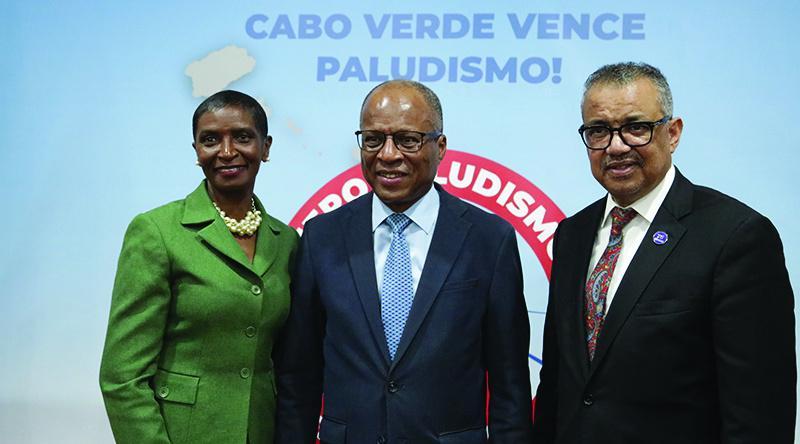
“We have to keep Cape Verde malaria-free”. The words are from Tedros Adhanom Ghebreyesus, Director General of the World Health Organization (WHO) who was in Cape Verde last weekend to deliver the malaria-free country certificate to the government.
However, the official did not fail to warn that the country’s biggest challenge now is how to remain free from this disease.
Artur Correia, a UN consultant who supported the certification process and former National Director of Health, agrees with this idea of the WHO Director General.
“More than having the certificate, [the important thing] is to maintain the status of a malaria-free country”, he points out in a conversation with Expresso das Ilhas.
Cape Verde already has a plan to prevent the reintroduction of the disease in the country and, therefore, “we are facing greater responsibility on the part of national authorities, not only the Ministry of Health, but other ministries that are also involved in this”.
Artur Correia even argues that at this moment “it is already the country’s credibility that is at stake. The status must be maintained. There is no turning back.”
And how do we maintain this status as a malaria-free country?
Artur Correia has no doubts: “We have to invest in greater professionalism and responsibility in the management of imported cases, which continue to appear. Every year we have around 25, 30 imported cases. We have to be vigilant.”
Epidemiological surveillance is, in this expert’s opinion, essential to detect these cases early and act early.
“Anti-vector control is also a fundamental component that we have to implement, greater professionalism, with greater motivation for professionals in this area. And this motivation fundamentally comes from the framework, let’s say, of the professional relationship with the Ministry of Health”, he argues.
Artur Correia also understands that “in this phase of maintaining certification, we can no longer continue with some agents in an indefinite employment situation. The State has the obligation to properly qualify them, give them a decent salary so that, in fact, we can have a response in terms of epidemiological surveillance, in terms of anti-vector control”.
Mosquito (still) present on several islands
The certification of Cape Verde as a malaria-free country proves that prevention work has been carried out by health authorities. However, the mosquito that transmits malaria, anopheles gambiae, remains present in the country, namely on the island of Santiago, on the island of Maio, on the island of Boa Vista, on the island of São Vicente, and was also recently detected on the island of São Nicolau, where it has been in the past, and a very isolated area was also detected in Santo Antão, therefore, in Porto Novo.
The spread of the mosquito that transmits malaria across several of the country’s islands shows that the fight against the resurgence of the disease in the country is not yet over.
“There is anti-vector control, whether against adult mosquitoes, with the spraying of houses, with insecticides… And there is also anti-larval control, which is necessary to maintain the density at a low level, to avoid possible cases of retransmission of imported cases. In relation to the islands, there is the issue of the spraying of planes, which depart from areas where the vector exists, to islands where it does not exist, and when we talk about planes, we also talk about boats, which is an activity that is not yet resumption. The elimination [of the disease] therefore requires the country’s responsibility in delimiting the mosquito vector detection zones”.
Another challenge, says Artur Correia, lies in early diagnosis “which requires a quick response at all levels”.
In the fight against the autochthonous transmission of malaria there is today “greater responsibility, greater professionalism, it is no longer consistent with some amateurism in relation to this. It is the price that the country has to pay to maintain certification.”
Pay attention to still water
But it is not just health authorities who have responsibilities in the fight against the mosquito that transmits the disease.
As happened with dengue or zika where one of the forms of prevention was to avoid stagnant water, the same applies to these mosquitoes that transmit malaria.
“The aquatic phases of the mosquito are important. It is important to know the bioecology of these two vectors of ours so that we can act more effectively”, points out the former National Director of Health.
“The malaria vector mosquito is a less urban mosquito than Aedes aegypti (which transmits duengue and zika). Aedes aegypti is a mosquito that even grows inside houses, in plant pots and also in water tanks at home. But anopheles gambiae (which transmits malaria) does not have this habit of developing indoors. It appears more especially when it rains in areas with water, let’s say without large amounts of decomposing organic matter and therefore has a different bioecology than Aedes aegypti and the control measures are also slightly different, but can, perfectly, be integrated. There can now be an integrated anti-vector fight that takes these two fundamental aspects into account.”
“Historic mark”
On Friday, during the certification ceremony for Cape Verde as a malaria-free country, the prime minister did not hesitate to classify the moment as “a historic milestone”.
Ulisses Correia e Silva recalled that this certification is the result of a journey made across the country over the years, but that with this certification, responsibilities also increase.
“In a country that has tourism as its main economic activity, the eradication of malaria means the elimination of a constraint on mobility and the strengthening of health confidence”, recalled Ulisses Correia e Silva.
Ulisses Correia e Silva also highlighted that sectors such as Health and Education are two decisive pillars in the fight against the disease.
The Prime Minister also pointed out that the certification of Cape Verde as a malaria-free country has a “huge impact” and it took a long time to get to this point. In terms of the country’s external image, he considered this to be “very good”, both for tourism and for all other sectors.
“The challenge that Cape Verde overcame in the health system is being recognized”, pointed out Ulisses Correia Silva.
With this certification, Cape Verde joins the group of countries that the WHO has granted this certification, with so far 43 countries and one territory.
Furthermore, highlighted the prime minister, the certification of malaria elimination will drive positive development on many fronts for Cape Verde. “The systems and structures created to eliminate malaria have strengthened the health system and will be used to combat other mosquito-borne diseases, such as dengue fever. With this distinction, travelers from non-malaria-endemic regions can now travel to the Cape Verde islands without fear of local malaria infections and the potential inconvenience of preventive treatment measures”, he recalled.
“I certified Cape Verde as malaria-free, I congratulate the Government and people of Cape Verde, and all partners, in this historic achievement”, said, in turn, the Director General of the WHO, Tedros Adhanom Ghebreyesus, in the speech he gave during the certification ceremony.
The WHO director-general considered Cape Verde “a model in many aspects” and highlighted that the “strong political commitment, vigilance, intersectoral coordination, collaboration, partnership and investments” made, not only in the health sector, made this achievement possible.
The WHO Director General also said that the work done in the last two years to show that there are no more cases of indigenous malaria in the country and to ensure that it never returns is a source of pride for the WHO, the Global Fund and other partners who supported this process. at all stages.
“These words ‘malaria free’ are a sweet sound for those of us who live public health, and especially for those who specialize in malaria”, highlighted the director of the WHO, who lamented the fact that malaria continues to be “a of the biggest public health challenges worldwide.
However, he recalled that the vast majority of these cases and deaths occur on the African continent and that four out of five malaria-related deaths occur among children under five years of age.
Although there are still “many challenges”, he said that “many important achievements” have also been achieved to celebrate and which leave real hope for realizing the dream of a malaria-free world.
“Today, we are taking a step towards realizing that dream, by celebrating a malaria-free Cape Verde, but we remember that this moment is really the end of a beginning, Cape Verde will always be at risk of malaria returning and the work What brought us here must continue”, he noted.
To keep Cape Verde free from malaria, Tedros Adhanom Ghebreyesus argued that it will be necessary to continue investing in training and continuous investment in systems that protect the country against communicable diseases and investment in the primary sector of the health system, without which the elimination of malaria would not have been possible.
“Ensuring the continuity of malaria surveillance, quality diagnosis, multi-sectoral collaboration and the allocation of necessary resources will be vital to prevent the re-establishment of malaria transmission”, added the director who was confident that the Government of Cape Verde will do every effort to maintain its malaria-free status.
“This achievement sends a clear message to the world that, with the will, strong partnership and total commitment of each partner, it is possible to eliminate malaria anywhere”, concluded Tedros Adhanom Ghebreyesus.
Malaria in Cape Verde
Although it has only now achieved certification, this is not the first time that Cape Verde has managed to prevent the emergence of indigenous cases of malaria.
“In historical terms, we can say that the year 1950 was when the fight against malaria began in the country. In that decade the vector, Anopheles gambiae, had already been eradicated from practically all of the country’s islands, with the exception of Santiago. From the 1960s onwards, the fight against malaria was mainly concentrated here on Santiago Island. And, in 1967, there was no longer any transmission of indigenous cases in the country”, recalls Artur Correia.
Between 1967 and 1972 the country had no indigenous cases.
“What happened? The authorities dismantled the entire service that had been set up. As there were no cases, they dismantled the services. It was the big mistake that was made in this process”, he explains, adding that from 1973 Cape Verde faced a major epidemic that led, after independence, in 1978, to the creation of the Brigade to Fight Malaria. “A service aimed specifically at providing this service of prevention, prevention and control of the disease, which has yielded results.”
Between 1983 and 1985 there was a new interruption in indigenous cases. “Meanwhile, our guard was lowered in terms of prevention and control, and, from 1986 onwards, we began to have cases, every year, to have cases, 10 cases, 20 cases, 30 cases, and the cases increased, until we had a major epidemic in 2017.”
After this last epidemic starting in February 2018 and until now, Cape Verde has not recorded transmissions of the disease throughout the national territory.
For More News And Analysis About Cape verde Follow Africa-Press