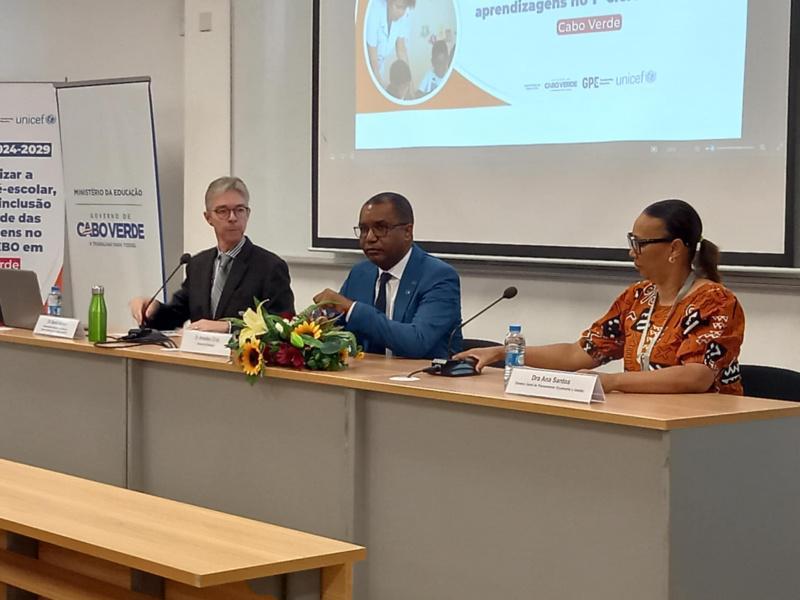
Africa-Press – Cape verde. The Minister of Education, Amadeu Cruz, today presented the main guidelines of the new Support Programme for Priority Education Reform in Cabo Verde (PAREP-CV 2024-2029), financed by the Global Partnership for Education (GPE) with 5 million dollars. The programme aims to consolidate reforms in basic education and to restructure pre-school education, a priority of the government.
Speaking to journalists at the launch of PAREP-CV, Amadeu Cruz explained that the programme aims not only to universalise pre-school education, but also to prepare for its mandatory nature before entering primary education.
“Firstly, we are mobilising this subsidy from the Global Partnership for Education to consolidate the reform in basic education, in the first cycle, which is an important stage in students’ learning. And, secondly, to begin a process of restructuring pre-school education, which we had already identified for some time as a priority for educational action”, he stated.
The Minister of Education also emphasized the collaboration with city councils and civil society organizations that manage kindergartens, aiming to improve the working conditions of educators. Amadeu Cruz also stressed the commitment to the inclusion of students with special educational needs, mentioning that a decree-law on special education has already been approved.
“We have had a strong partnership with city councils and civil society organizations, with the aim of improving the general working conditions of kindergarten teachers. We approved and published a decree-law on special education, precisely to create the conditions for our students with special educational needs to have normal access to schools”, he stated.
With the new program, it is expected to further improve the conditions for these students, with the provision of appropriate teaching materials and the creation of inclusive environments in both kindergartens and schools.
Since 2016, according to the minister, the attendance rate in preschool has increased from 80% to 86% of children aged 4 to 5. However, Amadeu Cruz stressed that it is necessary to expand access, especially in large cities such as Praia, Sal, São Vicente and Boa Vista.
“We must now make an effort, particularly in large urban centres, to expand access, so that no child from the urban peripheries is left out of kindergarten”, he explained.
In turn, the Resident Representative of UNDP, UNICEF and UNFPA, David Matern, reinforced the commitment to inclusive and quality pre-school education in the country.
“It is with great pleasure that I participate today in this official launch of the programme to support the implementation of the Partnership Pact, established last year, which aims to universalise pre-school education, inclusion and quality of learning in the first cycle of compulsory primary education here in Cape Verde”, he said.
David Matern pointed out that there are significant challenges with regard to equitable access to pre-school education, especially in rural areas and vulnerable communities.
“The national coverage rate is 86%, but there are municipalities, especially in rural areas, where it is only around 60%. Families often do not have options that meet their children’s needs, which perpetuates cycles of inequality,” stressed the UNICEF representative.
In addition to unequal access, the representative stressed the importance of ensuring continued funding and adequate training for professionals working in preschool, essential elements for offering an inclusive learning environment.
“Quality preschool education is a right, it is an essential investment in the country’s human capital. The experiences that children have at this stage shape not only their cognitive abilities, but also their social and emotional skills. Providing quality education in this subsystem ensures that children reach primary education with a solid foundation,” he stressed.
David Matern highlighted the importance of coordination between partners and dialogue between different sectors as key strategies for the success of the program.
“Coordination of partners, sectoral and intersectoral dialogue with various partners — city councils, civil society organizations and international cooperation — are essential strategies for aligning efforts, sharing knowledge and implementing educational policies that ensure the effectiveness and continuous improvement of preschool and primary education,” he said.
The Support Program for Priority Education Reform in Cabo Verde (PAREP-CV), following approval of funding from the Global Partnership for Education (GPE) grant, worth US$5 million, will last five years and seeks to promote the universalization of preschool education and improve the quality of teaching in the first cycle of primary education.
For More News And Analysis About Cape verde Follow Africa-Press