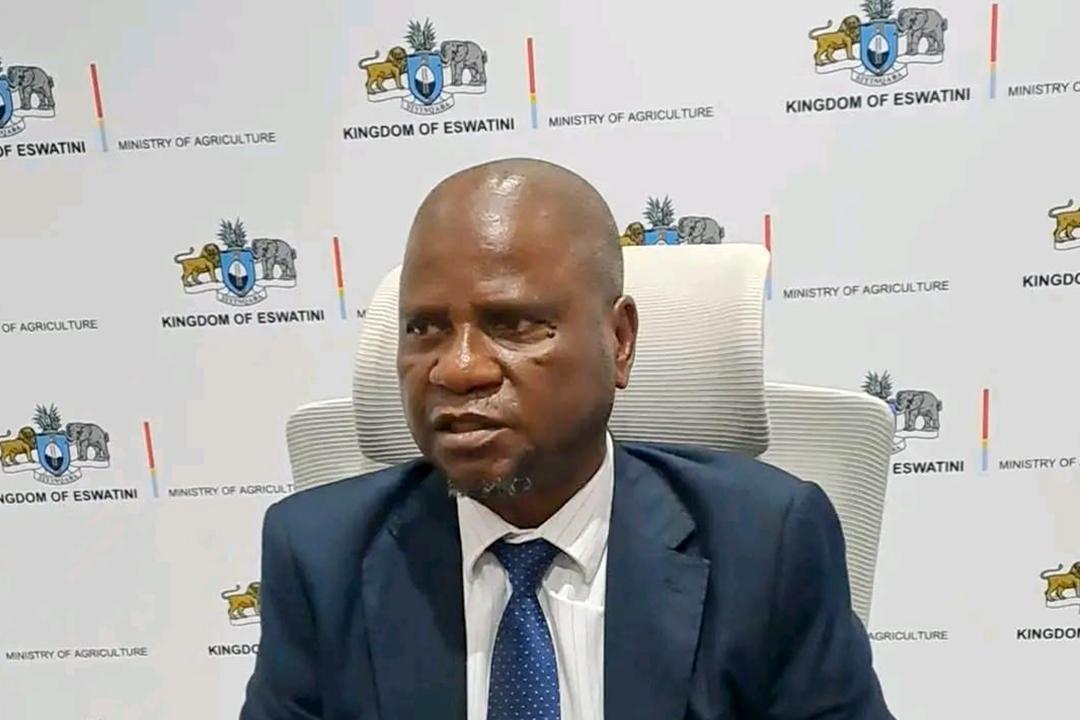
Africa-Press – Eswatini. The Minister of Agriculture Hon. Mandla Tshawuka has reiterated that farmer commitment and the right mindset are critical if Eswatini is to achieve its annual maize production target of 140 000 metric tons.
The minister made these remarks during a media briefing held earlier this month, when government signed a Memorandum of Understanding (MoU) with Standard Bank as part of broader efforts to strengthen agricultural productivity and food security in the country.
Speaking at the signing ceremony, Tshawuka said while government continues to mobilise resources, infrastructure and financing for the sector, success ultimately depends on farmers who are determined to succeed and committed to feeding the nation.
“The most important thing is the person and the mindset of that person,” said Tshawuka. “Government can provide all the resources, and even God can provide a good climate, but if we do not have committed farmers who want to succeed and who want to feed their nation, we will not hit our target of 140 000 tons of maize per year.”
Eswatini’s annual maize demand stands at approximately 140 000 metric tons, yet local production continues to fall short. In 2024, the country produced between 74 946 and 75 000 metric tons, underscoring the need for increased productivity and farmer participation to close the supply gap.
To address one of the major constraints in agriculture mechanisation the minister revealed that government, through the Ministry of Agriculture, the Eswatini Agricultural Development Fund (EADF) and the National Maize Corporation (NMC), has entered into a strategic partnership with the American Embassy, John Deere and Standard Bank.
The partnership which cost E180 million will avail 250 mechanisation packages to the NMC and private tractor owners over the next five years, delivered in tranches of 50 packages per year. The first batch of 50 tractors has already arrived in the country.
Each mechanisation package will include a tractor with a selection of implements, including a limited number of combine harvesters. Of the annual allocation, 10 tractor packages will go to the NMC, while 40 will be distributed to private tractor owners to strengthen service provision at community level.
Tshawuka said the mechanisation programme is expected to significantly improve timely land preparation, planting and harvesting, enabling farmers to increase yields and reduce production losses.
Beyond mechanisation, government has allocated E65 million to the NMC for the Input Subsidy and Tractor Hire Programme and a further E40 million for commercial maize farming in the 2025/26 financial year. More than 8 000 vulnerable farmers are benefiting from subsidised inputs for maize, beans and sorghum.
The Commercial Maize Project, implemented by the Eswatini Water and Agricultural Development Enterprise (EWADE) in partnership with the NMC and the National Disaster Management Agency (NDMA), targets the production of over 30,000 metric tons of maize annually from 6 800 hectares under commercial cultivation.
Long-term investments in irrigation, including the Lower Usuthu Smallholder Irrigation Project (LUSIP) II, continue to strengthen the sector’s resilience to droughts and erratic weather patterns, while the NMC guarantees a reliable market for locally produced maize.
The minister said with strong partnerships now in place, the remaining challenge is farmer commitment. “If farmers embrace agriculture as a business and a national responsibility, Eswatini can achieve maize self-sufficiency and secure its food future,” he said.
For More News And Analysis About Eswatini Follow Africa-Press