Africa-Press – Eswatini. The Kingdom of Eswatini has reaffirmed its unwavering commitment to African-led solutions to conflict and instability.
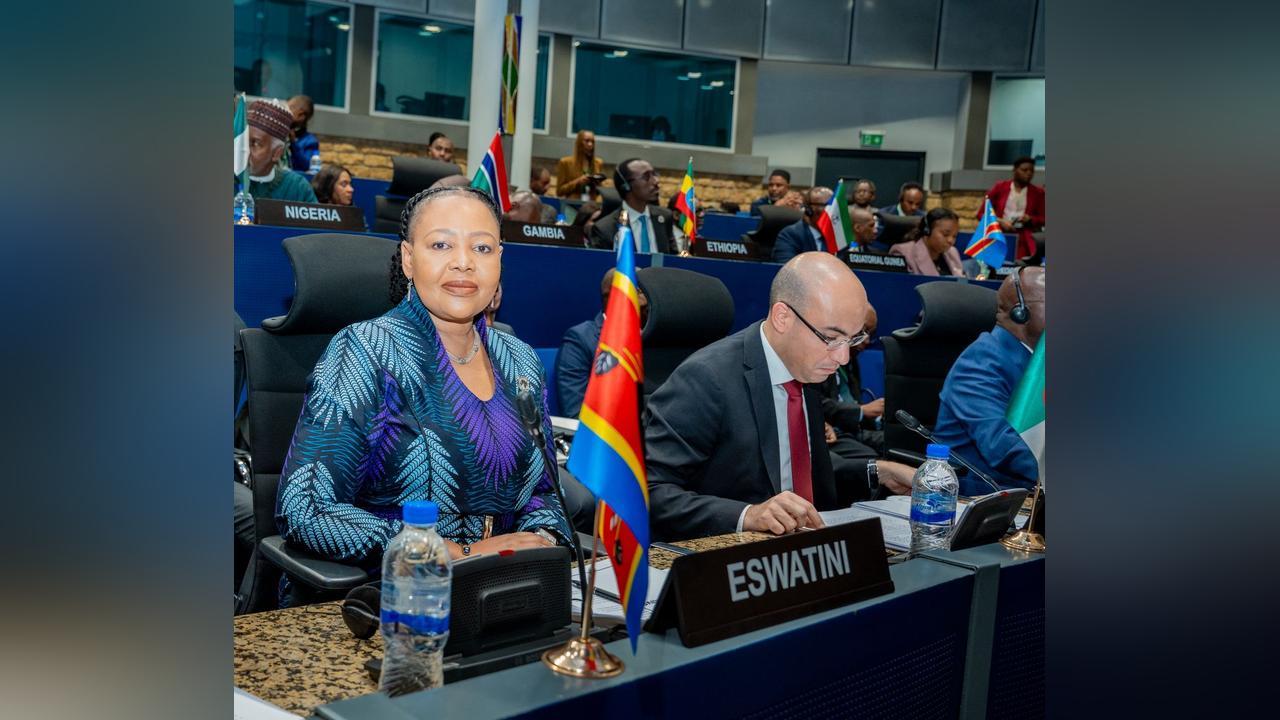
This happened yesterday as Minister for Foreign Affairs and International Cooperation, Senator Pholile Shakantu, delivered a comprehensive statement at the 1330th Meeting of the Peace and Security Council of the African Union (AU).
Opening her address with diplomatic courtesy, Minister Shakantu commended the Democratic Republic of Congo for its stewardship as Chair of the Council during the month of January.
She acknowledged the leadership demonstrated in navigating complex and evolving peace and security challenges across the continent.
Turning to pressing continental matters, Minister Shakantu expressed deep concern over the deteriorating situation in Sudan.
She noted that the protracted conflict, continued hostilities, humanitarian suffering, and political uncertainty underscore the urgent need for renewed and sustained efforts towards a peaceful resolution.
“The deteriorating humanitarian situation, including the impact on women, children, and vulnerable populations, calls for collective action rooted in solidarity and responsibility,” she emphasised.
Eswatini reiterated its alignment with the consistent position of the AU Peace and Security Council: that a durable and sustainable solution in Sudan can only emerge from an inclusive, Sudanese-owned and Sudanese-led political process.
Minister Shakantu stressed that such a process must be supported by the AU, working closely with regional mechanisms and international partners, while fully respecting Sudan’s sovereignty and territorial integrity.
She underscored the necessity of an immediate and sustained cessation of hostilities, unhindered humanitarian access, the protection of civilians, and the preservation of state institutions as essential foundations for peace and recovery.
In relation to the developments in Somalia, Minister Shakantu acknowledged the continued efforts supported by the AU and international partners, to advance state-building, security sector reform, and institutional consolidation.
She commended the resilience of the Somali people and recognised progress achieved in political dialogue and governance reforms.
At the same time, Minister Shakantu cautioned that significant challenges remain, particularly the ongoing threat posed by terrorism and violent extremism.
In this context, Eswatini called for sustained, coordinated, and predictable support for Somali-led processes, inclusive governance, and a carefully managed, conditions-based transition towards lasting peace, stability, and self-reliance.
Broadening her remarks to the wider continental context, Minister Shakantu emphasised that instability in one region of Africa inevitably carries implications for others, including Southern Africa.
Conflict and insecurity, she observed, undermine development gains, strain humanitarian systems, and weaken collective efforts to “Silence the Guns”.
She noted that persistent instability also hampers the realisation of the aspirations of Agenda 2063, particularly the vision of a peaceful, secure, and prosperous Africa.
In response to these challenges, the Kingdom of Eswatini reaffirmed its strong commitment to African-led solutions to African challenges, with the Peace and Security Council remaining central to conflict prevention, management, and resolution.
The minister placed particular emphasis on preventive diplomacy, early warning and early action, mediation, and sustained political engagement as indispensable tools in addressing emerging risks and preventing the escalation and recurrence of conflicts.
A significant portion of her address highlighted the importance of United Nations Security Council Resolution 2719.
Minister Shakantu described the Resolution as a direct response to longstanding calls by the African Union for predictable, sustainable, and adequate financing of African Union-led peace support operations.
She stressed that its effective, timely, and principled operationalisation would significantly enhance the capacity of the Peace and Security Council to implement its mandates and decisions, strengthen African ownership, and improve the effectiveness of peace operations in support of silencing the guns.
Eswatini therefore encouraged continued and structured engagement between the African Union and the United Nations, anchored in coherence, complementarity, and shared responsibility, in support of PSC-mandated efforts to promote peace and stability across the continent.
Looking ahead, Minister Shakantu noted that the Kingdom of Eswatini is preparing to assume the Chairmanship of the Peace and Security Council for the month of March. S
he expressed confidence in working collaboratively with all Member States and the African Union Commission to ensure a prevention-driven and responsive Council.
Such a Council, she said, must promote dialogue, address the underlying causes of conflict, and contribute meaningfully to continental efforts towards Silencing the Guns within the framework of Agenda 2063.
In concluding her address, Minister Shakantu reiterated Eswatini’s solidarity with the peoples of Sudan and Somalia and reaffirmed the Kingdom’s unwavering commitment to collective African efforts aimed at promoting peace, security, and stability across the continent.
Her remarks underscored Eswatini’s consistent diplomatic posture: one rooted in solidarity, sovereignty, and the conviction that sustainable peace in Africa must be shaped, owned, and led by Africans themselves.
…Ex-Minister Moses Vilakati, delivers keynote address
ADDIS ABABA- For former Eswatini Minister for Agriculture Moses Vilakati, this year’s African Union Summit is very significant.
This is because it happens at a time when it has been a year since he scored victory when he was voted into the position of the African Union Commission the Commissioner for Agriculture, Rural Development, Blue Economy and Sustainable Environment (ARBE).
Making the event even more significant is the fact that this year’s theme rhymes well with his portfolio.
As a result, yesterday he delivered a keynote address during a side event on the margins of the AU Executive Council.
The event was held under the theme ‘Water and Sanitation in Africa’.
During an interview, Vilakati reiterated that it he has just been in the position for a year and that it has been a demanding task.
“The position involves agriculture, it means entirety for the whole (1:28) continent, rural development, blue economy. By blue economy, we mean the seas, the oceans, the dams, the lakes, etc. all over. It also involves a sustainable environment, which means climate change, biodiversity, but it also involves water,” he said.
He said he was grateful for the support that His Majesty King Mswati III accorded to campaign throughout Africa as it is never an easy thing.
Speaking about the theme, Vilakati said it is focused on his department.
“The theme resonates very well with what we call Agenda 2063 because Africa’s vision is to have better livelihoods for all by 2063, which is around the corner. So it is a mammoth task”.
The former minister shared that his office has already developed a road map which will be looking at the issues or the things that need to be enshrined in the water theme, particularly on governance, financing and other things.
He said the major challenge for now is that the shortage of finance for water is huge.
What is needed, he said, is a proper investment plan and devise some strategies to get individuals and organisations to finance water projects.
…Eswatini Chair of UN Peace and Security Council for March
ADDIS ABABA-The Kingdom of Eswatini will take over the stewardship as Chair of the African Union Peace and Security Council during the month of March.
This was relayed by Minister for Foreign Affairs and International Cooperation Pholile Shakantu when delivering her speech at the 1330th Meeting of the council
The minister extended warm congratulations to the Arab Republic of Egypt on assuming the Chairmanship for February, assuring the incoming Chair of Eswatini’s full cooperation and support in advancing the Council’s mandate.
The Peace and Security Council (PSC) is the standing decision-making organ of the AU for the prevention, management and resolution of conflicts.
It is a collective security and early warning arrangement intended to facilitate timely and efficient responses to conflict and crisis situations in Africa. It is also the key pillar of the African Peace and Security Architecture (APSA), which is the framework for promoting peace, security and stability in Africa.
The Protocol Relating to the Establishment of the Peace and Security Council was adopted on 9 July 2002 in Durban, South Africa, and entered into force in December 2003.
The PSC became fully operational in early 2004. The PSC Protocol, together with the PSC Rules of Procedure, the AU Constitutive Act and the conclusions of various PSC retreats, provide operational guidance to PSC activities.
The powers of the PSC, in conjunction with the Chairperson of the AU Commission, include to anticipate and prevent disputes and conflicts, as well as policies, which may lead to genocide and crimes against humanity and undertake peace-making and peacebuilding functions to resolve conflicts where they have occurred.
The PSC also has a mandate to authorise the mounting and deployment of peace support missions, and lay down general guidelines for the conduct of such missions including the mandate
It also recommends to the Assembly, pursuant to article 4(h) of the AU Constitutive Act, intervention, on behalf of the union, in a Member State in respect of grave circumstances, namely, war crimes, genocide and crimes against humanity as defined in relevant international instruments
The PSC also institutes sanctions whenever an unconstitutional change of government takes place in a Member State
It also implements the AU’s common defence policy and conducts follow-up promotion of democratic practices, good governance, the rule of law, protection of human rights and fundamental freedoms, and respect for the sanctity of human life and international humanitarian law.