Africa-Press – Eswatini. Government has approved an increase in the price of bread by six per cent.
This effectively means the proposal which had been tabled by Eswatini Bakers’ Association to the Ministry of Commerce, Industry and Trade for an increment of 13 per cent for both brown and white bread has been disapproved.
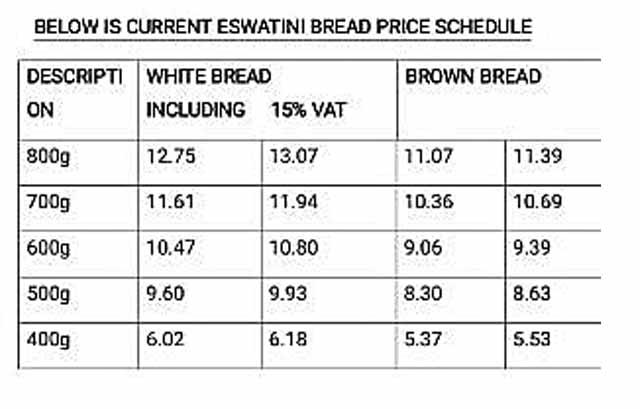
The 13 per cent hike translated to an increase of E1.70 at the highest. Yet the six per cent translates to only 70 cents which was E1 lower than the initial proposal. The approved prices place the price of brown bread at E12.10 from E11.39. White bread will rise to E13.85 from E13.07.
Meanwhile, the price of a white loaf of bread (800 grams) could have spiked from E13.07 to E14.77 if the bakers proposal eventually saw the light of the day. A loaf of brown bread could have been hiked to E12.87 from E11.39 since the last increase which was on October 26, 2020.
Increase
When announcing the increase, Minister of Commerce, Industry and Trade Manqoba Khumalo said it would come into effect from April 1, 2022.
He explained that the increase had been necessitated by the escalation of raw materials such as wheat, flour and premix among other ingredients used in the bread production.
Khumalo stated that the recent fuel hikes also had an adverse effect in the profitabilty of the industry.
“The increase is envisioned at keeping the business at sustainable profitability levels and retain the human resource as this industry has employed a significant number of EmaSwati,” he said.
An independent economist, who was also against the notion of increasing bread prices by up to E1.70, observed that the proposed increase would further dig deeper into the pockets of consumers because five cents coins were phased out in the kingdom.
Therefore, the price would have been further rounded up to E14.80 for white bread and E12.90 for brown bread.
The association had also made their request based on the increase of bread inputs and fuel hikes. An increase in the prices of wheat by up to 30 per cent was reportedly one of the key factors why the bakers felt their production costs were now too high.
The price of petrol recently increased by E1.40 per litre, while diesel and paraffin price increased by E1.60 per litre.
Principal Secretary (PS) in the Ministry of Natural Resources and Energy Dorcas Dlamini explained that the reason for the fuel price increase was mainly the international crude oil price which increased and reached an average of US$92.20 per barrel in the month of February, with the highest level being US$100 per barrel realised in mid-February, for the first time since September 2014.
“The situation of increasing oil prices is exacerbated by the decline in the crude oil supply due to low crude oil production by the members of the Organisation of the Petroleum Exporting Countries (OPEC) and the geopolitical tensions in the Arab Gulf region and the Russian-Ukrainian war. As a result, the fuel supply continues to lag behind the demand recovery,” she said.
Dlamini said alongside the crude oil price increase, the lilangeni/dollar exchange rate slightly appreciated and averaged E15.25 in the month of February compared to an average of E15.60 realised in the month of January. She further mentioned that the persistently high crude oil prices coupled with the slight appreciation of the lilangeni/US Dollar exchange rate has yielded huge under-recoveries (losses) in the fuel products to the value of E2 per litre.
Principal Secretary (PS) in the ministry of commerce, Siboniso Nkambule, is on record having said the 13 per cent increase was considered a bit high and viewed to be exorbitant.
Nkambule had also been probed as to whether following the devastating effects of the COVID-19 pandemic there would be any considerations made for the public which has a lessened financial muscle, to which he responded by acknowledging that the whole nation was still recovering from the recent unrest and also the pandemic which left most consumers out of jobs and some with pay-cuts, while bread has presented itself as a staple food for most households thus any increase should be fair to all parties.
It should be noted that economic activity depicted signs of recovery in the second half of the financial year 2020/21 following a poor start whic he manated from lockdown restrictions implemented earlier in the financial year.
For More News And Analysis About Eswatini Follow Africa-Press