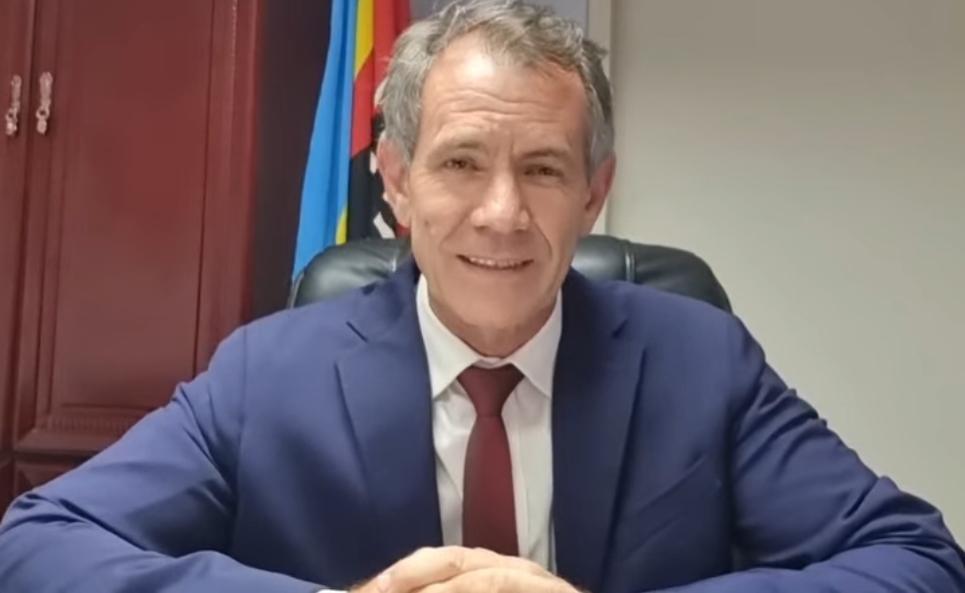
By Velaphi Mamba.
Africa-Press – Eswatini. The Tinkhundla regime routinely claims that it has decentralised State power and taken development closer to the people, yet the numbers tell a very different story.
Of a national budget of approximately E34 billion for 2025/2026, only E77 million is allocated to the country’s 59 tinkhundla centres for so-called people-led community development. This represents a mere 0.23% of the national budget, in real terms, each inkhundla centre receives E3 million per year – an amount that is grossly inadequate to finance meaningful development, build institutional capacity, or stimulate local economic activity.
Decentralisation without resources is not decentralisation at all and that is why I choose to characterise it as plastic decentralisation.
It is political theatre meant to bluff the citizens and give a veneer of work being done while nothing is being achieved, it creates the appearance of local governance while preserving fiscal power at the centre.
The result is a system where Tinkhundla centres function largely as conduits for consumption as opposed to smart centres of national development. This flawed model issues small grants, ad hoc handouts, and short-term projects that do not accumulate capital, build assets, or transform local economies.
The laughable part of these theatrics is when King Mswati is made to join the band wagon, Ibrahim Traore style, to deliver tractors and other projects to gullible communities who are fooled to think the King has their best interests at heart.
I believe that a different model is both possible and necessary.
I propose that the Minister of Finance Neal Rijikernberg must re-configure the design logic of the national budget.
A Ministry-wide process of re-examining all expenses and cost centres must be undertaken with the intention to restructure the entire budget and to re-assign national funds to priority spending areas.
As a start, allocating at least E25 million to each inkhundla per year would amount to E1.475 billion nationally, or 4.34% of the E34 billion budget.
I am acutely aware that Tinkhundla centres are not of equal standing and there might be room for a discussion on proportionality allocations, but I am proposing a flat allocation structure as a starting point.
This is not a radical or fiscally reckless proposal but on the contrary, it is a modest rebalancing of public expenditure towards where people actually live.
Globally, effective decentralised systems allocate between 5% and 20% of national budgets to local Government structures.
Against this benchmark, 4.34% is a conservative proposition. What is unacceptable is the current reality, where less than a quarter of one percent is expected to unlock development for our people at grassroots level.
Under the current policy framework, inclusive national development is not possible and may take the next hundred years to attain.
But the argument is not only about the quantum of funds involved but also about institutional design and a pro-people state.
If Tinkhundla Centres are to serve as genuine administrative and developmental nodes, they must be professionalised and capacitated, each Inkhundla should be staffed with a lean but competent executive team consisting of Chief Executive Officer (CEO) – responsible for overall strategy, coordination with central government, compliance, and performance management.
The Inkhundla executive team must also include Fund Managers responsible for financial management, investment decisions, risk assessment and capital growth.
Furthermore, the executive team must also include a Development Manager, responsible for identifying local economic opportunities, project design, partnerships, and community impact.
These public officers must be competitively recruited based on merit and qualifications across all tinkhundla centres, they must work on a contract basis whose extension must be based on clear performance targets.
This structure shifts Tinkhundla away from being passive recipients and distributors of national funds, and towards becoming active local development institutions.
The current model where Tindvuna Tetinkhundla are elected must be abolished – there is no development that can be driven by political functionaries unqualified for development work.
The Bucopho framework must be professionalized and while it can be left open to the public electoral system, those who run must be subject to basic qualifications criteria – a combination of community work experience and a minimum of a diploma qualification in any field of study.
The most damaging feature of the current tinkhundla system’s philosophy is its purely consumptive logic. National funds are allocated, spent, and exhausted within a financial year, leaving no assets behind.
Roads remain unbuilt, enterprises unfunded, and local economies stagnant, a reformed model must be hybrid in nature.
Under this hybrid approach, a portion of the annual E25 million allocation would continue to fund essential community projects, services and/or business grants. However, a strategic and significant portion would be invested over time under clear national guidelines and risk controls leveraging the annual guaranteed fiscal subvention from the central government.
These investments could include low risk financial instruments, local productive assets, cooperative and SME financing, infrastructure with revenue-generating potential, land-linked or agro-processing ventures, shares in profitable local and international companies.
The role of the Fund Managers would be to grow capital, preserve value, and expand liquidity.
Over time, each Inkhundla would begin to build a localized community development fund – a revolving pool of capital that grows year on year instead of resetting the inkhundla budget to zero each financial year.
This model fundamentally changes the development equation, instead of waiting annually for transfers from central government, Tinkhundla centres would gradually accumulate their own financial strength.
This would enable them to finance local enterprises and cooperatives and support employment-creating projects, co-invest with the private sector, cushion communities against economic shocks and reduce dependence on political patronage.
Crucially, this is not privatisation, nor is it speculative gambling with public funds, it is developmental finance, anchored in a vision for long-term value creation and public accountability.
It is a radical transition from tokenism to substance where national resources begin to make an impact where it matters the most – where the people are.
And here I am only using E1.5 Billion of the national budget as a benchmark, try to imagine what doubling that amount would achieve if implemented correctly and meticulously.
Strengthened Tinkhundla centres would also deepen economic inclusion and shift the country away from administrative to democratic decentralisation.
Local people understand their economies better than distant ministries and government technocrats, they know which projects are viable, which skills exist, and which interventions will work.
Decentralised capital allows these insights to be translated into action. Moreover, fiscal decentralisation has political consequences.
Institutions that manage real resources become sites of accountability, contestation, and civic engagement, they weaken the culture of dependency and reinforce the idea that development is planned, financed, and owned locally.
This means that the policy framework can be shifted to build in transparency and accountability measures to ensure anti-corruption and impactful resource utilization. That is what I would call a nation in progress. Allocating E3 million per Inkhundla annually is not development but tragic tokenism that is not working for our country.
It is the kind of sickening smokescreen that keeps our people busy with nothing while manufacturing mass poverty and inequality, it keeps communities weak, dependent, and administratively hollow.
Allocating E25 million to each inkhundla – just 4.34% of the national budget would begin to reverse this logic, if the regime is serious about decentralisation and inclusive transformative national development, then it must decentralise money, capacity, and decision-making, not just rhetoric.
Strengthened Tinkhundla centres, professionally run and financially empowered, could become engines of local development rather than ornaments of centralised power. Anything less is an admission that development is not the goal but hegemonic control is.
I believe this model can be adapted and implemented for the good of the country, I also believe that a democratic people’s government is required for such a model to thrive. It is time.