Africa-Press – Eswatini. The service sector’s growth primarily supported by financial and insurance operations, ICT, and the wholesale and retail subsectors has contributed 2.2 per cent to overall growth.
While ICT increased by 24.2 per cent, contributing 1.2 percent, financial and insurance activity increased by 28.5 per cent
Furthermore, despite the ongoing inflationary pressures in the period, the ‘W&R’ subsector saw significant development, expanding by 4.1 per cent to contribute 0.5 per cent to overall growth.
This is according to the ministry of economic planning and development’s Quarterly Economic Bulletin 2023 for the second Quarter period April to June.
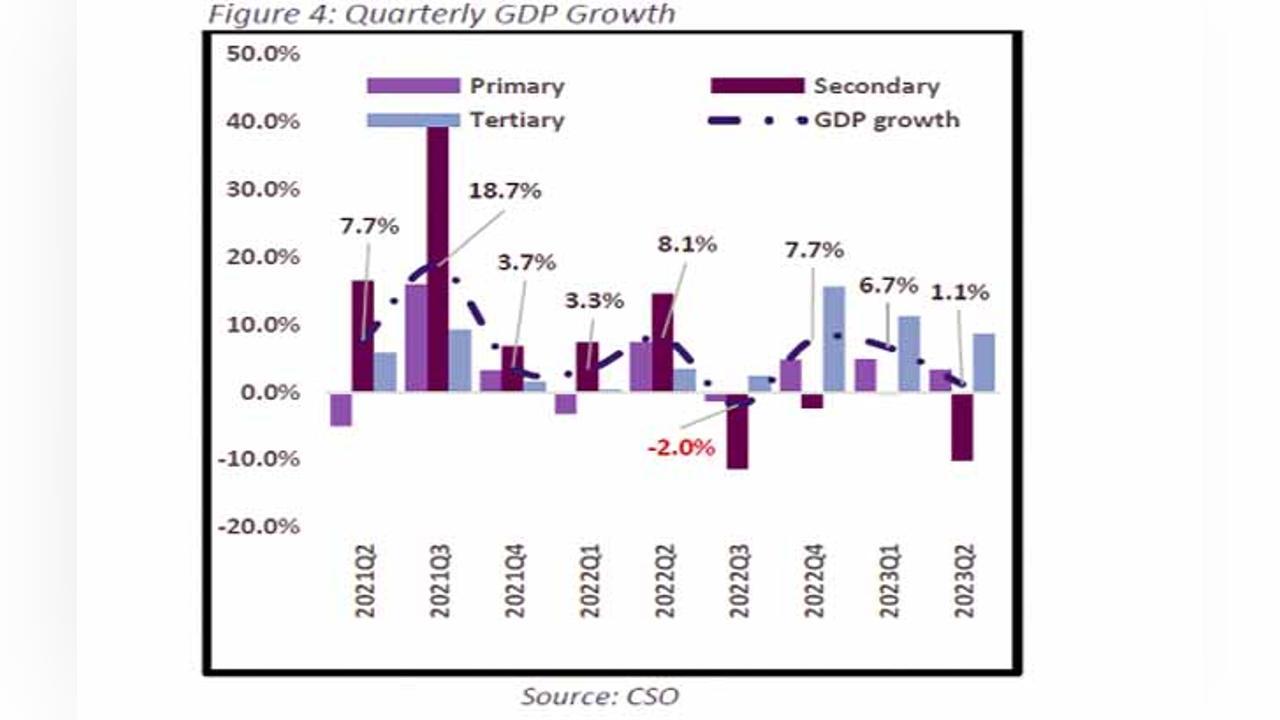
The report states that Eswatini’s real GDP growth slowed in first quarter of this year, growing by 1.1 per cent year-on-year following a robust growth of 6.7 percent in the fourth quarter of 2022.
“Growth in the quarter was backed by a strong performance in the services sector, which increased by 8.6 per cent during the period and contributed 4.2 per cent to overall growth,” reads the report.
It indicates that conversely, manufacturing activity remained subdued in the period falling by 10.1 per cent to contribute -3.1 per cent to overall growth.
“The contraction was at the back of constrained demand mainly for ‘textile’ and ‘beverages’ manufacturing,” reads the report.
In comparison, the report highlights that South Africa’s economy grew by 0.4 per cent in the first quarter this year, following a 1.1 per cent contraction in fourth quarter of 2022.
“The rebound was fueled by a positive performance in the manufacturing, transportation, personal services, and finance subsectors, which had marginal growth of 1.5 per cent, 1.1 per cent, 0.8 per cent and 0.6 per cent, respectively,” reads the report.
It further states that the manufacturing subsector grew partly due to higher output from food and beverages as well as petroleum, chemical, plastic, and rubber items, which increased by 4.6 per cent and 2.8 per cent, respectively in the period.
“Similarly, the transport subsector rose due to increasing activity under land and air transport as well as communication and transport support services,” states the report.
Moreover the report indicates that higher activity in financial intermediation, insurance and pension funding and real estate and business services aided the finance subsector, whereas stronger activity in community services supported personal services.
“The agriculture subsector, on the other hand, continued to struggle contracting by 12.3 per cent during the review period due to falling crops and animal output,” reads the report.
“Excessive rains during planting affected field crops, while animal production was hampered by the foot-and-mouth disease (FMD) outbreak and load-shedding,” reads the report.
For More News And Analysis About Eswatini Follow Africa-Press