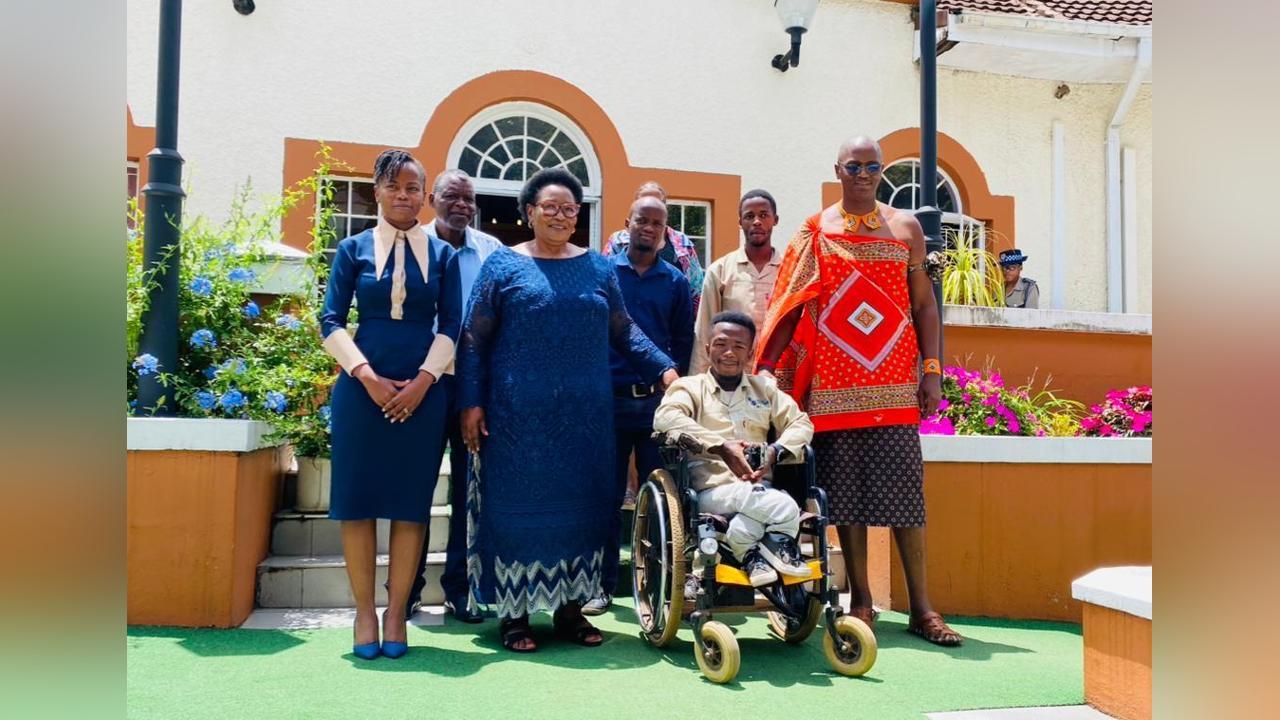
Africa-Press – Eswatini. A powerful example of inclusive innovation was on display on 2 February 2026 when student innovator Sifiso Maseko, accompanied by officials from BSA Training Centre, demonstrated an improved smart wheelchair to Deputy Prime Minister Thulisile Dladla at the Deputy Prime Minister’s Office (DPMO).
The demonstration showcased how persons with disabilities can achieve remarkable results when afforded equal opportunities, appropriate guidance and supportive learning environments. Deputy Prime Minister Dladla praised the innovation, describing it as clear proof that disability does not equate to inability.
“Those who think persons with disabilities are incapable are mistaken,” said Dladla. “When given equal opportunities, they display impressive intelligence, sometimes even surpassing those without disabilities.” She commended BSA Training for its inclusive approach and acknowledged the commitment of the DPMO Disability Manager, reaffirming that the office remains dedicated to including persons with disabilities in all initiatives.
Born with a condition that makes it difficult for him to push himself over long distances, Sifiso Maseko turned his personal challenge into an opportunity for innovation. Driven by a passion for engineering and problem-solving, he sought to enhance his independence after discovering that electric wheelchairs were far beyond his financial reach. Drawing on skills acquired during his auto electrical training at BSA, he modified his manual wheelchair into a smart, motor-assisted device.
Sifiso enrolled at BSA Training in April 2025, initially with an interest in motor vehicle repairs. Through orientation and mentorship from his lecturers, he discovered a natural aptitude for auto electrical work, which he found both accessible and practical in addressing real-life challenges. “I was born with mobility challenges that prevent me from travelling long distances on my own,” he explained. “I needed to innovate. My goal is to help other persons with disabilities move freely and go wherever they want.”
The improved wheelchair is fitted with a hooter, lights and reflectors, significantly enhancing safety and visibility, particularly in busy urban areas. His instructor, Ndumiso Hlophe, noted that the current model represents the first phase of the project. Future phases are expected to introduce more advanced automated functions and lever systems aimed at further improving comfort, control and independence.
Deputy Prime Minister Dladla described the innovation as a milestone in youth-led technological advancement and inclusive development. She emphasised that Sifiso’s achievement demonstrates what is possible when young people, including those with disabilities, are empowered through education, mentorship and institutional support.
The demonstration stood as an inspiring reminder that inclusive innovation not only transforms individual lives but also contributes meaningfully to national development, social inclusion and dignity for all in Eswatini.
For More News And Analysis About Eswatini Follow Africa-Press