Africa-Press – Eswatini. The Republic of China (Taiwan) has funded Eswatini with about E52 million for an aquaculture four-year project that will be carried out in two phases.
The budgeted amount for the implementation of the project is E18.1 (US$ 1 072 215) while approximately E33.8 million (US$ E2 million) will be for construction of the aquaculture centre.
Project Manager Andrew Su said the construction of the aquaculture centre would also be in two phases which is the construction of the laboratory to keep Tilapia breeder and reservoir to maintain necessary water, a phase that would be completed next year in February.
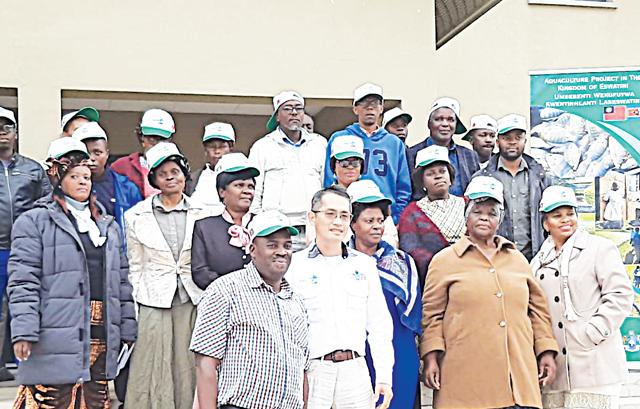
Su disclosed this during a one-day workshop held at the National Marketing Board (NAMBoard) Centre attended by 20 farmers last Friday.
The project is implemented by the Taiwan Technical Mission in partnership with the ministry of agriculture and the implementing agent being the department of fisheries.
Meanwhile, Phase II of the project will be the construction of aquaculture offices and demonstration ponds to produce various Tilapia and this phase is expected to be completed by July 2023.
“The introduction of aquaculture in Eswatini will play a huge role in improving the lives of Emaswati as it will provide farmers with all necessary guidance.
“So, to make sure this project becomes a success, the Republic of China (Taiwan) implemented the aquaculture Project in the Kingdom in October 2021 and will last until December 31, 2025,” he said.
Su added that the objectives of the project were to construct an aquaculture centre to provide tilapia fry (small fish) for local farmers and establish a standard operation process (SOP) to improve the quality and cultivation techniques.
He said training would availed for the fish farmers and ministry of agriculture technicians in order to increase capacity of aquaculture technology and knowledge.
Su said the project would also develop low-cost formula fish food as an alternative commercial concentrate to reduce economic pressure.
The project manager said the initiative was a result of a proposal made in 2020 by the ministry of agriculture.
“ The ministry proposed for the the creation of a fishery and aquaculture research centre from the Embassy of the Republic of China (Taiwan), as well as assistance in devising an aquaculture development strategy.
“Aquaculture is also part of the five major development projects proposed to Taiwan in 2019 by King Mswati III and it is also a key area of collaboration between aquaculture in Taiwan and Eswatini within the governments’ Africa Project.
“Eswatini is a landlocked country ant boasts abundant river resources. However, the local aquaculture lacks the necessary resources and nearly 90 per cent of its aquatic products are imported. Eswatini’s aquaculture consists of small family operations,” added Su.
He further said development bottlenecks included inadequate local fry (small fish) supply, high cost of imported fish feed and shortage of technical training resulting in low production.
To stimulate local aquaculture, Su said the agriculture ministry hoped to develop fish reproduction techniques through this project in order to stabilise the market demand for fry fish.
He added that the project would also help fish farmers to improve their cultivation experience, increase their income, and maintain the domestic prices, therefore, establishing the foundation for Eswatini’s local aquaculture.
He said Taiwan boasts extensive experience in aquaculture technology and industry development, which were some of its competitive advantages hence, after studying Eswatini’s proposals, the primary goal was set on building the foundation for aquaculture and facilitate the long-term development of Eswatini’s local aquaculture chain in several stages.
“The emphasis of the current stage is on improving the local fry and feed supply as well as reinforcing aquaculture technology in a bid to create a sound base for Eswatini’s aquaculture production techniques and knowledge,” concluded Su.
Meanwhile, one of the fish farmers Gugu Dlamini appreciated the Taiwan Technical Mission for the training and funding. She said they would now be able to tap into the minimally exploited industry.
She said they were positive that their livelihood would improve through this project and further hoped that the technical team would continue providing the necessary guidance throughout the project.
For More News And Analysis About Eswatini Follow Africa-Press