
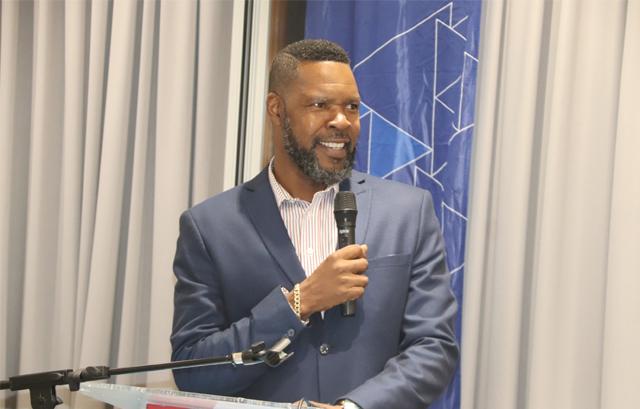
Africa-Press – Eswatini. The International Labour Organisation (ILO) Director Joni Musabayana has said the workplace legislation clearly needs to be adapted to meet the emerging reality of workplaces.
Musabayana said this during the launch of the Next Normal: The Changing Workplace in Eswatini report yesterday at Hilton Garden Inn hotel.
The report was done by Business Eswatini (BE) in collaboration with International Labour Organisation (ILO).
Musabayana said to better understand these dynamics, the Bureau for Employers Activities of the International Labour Organization (ILO) and the ILO Regional Office for Africa partnered with employer and business membership organizations (EBMOs) from across Africa to study changes in the workplace, enterprises’ views about them, and steps enterprises are taking in response to them.
He said to try to capture key trends that are most relevant for enterprises. The study focused on four closely related areas which are the working space, workplace relations and labour law, skills development, knowledge sharing and productivity and human resources management.
He stated that despite the challenging circumstances that came with the pandemic, many enterprises and their workers across the continent had taken a wide range of steps to adapt to this fluid environment.
“They have changed everything from the characteristics of their working space to their human resource strategies, and throughout, all have demonstrated great resilience and adaptability. Yet, the disruptive forces unleashed by COVID-19 will have longer-term implications for African labour markets,” he said.
Musabayana said the destabilizing effects of the COVID 19 pandemic had dramatic social, economic and health effects across the African continent while the consequences of the COVID 19 pandemic had been significant across the board, some groups such as informal and casual workers who had been hit hard.
“The pandemic also had a dramatic effect on enterprises, with many struggling to remain afloat due to higher costs, government restrictions, and changing consumer behaviour. Many African enterprises faced new costs, often associated with health and safety measures to ensure customers and workers are not exposed to COVID-19 and in many instances, costs associated with remote/virtual working,” he said.
He said that to support their constituents during these trying times, they embarked on several initiatives all aimed at helping them to cope and these included.
He added that they provided support to BE to undertake a COVID- impact assessment using the ILO developed Enterprise Survey Tool – Qualtrics so that as they engage government for relief measures, they do so through evidence-based advocacy.
In the report the Director said what he found common across the region was the fact that, no single trend has defined the pandemic era more than the shift from physical to remote work. He said not surprisingly, remote work was more common amongst certain groups of workers, suggesting that a person’s job type and the sector of the economy in which they work also determine how they work,” he said.
He said the study had raised several extremely pertinent issues related to Eswatini’s labour market and more broadly, the priorities outlined in the Abidjan Declaration.
“The disruptive effects of the COVID 19 pandemic will leave a legacy in respect of how, where and when we work. The main issue is that the legal and regulatory frameworks in many countries have not kept up with the changing ways people work as business leaders reported that; labour market regulations were behind the curve,” said the Director.
He stated that the workplace legislation would clearly need to be adapted to meet the emerging reality of workplaces.
Government pleased with ILO Progress in the country
Minister of Labour and Social Security Phila Buthelezi has commended the work done by ILO in the country.
The minister said it was not an exaggeration that COVID-19 destroyed many jobs as much as it did business establishments and the pandemic took away productive souls from our midst.
He explained that one was encouraged that as the country began to pick up the pieces it was doing so with a trusted partner such as the ILO.
“I have been following the activities of the ILO in the country for some time now, and one can only be pleased at the level of progress that this organization has achieved in partnership with employers of this country together with the labour movement,” he said.
He further extended credit to the ILO in partnership with Business Eswatini for creating this environment in which we can openly discuss the ravages of the pandemic and the impact it has had in the work place, and of course, on job creation.
“The ILO was the first organization to perform a rapid impact assessment study on businesses immediately the virus started to rear its ugly head. The study informed how labour relations and business processes could be managed at a time when confusion and shock were the order of the day,’ he said.
Buthelezi said not only did the assessment inform and empower business but it also helped the ministry to tailor some of its services appropriately and equip other organs of state which are working very closely with businesses which resulted with the ministry being able to play a significant role in moderating the issues of lay-offs and retrenchments which had a lot of grey and contentious areas.
He further stated that BE deserved to be singled out for praise due to the visible role they played throughout the pandemic which is from resource-mobilization to their participation in many forums geared towards rescuing the situation, their presence played a critical role as a partner to government on many other nation-building initiatives.
“Whilst Covid-19 was a scare, it was also an eye-opener for all of us to have another careful look at how the world has changed and how people have evolved and adapted given the developments of the fourth industrial; revolution, artificial intelligence and the general uptake of technological modes of service delivery to customer,” said the minister.
He stated that the positive social partners should embrace today is that they have an opportunity to reorganize ourselves to be better prepared for whatever eventuality or even for worse scenarios such as disasters exacerbated by climate change.
Business Eswatini Chief Executive Officer E. Nathie Dlamini said through the compiling of the report they realised that they now live in the times of pandemics so there would definitely be something that would be similar to COVID-19 in future which should find them prepared.
“Unlike with COVID-19 where we didn’t know what we do when working from home and the rules around that we will now know how to handle it through the findings of this study,” he said.
He said the pandemic taught them a lot hence they were now looking at where they were coming from and where they were going.
For More News And Analysis About Eswatini Follow Africa-Press