
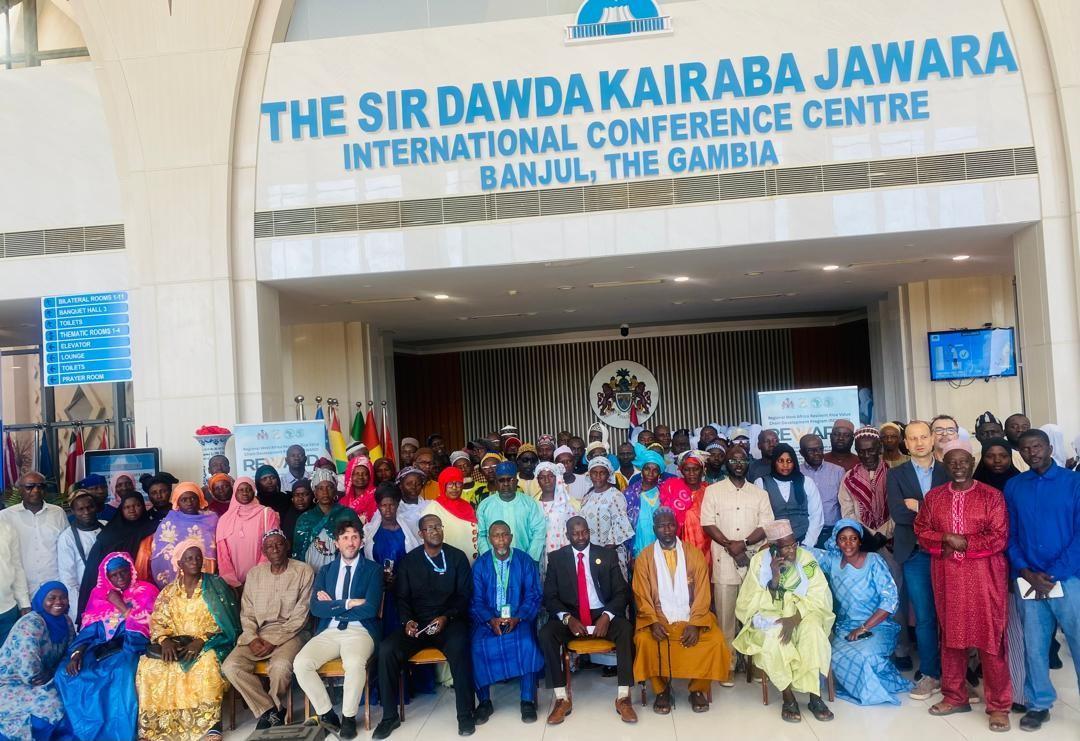
Africa-Press – Gambia. The Ministry of Agriculture Wednesday convened a three-day national workshop to review technical surveys and engineering designs of a project geared towards boosting rice self-sufficiency in Gambia.
Stakeholders in the agricultural sector meeting at Sir Dawda Jawara International Conference Centre have begun validating preliminary designs for major land development and road construction works under the Regional West Africa Resilient Rice Value Chain Development Programme (REWARD).
The project aimed at strengthening domestic rice production and improving farmers’ access to markets.
The meeting brought together development partners, policymakers, engineers, environmental and social experts, farmer organisations, civil society representatives and private sector actors involved in the rice value chain.
Organisers said the validation workshop seeks to gather technical inputs and stakeholder feedback before finalising designs prepared by consulting firm Hydro Nova.
Hydro Nova’s lead consultant, Paolo Benetazzo, described the validation exercise as a critical milestone in the project’s implementation, noting that the consultancy began work in July 2025.
He stressed the importance of continuous stakeholder engagement to ensure that the designs reflected local realities and can be effectively implemented.
The REWARD programme aims to enhance climate-resilient rice production through irrigation development, water harvesting systems and improved seed varieties, while also strengthening processing, marketing, mechanisation and access to finance for smallholder farmers. The initiative also includes institutional capacity building and policy support.
FAO Deputy Country Representative, Dr Mustapha M. Ceesay said the organisation had supported national rice strategies and contributed to the preparation of the regional programme. He noted that although rice remained central to national food security, progress in recent years has slowed, underscoring the need for improved planning and implementation approaches.
Director General of the Department of Agriculture, Musa Humma linked the project to the government’s 2030 rice self-sufficiency agenda, describing the infrastructure investments as critical to improving irrigation systems and market access for rural communities.
The project will develop and rehabilitate approximately 3,002 hectares of land for rice cultivation and construct 21 kilometres of access roads.
Humma urged farmers to actively participate in the initiative, emphasising that their experience and local knowledge would be key to achieving sustainable results.
The workshop continues with technical reviews ahead of finalisation of the project designs.