
Africa-Press – Ghana. As delegates of the New Patriotic Party (NPP) converge on Saturday, January 31, 2026 to elect a presidential flagbearer, the contest has grown beyond campaign promises, regional arithmetic, and delegate mobilisation.
It has instead been shaped by statistics and spirituality, data and divination.
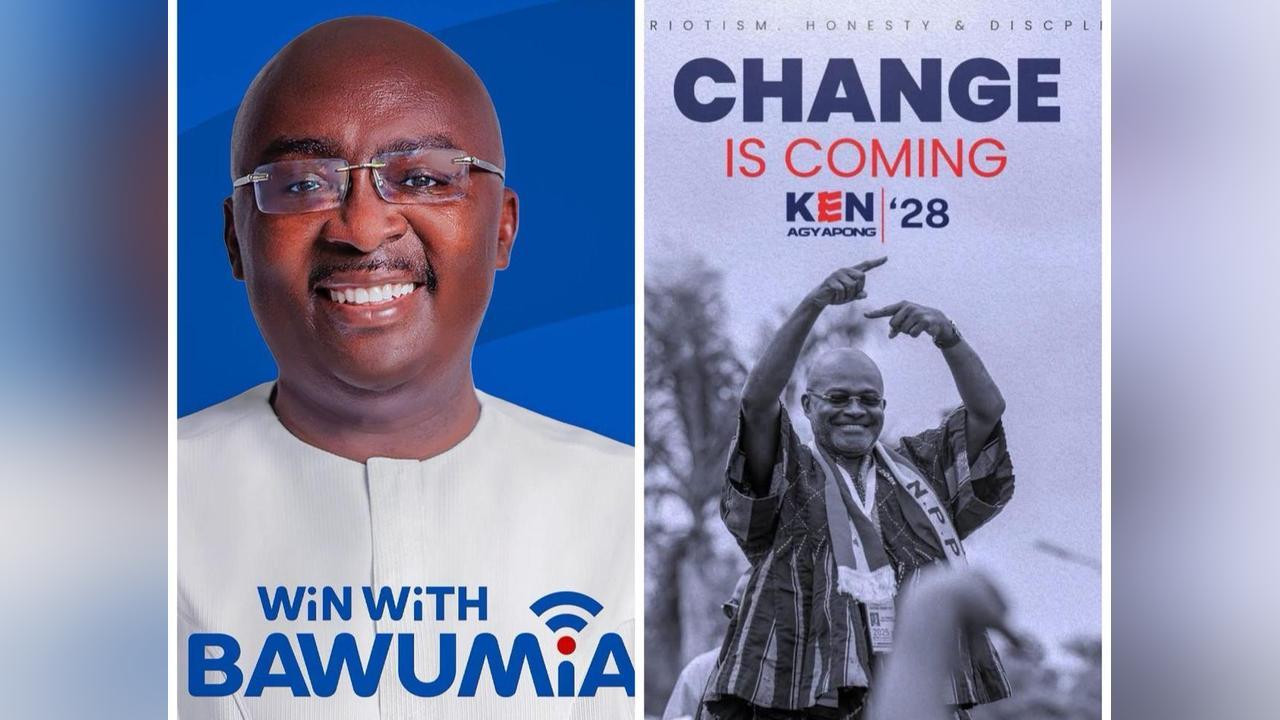
Although five candidates are in the race, attention has narrowed and framed around Dr Mahamudu Bawumia and Mr Kennedy Ohene Agyapong.
Dr Bawumia, former Vice-President and the NPP’s presidential candidate in the 2024 general election, is seeking a renewed mandate from party delegates.
Mr Kennedy Agyapong, a former Member of Parliament of Assin Central and an outspoken party stalwart, has positioned himself as a forceful alternative, appealing to sections of the grassroots calling for change and blunt leadership.
Yet beyond rallies, messaging and ground campaigns, two influential voices: one statistical and the other spiritual, have shaped public expectations ahead of the vote.
Has the Polls Tilted Toward Bawumia?
On the side of empirical analysis stands Mussa Dankwah, Executive Director of Global InfoAnalytics, whose firm has built a reputation for relatively accurate political polling in recent election cycles.
In its final pre-primary assessment, Global InfoAnalytics projects that Dr Mahamudu Bawumia is on course to win the NPP flagbearer contest with 57 per cent of the delegate vote, placing him well ahead of his closest challenger.
Kennedy Agyapong, according to the same poll, trails with 28 per cent support.
The projections are based on delegate-level sampling, regional breakdowns, favourability ratings, and historical voting patterns within the party.
The data suggests that Bawumia enjoys broad national spread and strong institutional support, with indications that he could secure victory in 14 out of the 16 regions, including commanding margins in traditional NPP strongholds such as the Ashanti Region.
Beyond Global InfoAnalytics, separate polls conducted by Africa Policy Lens (APL) and Governance Lab Africa similarly projected a win for Dr Mahamudu Bawumia.
For many political analysts, these figures point to a likely first-round victory, barring any dramatic last-minute shifts in delegate sentiment.
The Prophecy: A Spiritual Verdict for Ken Agyapong
While the polls point firmly in one direction, prophecy points in another.
Prophet Bernard ElBernard
Nelson-Eshun, a well-known Ghanaian prophetic figure whose declarations on national politics often generate both devotion and debate, has publicly declared that Kennedy Agyapong will emerge victorious in the NPP primaries and proceed to win the 2028 Presidential Elections.
The prophecy has since gained traction across social media platforms and political discussion spaces.
Supporters of Prophet El Bernard point to his past prophetic pronouncements, some of which they believe aligned with eventual political outcomes, as grounds for taking his declarations seriously.
To them, the contest transcends numbers and strategy, unfolding instead as a matter of divine orchestration, where the unexpected can override the predictable.
Sceptics, however, urge caution, noting that prophetic declarations, no matter how compelling, remain external to the NPP’s constitutional processes, which place decision-making authority solely in the hands of accredited delegates.
Prophecy vs Polls: Who Really Decides?
The contrast between Mussa Dankwah’s data-driven projections and Prophet El Bernard’s spiritual pronouncement reflects a broader feature of Ghana’s political culture — the coexistence of empirical analysis and spiritual interpretation in shaping political expectations.
Polls can measure sentiment. Prophecies can inspire belief. However, neither of them casts a ballot.
That responsibility rests entirely with the delegates, whose choices will be influenced by campaign engagement, personal conviction, loyalty, strategic calculations, and direct interactions with candidates, rather than projections or prophecies alone.
A Word to Delegates
As voting day arrives, delegates face a responsibility that transcends predictions.
Polls may suggest momentum, but turnout and conviction determine outcomes.
Prophecies may inspire confidence, but organisation and persuasion win votes.
Hard work, delegate mobilisation, and credibility on the ground remain decisive.
In the end, the NPP’s next flagbearer will not be chosen by a spreadsheet or a prophecy, but by ballots cast in secrecy.
And when the dust settles, one lesson will endure: in politics, predictions spark debate, but participation decides destiny.
Source: Ghana News Agency