
Africa-Press – Ghana. Ghana and Côte d’Ivoire have formalized a transboundary partnership to overhaul coastal management and protect vulnerable communities from the escalating threats of climate change.
The project, funded by the Adaptation Fund and implemented by UN-Habitat, represented a strategic shift from isolated national efforts to a unified, spatial planning approach aimed at preserving the shared West African shoreline.
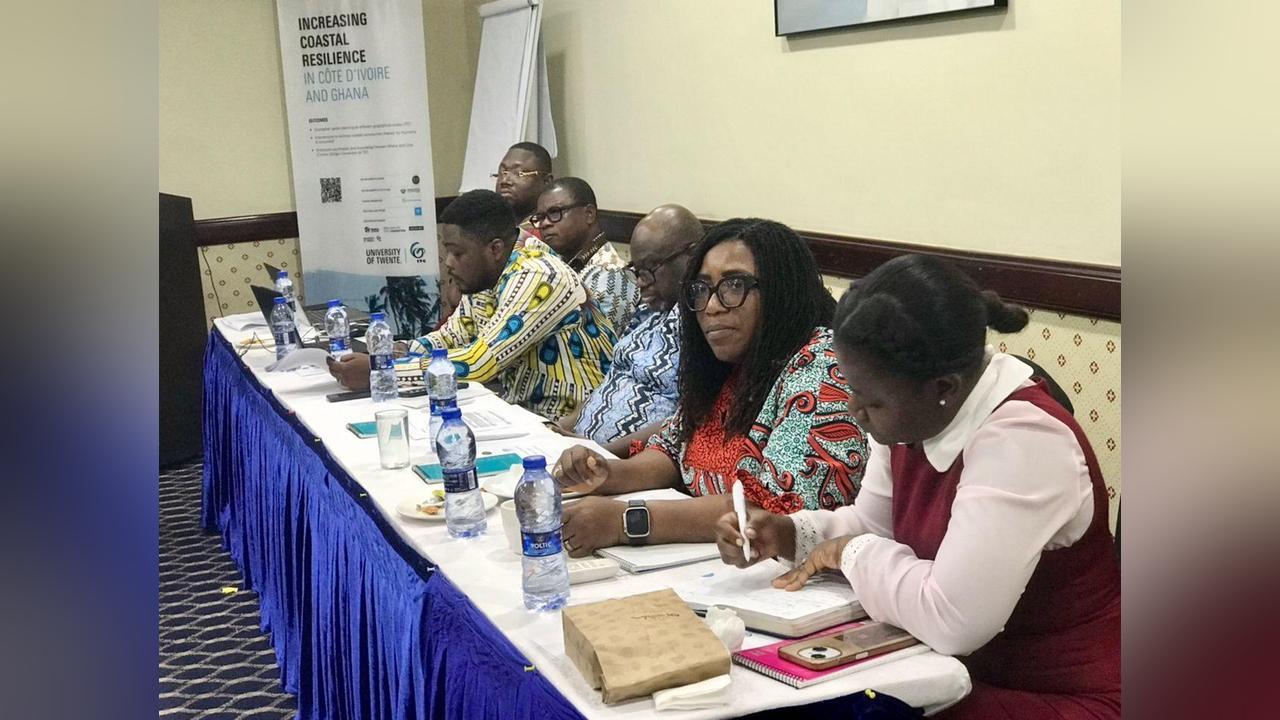
The initiative, titled “Improved Resilience of Coastal Communities in Côte d’Ivoire and Ghana,” held its second National Steering Committee meeting in Accra this week.
Dr. Peter Dery, Director, Ministry of Environment, Science, Technology and Innovation (MESTI), said that the coast served as a critical resource for every sector, including transport, energy, fisheries, and water.
“When we lose the coast, we lose livelihoods. Our fishermen are now pulling plastics out of the ocean instead of fish, and our protective mangroves are being depleted for fuel.”
He said the project arrived at a critical juncture where rising sea levels, tidal waves, and anthropogenic pressures such as rapid urban development threaten the survival of millions.
Mr. Luc Boerboom, an Associate Professor from the University of Twente and a technical partner in the project, noted that while coordination between two different national systems is complex, it is the only way to achieve lasting impact.
Mr Boerboom cited the year-long effort required just to align the different planning systems of the two nations.
“We are working with two languages and two very different administrative systems, but that is what makes the results valuable. We are building a continuity that will outlive the project itself,” he said.
He noted that the involvement of the University of Twente highlighted the project’s reliance on high-tech data management.
“By utilizing satellite imagery and geoinformation science, the team can track coastal changes in real-time, providing communities with the data they need to make informed decisions,’” he said.
Mr. Mathias Spaliviero, Senior Human Settlements Officer at UN-Habitat, emphasised that for any plan to succeed, it must be co-owned by the local population.
“The first victims of coastal erosion are the local communities. They must be the ones steering the decisions. We are using funds not just for physical solutions, but to create awareness. Whether it is cutting mangroves for cooking or urban encroachment, the solution starts with local understanding,” he said.
The project is being executed on the ground by partners, including ActionAid and Habitat for Humanity, who act as the bridge between national policy and community action.
This “multi-scale approach” ensures that strategic goals set in Accra or Abidjan translate into actual mangrove seedlings planted in a village in the Volta Region.
While the current focus is on the Ghana-Côte d’Ivoire corridor, the ultimate goal is to create a replicable model for the entire West African coast.
By producing materials in both English and French, the project aims to serve as a blueprint for other nations facing similar “polycrisis” scenarios of climate change and rapid urbanization.