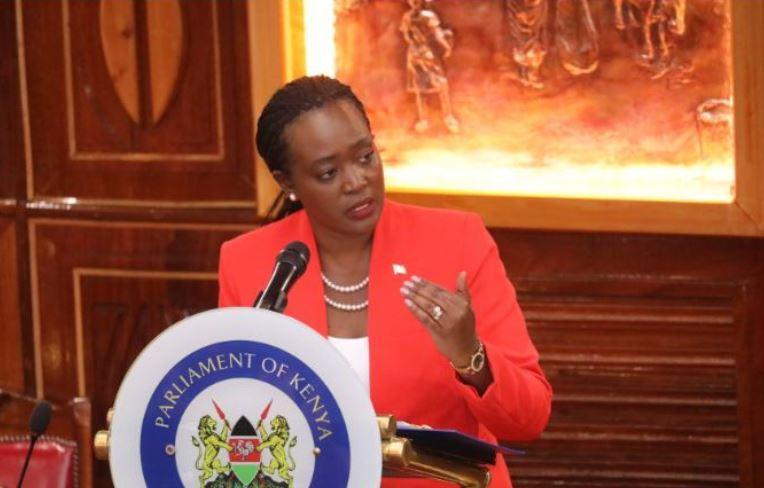
Africa-Press – Kenya. Defence Cabinet Secretary Soipan Tuya has said the East Africa, Red Sea, Southern Africa and wider Indian Ocean region continues to face multiple security challenges.
She reiterated that the region is facing constantly changing threats of piracy, illicit trafficking, Illegal Unreported and Unregulated (IUU) fishing, maritime terrorism and the increasing effects of climate-induced instability.
The CS said there is need for concerted efforts to address the menace.
She spoke in a speech read on her behalf by Commander of the Kenya Navy Fleet, Brigadier Mohamed Shemote, at a regional drive to strengthen maritime security across East Africa, the Red Sea, Southern Africa and the wider Indian Ocean.
“These threats do not respect national borders; neither can our responses be confined within them,” he said.
“This forum provides a unique opportunity to deepen our partnerships and reaffirm that security at sea is a shared responsibility.”
Shemote emphasised the need for a coherent, coordinated plan aligned with African priorities and anchored in regional mechanisms such as the Djibouti Code of Conduct, the Lomé Charter, and the African Integrated Maritime Strategy, to ensure safe waters, secure trade routes, and vibrant maritime economies.
Kenya is a signatory to the EU Safe Seas Africa Programme, a partnership that has enhanced cooperation, improved maritime domain awareness, and strengthened the capacities of navies, coastguards, and law enforcement agencies.
Nairobi this week became the centre of a regional drive to strengthen maritime security across East Africa, the Red Sea, Southern Africa and the wider Indian Ocean, as more than 100 delegates gathered for the first EU Regional Maritime Security Week held from December 2nd to 5th, 2025.
The week-long event brought together 112 delegates from 16 countries and 12 from regional and international organisations, uniting governments, security agencies and global partners behind a coordinated approach to maritime threats.
The meeting convened the Steering Committees of three key EU-funded programmes—the Red Sea Programme, the Safe Seas Programme, the Port Security and Safety of Navigation Programme.
It culminated with the Steering Committee of the Regional Maritime Security Architecture (RMSA), the region’s information-sharing platform.
The event was hosted jointly by the European Union, the Government of Kenya, the Indian Ocean Commission (IOC) and the United Nations Office on Drugs and Crime (UNODC).
It was supported by the International Maritime Organisation (IMO) and INTERPOL.
The week-long forum offered a comprehensive overview of ongoing EU maritime security initiatives and fostered closer coordination among partners.
Officials highlighted major achievements under the three programmes, including more than a dozen maritime operations, the seizure of 2.4 tonnes of drugs and illicit cargo among them 9.9 million cigarettes, 17 stolen vehicles and 30 tonnes of kratom and the arrest of 36 human traffickers and criminal suspects.
The programmes have also supported the rescue of sailors and fishermen in distress, the training of maritime officials, regional simulation exercises, and the strengthening of legal and operational frameworks for security at sea.
The EU delegation to Kenya reaffirmed Europe’s commitment to supporting African partners in tackling maritime insecurity.
Ondrej Simek, Deputy Head of the Delegation, said this was the first time all three EU regional maritime security programmes had been brought together, alongside the RMSA created in 2018.
“We believe that by uniting these initiatives, we can enhance cooperation and formulate joint solutions for threats that you are sharing across the region—and that we are sharing with you,” Simek said.
Beyond the high-profile maritime operations, the week placed strong emphasis on the less visible foundations of maritime security: information-sharing, inter-agency cooperation, training, equipment support, joint procedures, and strengthened legal frameworks.
By the close of the forum, organisers said the week had generated “clear momentum”, deepened coordination among regional partners, and helped cement a shared EU–Africa vision for safer and more resilient seas.
The success of the inaugural edition, they added, underscores the value of collective commitment in confronting complex, cross-border maritime threats.