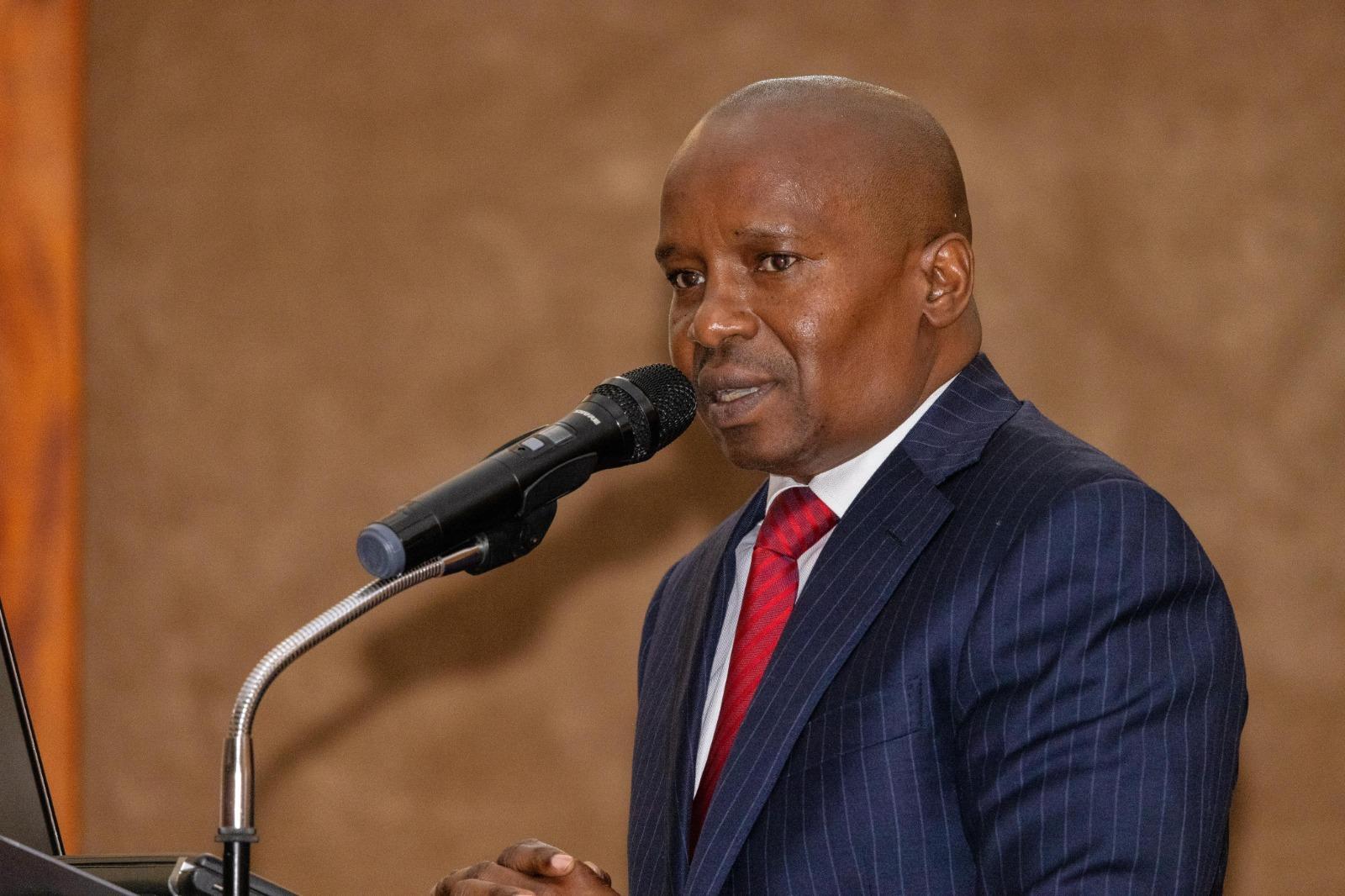
Africa-Press – Kenya. A three-judge bench is set to deliver a ruling on March 19, 2026, on an application by petitioner Joseph Aura, who is seeking the removal of Deputy President Kithure Kindiki.
Central to the application is a request by the petitioner for an expanded bench to hear the case.
The dispute is linked to the impeachment of former Deputy President Rigathi Gachagua.
The matter being heard by a panel comprising Justices Anthony Mrima, Freda Mugambi, and Eric Ogola has drawn significant public attention due to its constitutional implications.
Aura filed the petition in October 2024. Through his lawyer, Harrison Kinyanjui, he urged the court to certify the matter for hearing by an expanded bench, arguing that it raises substantial constitutional questions that require broader judicial scrutiny.
Kinyanjui told the court that the amended petition raises weighty issues of law that justify certification for a five-judge bench.
In the amended petition, Aura argues that Kindiki was sworn in as Deputy President outside constitutionally prescribed parameters.
He claims Kindiki is in office illegally because he had not resigned from his position as Cabinet Secretary for Interior and National Coordination at the time of his appointment.
Court papers state that the question of whether Kindiki could lawfully be appointed Deputy President without first resigning or being removed as Cabinet Secretary is a substantial issue of law that is unprecedented in Kenya’s jurisprudence.
Aura further argues that no gazette notice was ever issued to formalise Kindiki’s exit from the Cabinet, a move he says violates Article 137(2)(b) of the Constitution, read together with Section 6 of the Public Appointments (Parliamentary Approval) Act.
Kinyanjui told the court that Aura formally wrote to Chief Justice Martha Koome seeking expansion of the bench shortly after a Court of Appeal judgment delivered on May 9, 2025 dissolved an earlier-constituted bench.
He said the Chief Justice responded through a letter dated January 23, 2025, directing that the request be pursued before the trial court to allow other parties to respond and for the court to make a determination.
Kinyanjui added that the application was filed strictly in line with the Chief Justice’s directions, issued under Article 161(2)(a) of the Constitution, and said those directives carry constitutional authority.
He told the court that the petitioner has a legitimate expectation that a determination will be made on whether the dispute meets the threshold for empanelment of a five-judge constitutional bench.
Kinyanjui argued that the matter goes beyond the interests of the parties before court and raises serious public interest concerns.
He cited questions around electoral representation in constituencies whose Members of Parliament had died at the time of the alleged impeachment, without replacements and in the absence of the Independent Electoral and Boundaries Commission.
In his court filings, Aura further argues that if President William Ruto were declared mentally or otherwise unfit to hold office, the country could face a constitutional crisis with an unconstitutionally appointed Deputy President.
He contends that if the President were to become incapacitated or deemed unfit while the case is still pending, Article 146(2)(a) of the Constitution would be triggered immediately, handing over power to what he describes as an unconstitutionally appointed Deputy President.
On the other hand, lawyer Duncan Kiprotich, representing Parliament and the Clerk of the National Assembly, opposed the application.
He described the request, asserting that the petitioner had not demonstrated that the Chief Justice’s discretion in assigning the current bench was unlawful.
“The fact that the Chief Justice herself wrote to the Petitioner to apply to this court is not a concession by the Chief Justice that this matter should have an expanded bench,” he said.
“We submit it was an administrative decision. It does not impair the duty of this court to discharge its mandate of interpreting the constitution under Article 165.”
Lawyer Josphat Kuyioni, representing the Speaker of the National Assembly, underscored that the power to empanel and expand benches rests solely with the Chief Justice.
By assigning the current three-judge panel, the Chief Justice had met the constitutional threshold, he argued.
“The petitioner is asking the court to supervise the discretion of the Chief Justice. This court has no jurisdiction to supervise that discretion,” Kuyioni submitted.
In his rejoinder, Kinyanjui clarified that the case was framed solely for certification and forwarding to the Chief Justice for consideration of an expanded bench.
“No challenge over the Chief Justice’s discretion is being sought,” he said.
“This scenario is unprecedented and presents an opportunity to expand judicial wealth. The petition raises substantive questions of law that require careful consideration,” said Kinyanjui