
What You Need to Know
Kenya, in collaboration with Egypt and Uganda, is launching the ClimCam Payload to the International Space Station on April 8, 2026. This specialized climate camera will provide near-real-time weather and climate data, enhancing disaster management and climate resilience in Eastern Africa. The launch reflects a commitment to leveraging space technology for climate challenges.
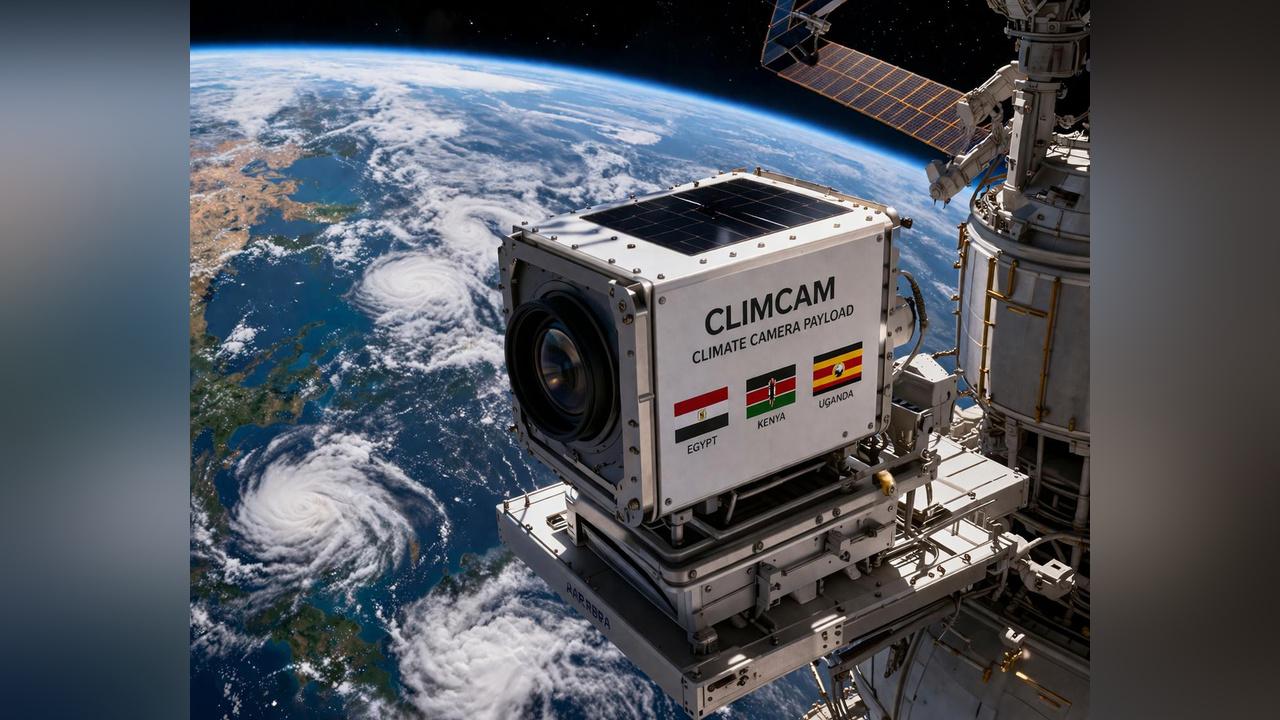
Africa-Press – Kenya. Climate camera artistic impression/AIKenya, in partnership with Egypt and Uganda, is set to take a major step in space and climate research with the launch of the Climate Camera (ClimCam) Payload to the International Space Station (ISS) on Wednesday, April 8, 2026.
The payload will travel aboard the Cygnus NG-24 mission, carried by a SpaceX Falcon 9 rocket from Cape Canaveral Space Force Station in Florida. The launch is scheduled for 3:51 PM Kenya Time and will be livestreamed via SpaceX.
The ClimCam Payload, a specialised space instrument designed to observe the Earth’s atmosphere and surface, aims to provide near-real-time, AI-powered weather and climate data. This data will strengthen disaster management, natural resources management, and climate resilience across Eastern Africa.
Developed through collaboration between the Kenya Space Agency (KSA), the Egyptian Space Agency (EgSA), and the Uganda National Space Program, the payload underwent comprehensive Assembly, Integration, and Testing at EgSA facilities in Cairo.
Final validation was completed at Airbus facilities in Houston, Texas, ensuring the device is fully qualified for space operations.
The initiative came after the consortium successfully responded to an Announcement of Opportunity issued by the United Nations Office of Outer Space Affairs (UNOOSA), in partnership with Airbus Defence and Space, under the UNOOSA Access to Space for All Initiative.
The competition allowed teams from across the world to propose payloads for the Airbus Bartolomeo external platform on the ISS. ClimCam will be hosted on Bartolomeo, attached to the European Columbus Module, for the duration of its mission in orbit.
According to the Kenya Space Agency, the payload “will deliver near real-time weather and climate data for strengthening disaster management, natural resources management and climate resilience in the Eastern African region.”
Officials describe the collaboration as a milestone for regional space science, combining technological expertise with practical climate solutions.
The launch reflects a growing focus in Eastern Africa on leveraging space technology to address climate challenges.
ClimCam’s AI-powered instruments will allow researchers and policymakers to access timely environmental information, helping communities anticipate and respond to extreme weather events.
The Cygnus NG-24 mission marks yet another example of Kenya’s commitment to advancing its space capabilities. Space enthusiasts and the general public can follow the live launch via the Cygnus NG-24 Launch Live Stream on SpaceX’s official website.
The collaboration between Kenya, Egypt, and Uganda on the ClimCam project represents a significant advancement in regional space science and climate research. This initiative was made possible through a partnership with the United Nations Office of Outer Space Affairs, which encourages nations to utilize space technology for addressing global challenges. The ClimCam Payload aims to provide crucial data that can help mitigate the impacts of climate change in Eastern Africa, a region particularly vulnerable to environmental shifts.