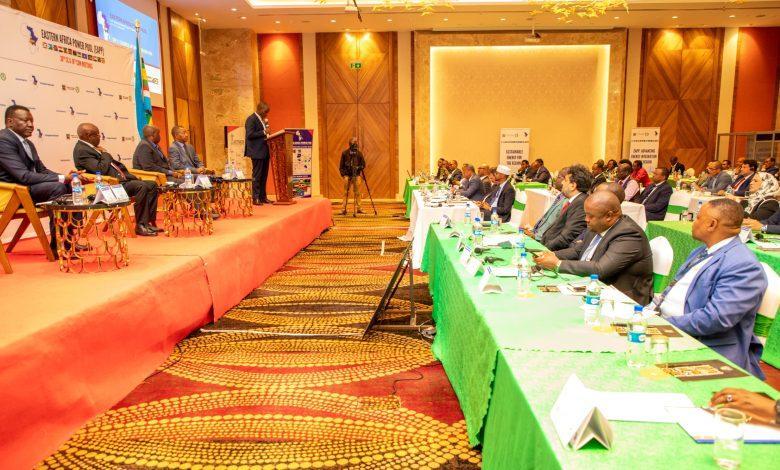
Africa-Press – Kenya. NAIROBI: THE Eastern Africa Power Pool’s (EAPP) Council of Ministers has agreed to fast-track the supervision of various energy projects among member states in a bid to realise their timely completion and generate sufficient electricity for citizens’ development.
Deputy Prime Minister and Minister for Energy, Dr Doto Biteko, said last Tuesday at the 18th EAPP Council of Ministers meeting held in Nairobi, Kenya, that the completion of power projects, especially transmission lines from multiple sources, will enable member states to back up one another in the event of electricity shortages.
“Our council is very important in attaining a joint regional commitment to utilising all available energy resources to generate sufficient electricity for socio-economic development. In this meeting, every country has expressed readiness to do business when it produces excess power,” he said.
Dr Biteko noted that the large population residing in the member states demands adequate electricity for their prosperity and industrialisation.
He said that after switching on all nine turbines, with a total capacity of producing 2115megawatts at the Julius Nyerere Hydro Power (JNHPP), Tanzania will become electricity self-sufficient and be able to supply other countries with shortages.
He mentioned that the country has various electricity inter-connectors, including those linking with Uganda, Burundi, and Rwanda, which have been facilitating electricity trade among the countries when there is an excess.
Dr Biteko also mentioned that there is another transmission line to Kenya already constructed and undergoing trials to facilitate power trade between the two countries in the near future.
In another development, Dr Biteko mentioned that the World Bank (WB) is financing a feasibility study for the construction of a 400-kilovolt transmission line from Tanzania to Uganda, which is expected to benefit other countries, including Kagera.
He stated that so far, the growth of the energy sector in Eastern African countries stands at six percent annually, calling upon member states to make major investments to lower electricity costs.
Dr Biteko mentioned that through the EAPP, various projects have been implemented, with some still in progress being undertaken by Kenya and Uganda, Kenya and Ethiopia, as well as Kenya and Tanzania.
He emphasised the importance of ensuring that projects are completed on time to address the challenge of power shortages.
Earlier, the chairperson of the meeting, Mr Davis Chirchir, said that electricity trade among member states can only be realised if they collectively generate a surplus.
According to Mr Chirchir, about 600 million people out of a total of 1.5 billion people in Africa have no access to electricity, calling for concerted efforts to address the problem.
Therefore, he said the meeting helped member states design a strong structure to cement unity and collaboration in addressing the setbacks of producing the desired amount of electricity.
Highlighting the benefits of the EAPP, he noted that Kenya has been receiving 200 megawatts from Ethiopia, which boosts its power supply.
The EAPP has 13 member states, including Tanzania, Kenya, South Sudan, Sudan, Somalia, Ethiopia, and Rwanda.
This year’s meeting was also attended by other development stakeholders, including representatives from the World Bank (WB) and the African Development Bank (AfDB).
For More News And Analysis About Kenya Follow Africa-Press