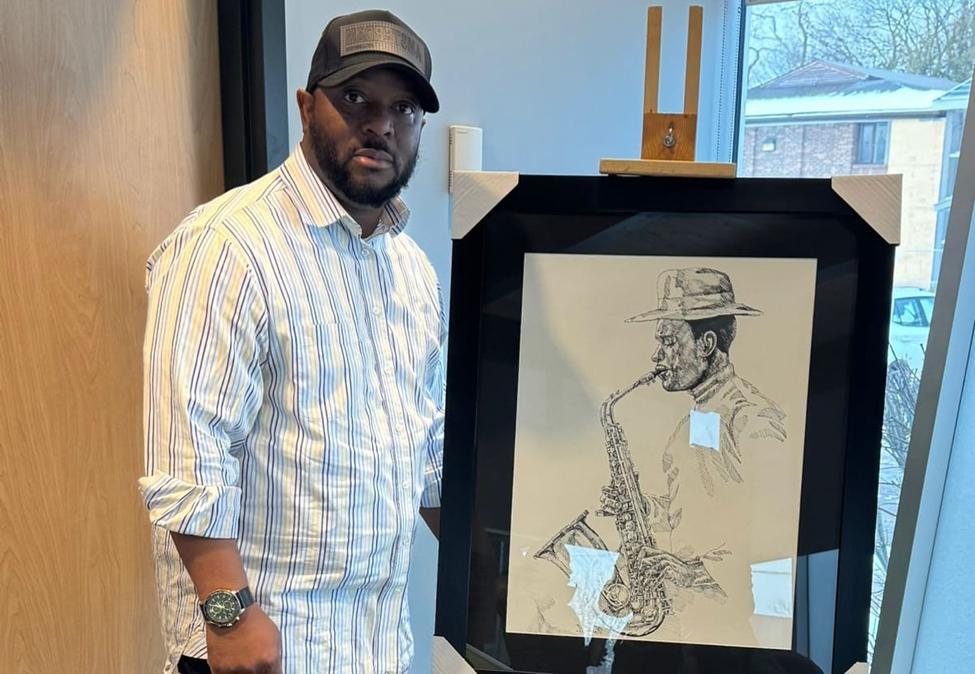
Africa-Press – Liberia. Hallie Andrews Ndorley, a Liberian artist based in Canada, has called on the Ministry of Education to introduce arts education in schools, arguing that creative subjects are as vital as mathematics or science for student development.
In a statement, Ndorley, a self-taught fine artist whose works have captivated audiences across Canada and the world, noted that arts education would greatly improve Liberian students’ emotional intelligence, creativity and critical thinking skills, as well as overall academic results.
“Arts education is an essential field for creating 21st-century skills that are defined as the four C’s of collaboration, creativity, communication and critical thinking,” Ndorley said. “As a result, the Ministry of Education must make it its duty to make arts a core, lifelong component of learning if we must improve the four C’s skill sets among Liberian students.”
According to Ndorley, the Ministry of Education — as a signatory to UNESCO’s 2024 Framework for Culture and Arts Education and other relevant international conventions and declarations on arts education — is under obligation to ensure Liberian students benefit from the cognitive development impacts of arts education.
Ndorley’s call comes as UNESCO has published the implementation guidance for its Framework for Culture and Arts Education, mandating member states to integrate culture and the arts across formal, non-formal and informal education settings. The guidance offers a practical roadmap for all UNESCO Member States to recognize the transformative power of arts education in fostering learners’ holistic and inclusive development, enhancing well-being, and promoting social cohesion.
According to UNESCO, arts education is integral to inclusive, equitable and quality education, as it “nurtures creativity, critical thinking, and respect for cultural diversity,” empowering learners to engage meaningfully with the world.
The UNESCO position is supported by a 2023 ScienceDirect paper, which found that arts education cultivates disciplined habits of mind, including analytical thinking, decision-making, and continuous reflection, with these cognitive skills transferring to other academic disciplines and improving students’ overall performance.
The study, contributing to a growing body of research, shows that arts education in schools leads to significant gains in students’ creative thinking, social-emotional skills, and academic performance, especially in subjects requiring innovation and higher-order thinking, creating what scholars call “an interdisciplinary learning environment that bridges creativity and analytical reasoning.”
According to Ndorley, art, in all its diversity, is a fundamental building block of cognitive development skills and values, which encompasses creativity, collaboration, and innovative problem-solving. He argues that in the absence of arts education, Liberian students are being prepared for a world that no longer exists, while their peers in countries with robust arts programs develop the flexible, creative thinking that modern employers demand.
The artist, who is known for his “mystic flowing colors,” draws from his own experience as a self-taught artist to illustrate the limitations of learning outside formal education structures. Starting at age seven with no guidance except his own instinct and passion, he spent years working with and learning from various artists — a path he describes as rewarding but unnecessarily difficult and inaccessible to most young Liberians with artistic talent.
“When I look at the struggles I faced — the years of trial and error, the lack of foundational knowledge about techniques, color theory, or art history — I see what we’re asking young Liberian artists to endure,” Ndorley said. “We cannot continue to rely on chance encounters and individual determination. Every child deserves the structured education that unlocks their creative potential, not just the fortunate few who persist despite the obstacles.”
For More News And Analysis About Liberia Follow Africa-Press