Africa-Press – Liberia. Ireland’s Ambassador to Liberia, Gerard Considine, has called for stronger accountability, transparency and collaboration in Liberia’s response to climate change, stressing that effective climate action cannot succeed without good governance and inclusive participation.
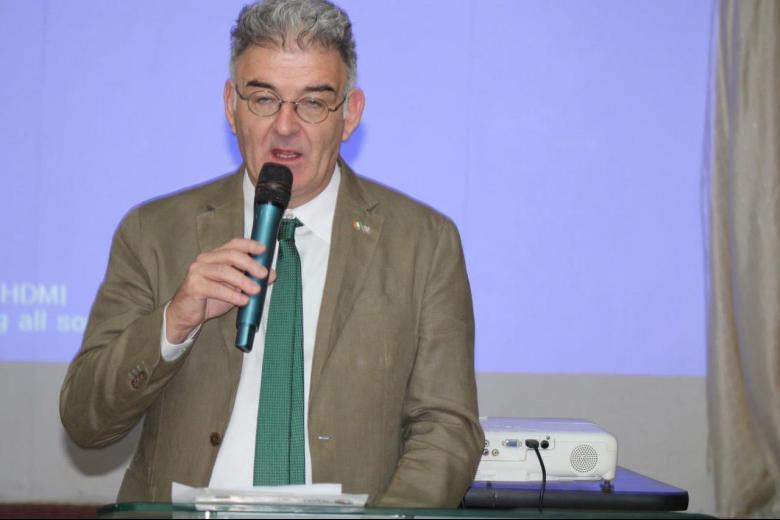
Ambassador Considine made the remarks on Wednesday, during the opening of a High-Level National Policy Dialogue on Climate Governance and National Adaptation Plan (NAP) Implementation held at the Sinkor Palace Hotel in Congo Town, outside Monrovia.
The event, organized in collaboration with the Environmental Protection Agency (EPA) and the Governance Civil Society Organizations Consortium — comprising the Center for Democratic Governance (CDG), the Center for Transparency and Accountability in Liberia (CENTAL), and Naymote Partners for Democratic Development — brought together government officials, civil society representatives, development partners, local authorities, youth and women leaders, and other stakeholders.
Ireland, a key supporter of the initiative, sponsored the dialogue as part of its continued partnership with Liberia in promoting climate resilience and strengthening governance systems.
In his opening remarks, Ambassador Considine described climate change as one of the defining challenges of the modern era, noting that its effects are already being felt across Liberia.
“Climate change is not an abstract threat. It is a daily reality for Liberians,” Ambassador Considine said.
“Rising temperatures, erratic rainfall patterns, coastal erosion, and flooding are already threatening livelihoods, biodiversity, and food security.”
He emphasized that the burden of climate change falls most heavily on the poor, women, youth, and vulnerable communities — those who have contributed the least to the crisis.
“This injustice demands our urgent response,” he said.
The Irish envoy said Liberia’s National Adaptation Plan offers hope as a roadmap for strengthening institutional capacity, protecting livelihoods, and building resilience across key sectors.
However, he cautioned that a policy document alone would not be enough to guarantee results. “But a plan on paper is not enough,” he said. “Success depends on something more fundamental: accountability, transparency, and genuine collaboration among all stakeholders.”
Ambassador Considine noted that Ireland’s support for the Governance Civil Society Organizations Consortium reflects its belief that effective climate action is closely linked to good governance.
“Ireland recognizes that effective climate action is inseparable from good governance,” he said.
“When institutions are transparent, when citizens have a voice in decisions affecting their futures, and when resources are allocated equitably, climate adaptation becomes not only more effective but also more just.”
He praised the theme of the dialogue — “Promoting Accountability and Collaboration for Effective Climate Change Adaptation and Resilience” — as central to the values needed to make Liberia’s climate response successful.
According to him, accountability means ensuring that the Environmental Protection Agency has the institutional capacity to rigorously oversee the implementation of the National Adaptation Plan, while civil society organizations must have the freedom and space to monitor progress, identify gaps, and hold duty-bearers accountable.
He further said collaboration requires government institutions, local forest management structures, the private sector, and especially women and youth to work together across sectors such as agriculture, forestry, energy, water, health, and fisheries.
On transparency, the ambassador stressed the importance of ensuring that communities affected by climate change understand how climate resources are being used and whether the benefits are being distributed fairly.
“Transparent processes build trust. Trust builds ownership. Ownership ensures sustainability,” he said.
Ambassador Considine also challenged participants to use the dialogue as an opportunity to address key questions around coordination gaps, transparency in climate financing and sector-wide contributions to climate resilience.
He referenced Pillar 5 of Liberia’s ARREST Agenda, which focuses on responsible natural resource management, biodiversity protection, and building resilience to environmental and climate threats, and said achieving those goals would require stronger institutions and more inclusive decision-making.
“As you engage in this dialogue, think boldly,” he urged participants. “Achieving this vision requires that we strengthen the accountability and transparency of our institutions, include the voices of women, youth, and marginalized groups in decision-making, and ensure climate investments benefit those most vulnerable to climate impacts.”
He emphasized that the decisions and commitments made at the dialogue would have far-reaching implications for Liberia’s future.
“The work you do here today matters,” he said. “It will echo far beyond these walls. It will shape how resources flow, whose voices are heard, and ultimately, whether Liberia builds a future of shared prosperity and genuine resilience.”
The high-level policy dialogue forms part of ongoing efforts by Liberia and its development partners to improve climate governance and ensure effective implementation of the country’s National Adaptation Plan in the face of increasing environmental challenges.
For More News And Analysis About Liberia Follow Africa-Press