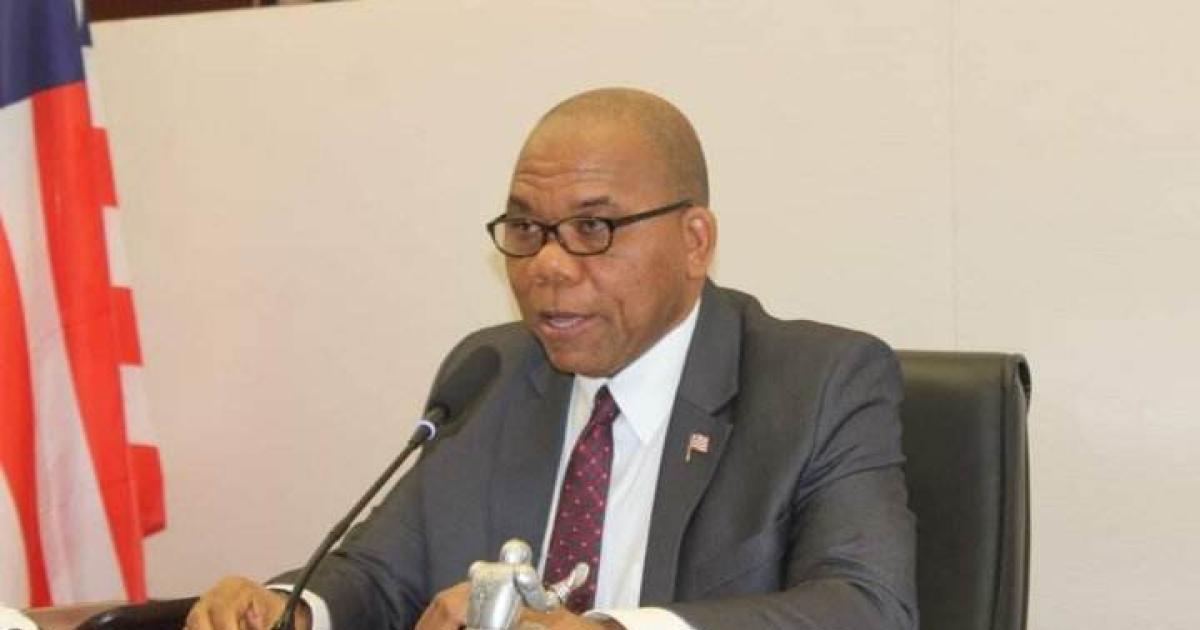
Africa-Press – Liberia. After apparently sensing a wave of resistance to President George Weah’s nominees for the Liberia Anti-Corruption Commission (LACC), Senate Pro-Tempore Albert Chie has informed his colleagues that the Senate will no longer be holding open confirmation hearings.
Chie, who is an ally of the President and Senator from Grand Kru County, instead announced that confirmation “for the nominees” would be handled by the Committee on Autonomous Commissions and Agencies — a process usually marred by secrecy and some exchanges of favor for committees to approve nominations for a general senate vote.
Chie said the leadership’s decision is predicated on the desire to now follow the dictates of the Senate confirmation procedure.
The Pro-tempore’s rally for the adherence of the senate’s rules follows a day after he seized a motion, supported by scores of senators, requesting plenary reject the president’s nominees on the grounds that the appointments come at the eleventh hour with elections just around the corner.
“We have consulted and completed the consultation in respect of legal, procedural, and political issues,” Chie said yesterday. “The leadership is pleased to recommend that the letter be sent to the committee on Autonomous Commissions.
“The Senate Leadership’s decision to revert to the committee style is intended to follow normal Senate procedure regarding nominees, which is followed by confirmation votes.”
The Pro-tem decision, however, had left many senators accusing him of attempting to outsmart them “to ensure” that the president’s nominees slid through when there was strong resistance.
Chie’s decision came after some of his colleagues argued that the President’s appointments were too close to the ensuing elections and, therefore, not necessary; and that elections should be concluded in October before the Senate considered new crops of officers for the country’s anti-graft institution.
They argued that it should be a matter of principle to let the next president, who would be elected by the people, make the nomination and allow the Senate to confirm or reject the nominee.
But other Senators assert that the Constitution grants the President the authority to make appointments, and, as such, his appointments should not be open to debate as it would impede his authority.
They emphasize that the passage of the amended LACC law supersedes the previous law, indicating that the new legislation should now be the governing law.
The President’s appointments come after the legislature repealed and restated the Liberia Anti-Corruption Commission Act of 2008 — which dissolved the Commission’s current leadership and called for appointments of new officials vetted by an Ad-hoc committee.
The Supreme Court of Liberia had earlier ruled that the legislature has the constitutional power to make and alter laws without limitation after the restated act has been challenged.
The court’s ruling was in response to a petition from Cllr. Edward Martin, the current Executive Person of the LACC. He asked the court to declare sections 16.1 and 16.2 of the amended LACC Act unconstitutional, saying it was an abuse of power for a government to dissolve a tenured position and recreate the same.
However, the Court in its unanimous verdict delivered by Chief Justice Sie-A-Nyene Yuoh, ruled that the Legislature has the “unquestionable power to amend, modify or abolish the LACC as deemed expedient in the interest of the state, and its action cannot be said to violate the constitution.”
Martin’s lawyers had argued that Parts 16.1 and 16.2 of the restated LACC Act were not in accordance with the norms and concept of ex post facto law as entrenched in Article 21 of the Constitution and that allowing the sections to remain would be a grave breach of the Constitution.
Article 21 of the 1986 Constitution, which Martin’s lawyer is quoting, states that “no person shall be made subject to any law or punishment which was not in effect at the time of the commission of an offense, nor shall the Legislature enact any bill of attainder or ex post facto law.”
The Court Justices, however, disagreed and ruled that no public official has the vested right to a public office except for those officers or offices that are clearly and expressly protected by the Constitution, “which is not the case in the present petition.”
The Court added that “however, should it become necessary to terminate the services of the petitioner and others similarly situated before the expiration of their contractual rights, the sanctity of contract as enshrined in the Constitution should be given due consideration.”
Meanwhile, a motion from Senator J. Milton Teahjay, a supporter of the President calling for the nomination letter to be sent to the Committee report passed through a “yea and nay” vote instead of a “headcount.”
The committee is expected to report within weeks before final vote on the Senate floor is taken.
The former voting system, according to Senators who oppose it, breeds misinterpretation of the votes and is prone to abuse. Senators, such as Montserrado County Senator Abraham Darius Dillon, who oppose such voting have vowed to scrutinize such nominations and not give them an easy ride, as they have done in the past.
Dillon claimed that with the number of like-minded “opposition Senators” now joining forces together, there is no longer going to be the usual easy walk in the park for the President, especially nominations for tenure positions and loan agreements, among others.
Teahjay’s motion to allow President George Manneh Weah’s nomination letter to go to the Committee and report to plemary within a reasonable time, was accepted through a yea vote instead of a “head count” vote.
Elsewhere, the Secretary of the Senate, J. Nanborlor Singbeh, has announced that his office had received copies of the fiscal 2023 national budget more than three months after passage.
The issue of the budget copies has been a concern for Senators, especially Dillon and Jonathan Borycharles Sogbie.
Dillon has been vocal in his criticism of the Executive branch, especially on matters of budget transparency and accountability. His reminder on any other business prompted Singbeh to announce budget copies were finally in his office’s possession and would be distributed to Senators soon.
The lack of budget performance reports from government agencies has also raised eyebrows in the Senate. Despite the current budget being in its second quarter, no agency has reported to the Senate plenary or its oversight committee on how they have used the funds allocated to them. This situation could invite more scrutiny and calls for accountability from some Senators, as they see it as a sign of inefficiency and non-compliance.
For More News And Analysis About Liberia Follow Africa-Press