Africa-Press – Liberia. A quiet but consequential transformation is unfolding across Liberia’s maritime gateways, where policy is beginning to translate into performance and where reform is no longer an abstract promise but a measurable shift in how the country connects to global trade.
At the center of this transition is National Port Authority Managing Director Sekou A. M. Dukuly, whose tenure is increasingly being defined not by rhetoric, but by a sequence of structural decisions that are repositioning the port system as a serious regional contender.
What once functioned as a constrained, contract-bound system is now being recalibrated into a more responsive and strategically aligned maritime architecture.
The shift did not begin with a single policy announcement, nor with a flagship infrastructure project. Instead, it has emerged through a layered reform doctrine that combines governance discipline, operational upgrades, international engagement, and human capital development into a single coordinated agenda.
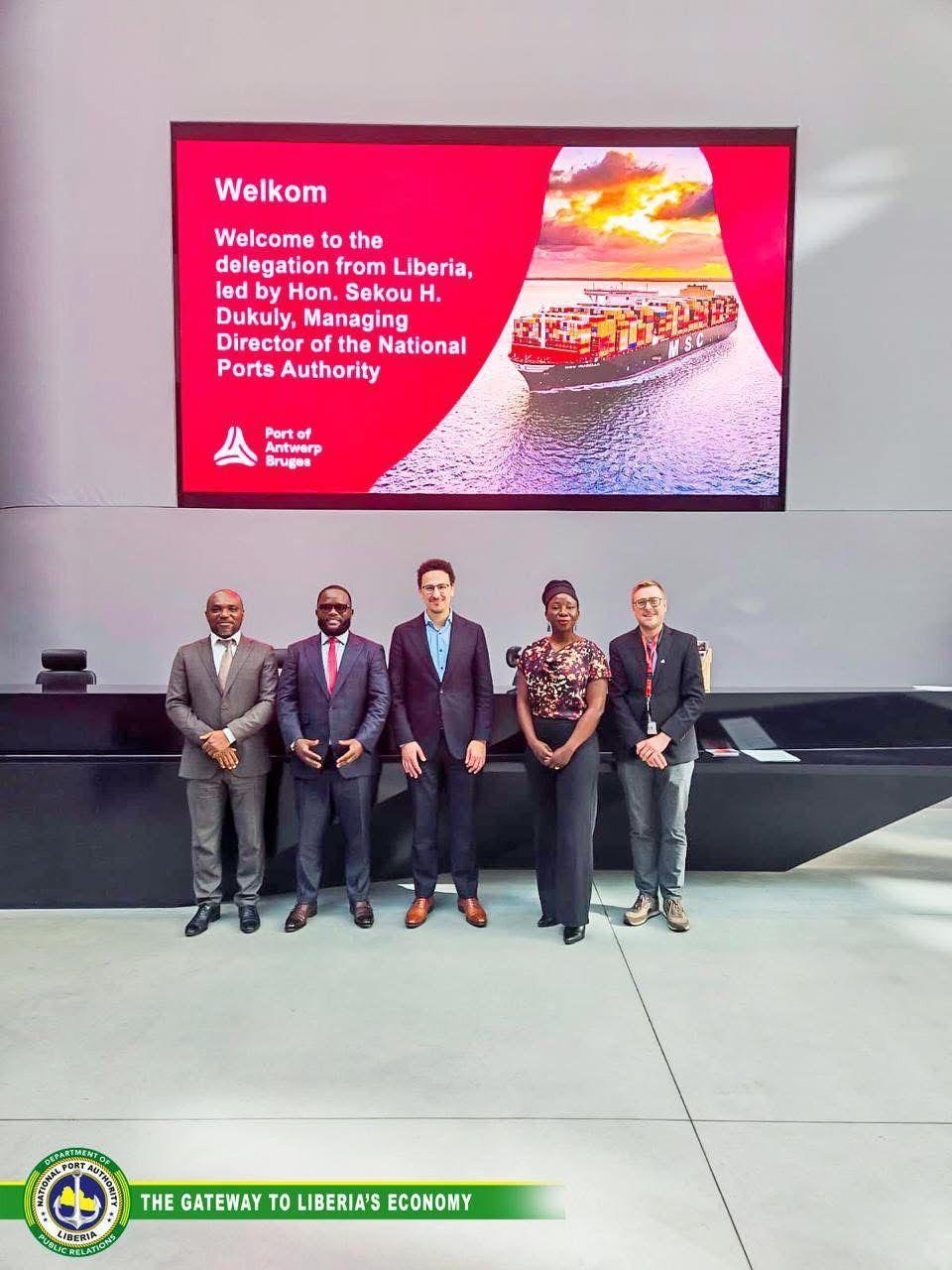
That agenda was on full display in February 2026, when Dukuly led a high-level delegation to the Liberia–European Union Business Conference in Antwerp.
The visit carried significance beyond diplomatic optics. It represented a deliberate effort to embed Liberia within a network of global port expertise while drawing practical lessons from one of Europe’s most advanced port ecosystems.
In Antwerp, discussions between the National Port Authority and Port of Antwerp International moved quickly beyond ceremonial exchanges.
The focus was technical, grounded in governance modelling, infrastructure sequencing, and operational optimization.
For Dukuly, the engagement was an opportunity to reinforce a central principle of his leadership approach, that reform must be structured, measurable, and insulated from the inconsistencies that have historically undermined institutional performance.
“We came to Antwerp with clarity of purpose and a firm understanding that Liberia’s port system must transition from incremental adjustments to structured, disciplined transformation. Our engagement with Port of Antwerp International was not about symbolic partnership, it was about interrogating systems that work and identifying how those systems can be adapted to our realities in Monrovia, Buchanan, and Greenville,” he said.
Continuing, he added, “We discussed governance frameworks that enforce transparency, operational models that reduce vessel turnaround time, and infrastructure planning that is tied directly to market demand rather than ambition alone. Liberia cannot afford inefficiency at its ports, because inefficiency at the port translates into higher food prices, weaker supply chains, and reduced investor confidence. What we are building is a port system that is predictable, accountable, and competitive within the West African corridor, one that aligns national economic priorities with global operational standards.”
He added, “What impressed us most in Antwerp was not only the scale of infrastructure, but the discipline of systems, the integration of technology, and the consistency of performance measurement across every level of port operations. That is the direction we are pursuing at the National Port Authority. We are not seeking to replicate Antwerp, but to learn from its principles, structured planning, phased investment, strong regulatory oversight, and a deliberate commitment to human capital development.”
“Any partnership we enter will be clearly defined, with measurable deliverables and strict governance safeguards, because Liberia’s interests must remain protected at all times. Our objective is to ensure
that Liberian professionals are not sidelined but empowered, that knowledge transfer is real and sustained, and that the reforms we are implementing today will outlast individuals and become embedded within the institution. This is how we secure long-term efficiency, resilience, and credibility for Liberia’s maritime sector.”
He framed Liberia’s ports not as peripheral assets, but as critical economic pressure points. Cargo throughput, he noted, directly influences food prices across domestic markets.
Vessel turnaround times shape industrial supply chains and determine whether Liberia is seen as a reliable logistics hub or a secondary option. Concession management, often overlooked in public discourse, plays a decisive role in investor confidence and long-term capital inflows.
The reform blueprint he presented rests on five pillars, infrastructure modernization aligned with actual market demand, stronger concession oversight mechanisms, full integration of digital port systems, performance benchmarking across operations, and a sustained push to elevate the technical capacity of Liberian professionals.
The emphasis throughout is on discipline, ensuring that each phase of reform builds on verifiable outcomes rather than aspirational targets.
The Antwerp engagement is only one part of asuccess story that began to take shape in 2025, a year many observers now describe as a turning point for Liberia’s maritime sector.
For years, one operational limitation symbolized the system’s inefficiencies, the Freeport of Monrovia did not operate at night. Vessels arriving after sunset were forced to anchor offshore, incurring delays that translated into higher costs for importers, exporters, and ultimately consumers.
Shipping lines adjusted accordingly, often favouringalternative ports in the region where turnaround times were more predictable. That constraint has now been removed.
With the installation of modern navigational aids and the expansion of pilot and tugboat services, the port transitioned to round-the-clock operations.
The technical adjustment carried immediate commercial consequences. Turnaround times improved, demurrage exposure declined, and scheduling flexibility increased for international shipping lines.
More importantly, the change sent a signal that Liberia was no longer content to manage decline, but was prepared to compete. Parallel to these operational improvements came a more complex and arguably more consequential reform effort, the renegotiation of legacy concession agreements.
After more than a decade without review, the country’s primary container terminal concession entered renegotiation, placing fees, investment commitments, and performance standards under renewed scrutiny.
At the same time, adjustments to other key agreements produced tangible financial benefits. Lower transaction costs for port users, increased revenue shares for the government, and revised marine service frameworks aimed at expanding opportunities for Liberian operators began to reshape the economic logic of the port system.
These were not isolated policy actions, but part of an attempt to realign the interests of operators, regulators, and users within a more transparent and accountable framework.
International engagement has reinforced these domestic reforms. Liberia’s hosting of a major regional maritime conference in 2025 repositioned Monrovia as a convening point for port authorities across West and Central Africa.
Inclusion in a European Union-supported maritime security and corridor program further expanded the country’s access to technical resources and institutional partnerships.
Engagements with global port operators and development partners have followed, creating a pipeline of conversations that did not exist prior to the current administration.
For investors and logistics planners assessing the West African corridor, Liberia is gradually re-entering the map as a location with both strategic intent and emerging operational credibility.
Equally significant is the shift taking place within the human capital structure of the National Port Authority. For decades, critical maritime roles were dominated by foreign expertise, creating both financial strain and institutional dependency. That pattern is beginning to change.
The certification of Liberia’s first locally trained marine pilot and tugboat captain marked a symbolic and practical milestone. Each certified professional represents a reduction in foreign exchange outflows and a step toward building a self-sustaining operational base.
Training programs conducted across multiple countries have further expanded the technical exposure of NPA staff, while internal knowledge transfer initiatives are ensuring that these skills are institutionalized rather than isolated.
This emphasis on capacity building was reinforced again in March 2026, when more than twenty-five NPA firefighters completed a specialized training program under the SCOPE Africa Initiative.
The program, supported through European Union funding, focused on strengthening compliance with international safety and security standards while enhancing crisis response capabilities.
Speaking at the close of the training, Deputy Managing Director for Administration James R. Bernard described the initiative as a strategic breakthrough that aligns with the broader reform trajectory of the port system.
He emphasized that improved safety and security are not merely regulatory requirements, but essential components of a modern trade environment where efficiency and resilience are increasingly interconnected.
The training also reflects a deeper institutional shift, one that recognizes the importance of integrating security, environmental resilience, and operational efficiency into a single framework. By strengthening these elements simultaneously, the National Port Authority is positioning itself to handle increased cargo volumes while meeting the expectations of international shipping and logistics partners.
Taken together, these developments form a coherent narrative of transformation. They reveal an institution that is moving away from reactive management toward proactive strategy, from fragmented interventions toward coordinated reform.
Challenges remain, as they do in any system undergoing structural change. Infrastructure gaps persist, financial constraints continue to shape the pace of modernization, and the success of ongoing reforms will depend heavily on consistent implementation. Yet the direction of travel is becoming increasingly clear.
Liberia’s ports are no longer defined solely by their limitations. They are being reintroduced as instruments of economic policy, capable of influencing trade flows, supporting industrial growth, and enhancing the country’s position within regional and global markets.
For Dukuly, the measure of success will not lie in individual milestones, but in whether the system he is reshaping can sustain momentum beyond his tenure. Early indicators suggest that the foundation is being laid with that long-term objective in mind.
What is unfolding in Monrovia, Buchanan, and Greenville is not a sudden transformation, but a disciplined progression. It is a story of systems being rebuilt, standards being enforced, and expectations being reset.
And for a country whose economic fortunes are closely tied to the efficiency of its maritime gateways, that progression may prove to be one of the most consequential developments of its current chapter.
For More News And Analysis About Liberia Follow Africa-Press