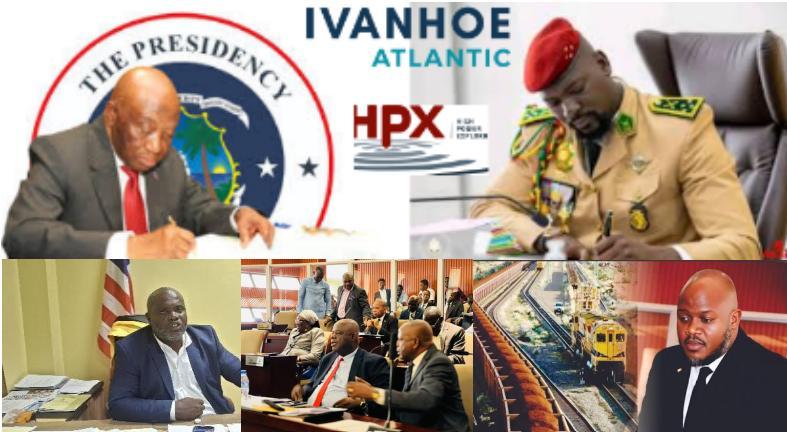
Africa-Press – Liberia. The Joint Committee reviewing the Concession and Access Agreement (CAA) between the Government of Liberia and Ivanhoe Atlantic has raised serious concerns about treaty compliance, diplomatic risks, and infrastructure governance, warning that the agreement cannot proceed without major amendments.
In a detailed report submitted to the Senate Plenary, the Joint Committee—comprising the Committees on Transport, Concessions, Judiciary, Ways, Means, Finance and Budget, and other relevant panels—said its review uncovered no evidence of formal engagement with the Government of Guinea since 2021, despite the agreement being fundamentally dependent on the transshipment of Guinean iron ore through Liberia.
The committee was mandated to assess the legal, economic, technical, fiscal, environmental, and governance implications of the proposed agreement, as well as determine whether the Executive Branch complied with domestic laws and Liberia’s treaty obligations under the Liberia–Guinea Implementation Agreement (IA).
What it is, in simple terms?
The Liberia–Guinea Implementation Agreement (IA) is a bilateral treaty between the Republic of Liberia and the Republic of Guinea that sets the rules and institutions for shared use of transport infrastructure—mainly railways, roads, and ports—linked to cross-border mining activities.
It is the legal framework that governs how Guinea-based iron ore projects can move minerals through Liberia, and how both governments coordinate, approve, and supervise that access.
Why it was created
Guinea has large iron ore deposits that lack direct access to the sea, while Liberia has existing rail and port infrastructure (notably the rail line to Buchanan). The IA was designed to enable transshipment of Guinean iron ore through Liberia, protect Liberia’s sovereignty and infrastructure and ensure mutual consent, oversight, and benefits for both countries
The IA requires the creation of joint governance institutions, including inter-ministerial committee made up of ministers from both countries, provides high-level political oversight and approvals, monitoring committee, reviews access applications, ensures compliance with agreed rules, issues technical opinions, joint technical secretariat, develops standard access templates and provides technical and operational guidance.
These bodies are meant to ensure that no private company gains access unilaterally without both governments’ approval.
Analysts say the IA is an international treaty, not just a policy document, and under Liberia’s Constitution, it carries binding legal obligations. Any concession or access agreement (like the Ivanhoe Atlantic CAA) must be consistent with the IA. The Liberia–Guinea Implementation Agreement is the legal backbone governing cross-border mineral transport between the two countries. Without compliance with it, any mining access deal is vulnerable to legal challenge, diplomatic fallout, or termination.
Executive Faulted for Non-Responsiveness
The committee disclosed that repeated requests for critical documents from the Executive Branch went largely unanswered ahead of a public hearing held on December 12, 2025.
While the Ministry of Transport submitted some documents, the committee found them to be largely historical, dating back to before September 2021, and insufficient to address core compliance questions. The committee further noted that no documentary proof was provided to support claims of recent engagement with Guinean authorities.
“All documentary evidence before the Committee indicates that the last formal communication between the Governments of Liberia and Guinea occurred in or about August 2021,” the report stated.
Joint Institutions Under Treaty Never Activated
A key finding of the report centers on Liberia’s obligations under Article 9 of the Implementation Agreement with Guinea, which mandates the creation of joint governance institutions to oversee access to shared infrastructure.
The committee found no evidence that the required Inter-Ministerial Committee, Monitoring Committee, or Joint Technical Secretariat was ever established or operational.
“No minutes, resolutions, technical opinions, or access templates were presented to demonstrate compliance,” the report said, raising serious questions about whether the Executive honored Liberia’s treaty commitments.
Diplomatic and Sovereignty Risks
The committee warned that proceeding with the agreement without documented consent from Guinea exposes Liberia to diplomatic, legal, and commercial risks, noting that Guinea’s approval is indispensable to the project’s viability.
“This absence of Guinean concurrence constitutes a material risk to the implementation and sustainability of the agreement,” the report cautioned.
Economic Projections Lack Independent Verification
The Executive projected that the agreement would generate about 400 direct jobs, nearly 2,000 indirect jobs, and approximately US$1.8 billion in payments to Liberia over 25 years, with US$110 million earmarked for affected communities.
While acknowledging the potential benefits, the committee said the projections were not supported by independent studies or verifiable assumptions.
Infrastructure, Rail, and Road Concerns
The committee expressed alarm that the proposed 25-mile heavy-haul road from the Guinea–Liberia border to Tokadeh would initially be laterite rather than paved, raising concerns about durability, safety, and environmental impact.
It also faulted the agreement for failing to bind Ivanhoe to a clear timeline for constructing a rail connection from the Guinean mine to the Tokadeh rail line, despite feasibility studies indicating a two-year construction period.
Access Fees Deemed Too Low
Senators also questioned the access fees ranging from US$1.55 to US$1.95 per metric ton, describing them as potentially undervaluing Liberia’s strategic rail and port infrastructure.
Although the Executive claimed the fees were based on a study, the committee said no such study was provided for legislative review.
Legislative Authority at Risk
The committee raised constitutional concerns over provisions mandating the establishment of a National Rail Authority (NRA) within the agreement, warning that embedding such decisions in a concession could undermine legislative sovereignty.
“Statutory bodies must be created by law, not by contract,” the report emphasized.
ArcelorMittal Rights and Coordination Gaps
The committee also examined the potential implications of the Ivanhoe agreement on the rights of ArcelorMittal Liberia (AML), cautioning that the Executive should have coordinated the passage of the AML agreement, the Rail System Operating Principles (RSOP), the NRA Act, and the CAA to avoid conflicts.
US$37 Million Payment Raises Red Flags
Lawmakers expressed concern over the reported US$37 million payment by Ivanhoe, including a US$7 million payment made in December 2019, questioning whether there was legislative authorization at the time.
The committee warned that without clarification, the payment could be construed as a loan, exposing the government to future repayment claims.
Conditional Approval Recommended
Despite the concerns, the Joint Committee recommended that the agreement be approved only if amended. Key among these recommendations include requiring the 25-mile heavy-haul road to be fully paved before any ore haulage begins; restructuring social contributions so that community projects are implemented by the government and affected communities, not Ivanhoe; mandating construction of the rail line within two years of commercial production; declaring the US$37 million payment a non-refundable signature bonus;
increasing access fees to between US$2.00 and US$3.00 per ton; automatically terminating the agreement if Guinea does not approve transshipment within five years; and protecting the Legislature’s authority over the establishment of a National Rail Authority.
Senate Plenary to Decide
The report has now been submitted to the Senate Plenary, which will determine whether to concur with the House of Representatives’ passage of the agreement under the committee’s recommended conditions.
While recognizing the potential economic upside of the Ivanhoe project, the committee stressed that national interest, sovereignty, and treaty compliance must take precedence.
Meanwhile, critics of the Ivanhoe–Liberia deal have applauded the Joint Committee for exercising due diligence after the bill was passed by the House and forwarded to the Senate for concurrence. They argue that had the House conducted a more thorough review, several of the alleged irregularities would have been identified earlier.
Source: FrontPageAfrica
For More News And Analysis About Liberia Follow Africa-Press