
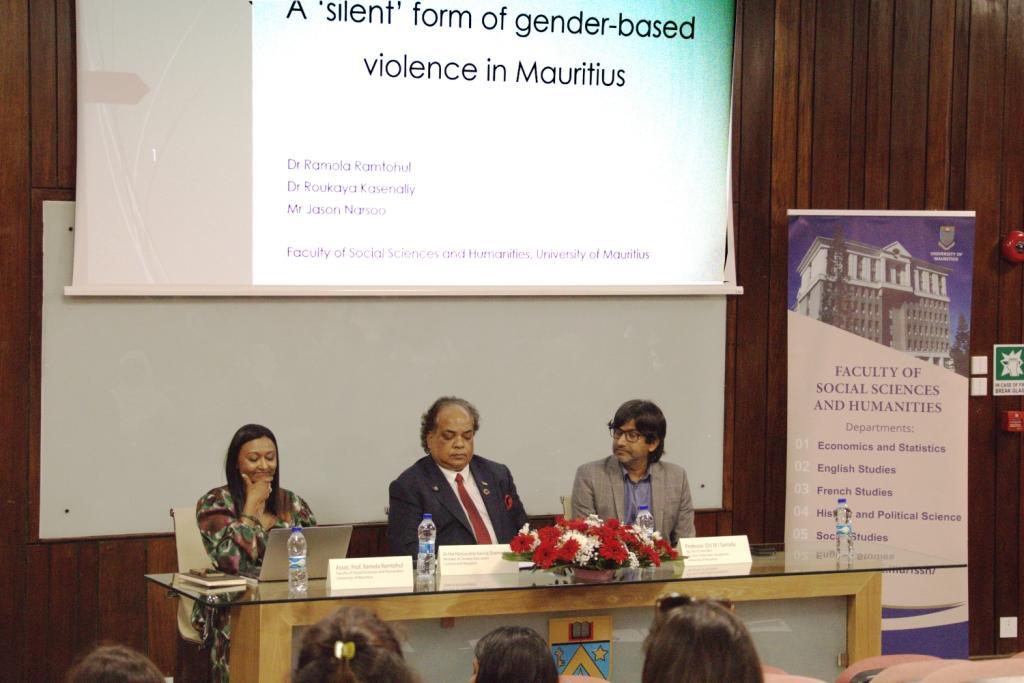
Africa-Press – Mauritius. A National Dissemination Workshop was held yesterday at the University of Mauritius (UoM) to present the findings of a collaborative research project conducted jointly with the University of Oslo and the University of Pretoria. The Mauritius component of the study, funded by the UoM, was undertaken by the Faculty of Social Sciences and Humanities. The project examined the issue of street harassment as experienced by young people in Mauritius, building on limited local research and providing updated evidence to support academic, policy and institutional engagement.
The Minister of Tertiary Education, Science and Research, Dr Kaviraj Sharma Sukon; the Acting Vice-Chancellor and Pro Vice-Chancellor (Academia), Professor Mohammad Issack Santally; Associate Professor Ramola Ramtohul and representatives from relevant institutions and organisations were present for the occasion.
The research aimed to document the causes, prevalence, and effects of street harassment among the Mauritian youth population through an intersectional approach. Specific attention was given to patterns of behaviour observed in public spaces, the influence of gender norms and the broader social factors associated with this form of gendered interaction. The study also examined the impacts of harassment on individuals and the coping strategies adopted in response.
The programme also featured a round-table discussion involving national experts and civil society representatives, as well as a question-and-answer segment. The event provided an opportunity for participants to further engage with the findings and discuss their implications for future policy, research and practice.
In his address Minister Sukon highlighted the need for applied research that produces tangible benefits for society. He pointed out that research on street harassment should not remain confined to academic spaces or publications adding that the dissemination of findings to communities, schools and relevant institutions must be prioritised. International studies, including work from Cornell University and the University of Michigan, were cited to demonstrate the economic, emotional, and psychological impacts of street harassment, particularly on young people. These effects influence mobility, academic engagement, wellbeing and confidence, underscoring the importance of translating evidence into practical interventions, said Mr Sukon. He encouraged discussions on how research findings can be transformed into concrete actions that support those affected.
The Minister further highlighted the role of universities in driving social change through education, awareness and collaboration with national bodies and civil society organisations. He shared personal reflections to illustrate how societal attitudes have, over time, normalised harassment, reinforcing the need to teach young people early that such behaviour is wrong and must be challenged.
He also expressed interest in expanding similar workshops to secondary schools and training centres so that students can learn how to identify harassment, report it and protect themselves. According to Minister Sukon efforts to address gender-based violence should continue throughout the year and not be limited to short-term campaigns such as the 16 Days of Activism.