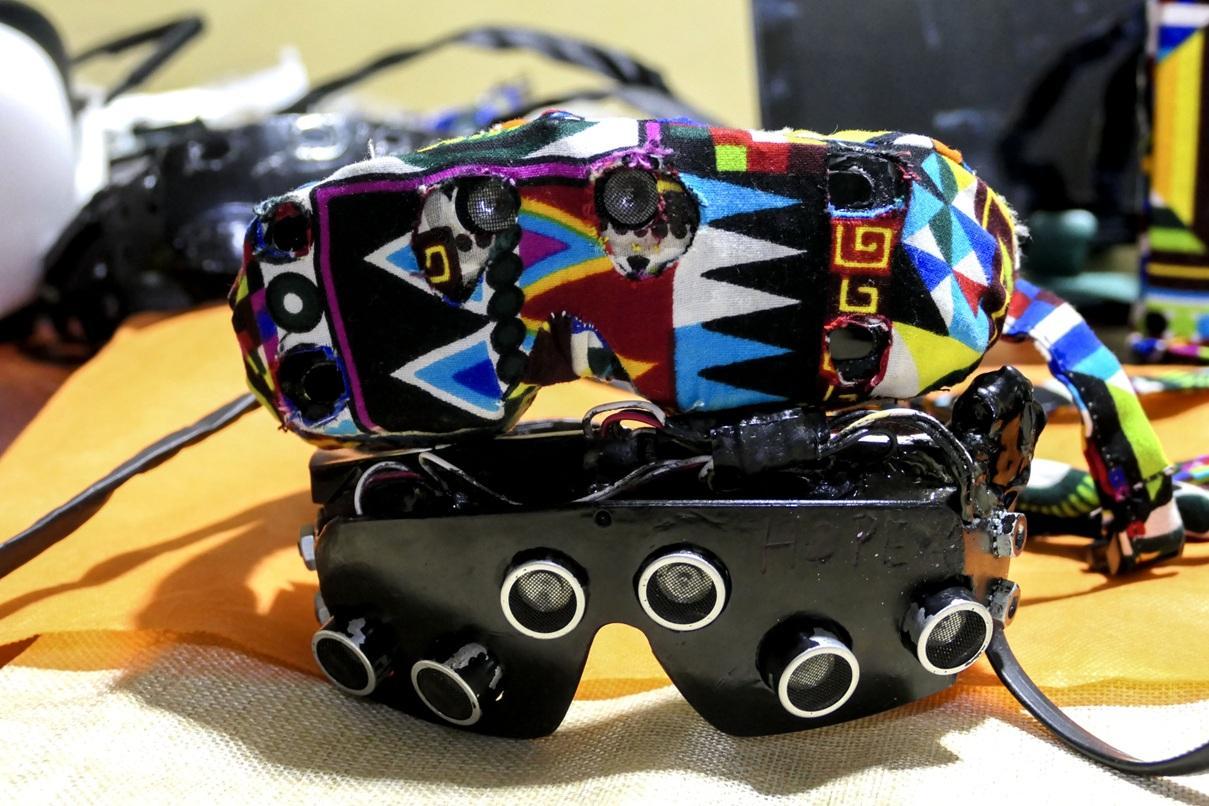
Africa-Press – Mozambique. João Rego has been working since 2022 on creating the first glasses capable of helping restore autonomy to visually impaired people, driven by the desire and ambition to develop more assistive technologies adapted to the urban reality in Mozambique.
Sitting at his workbench on the outskirts of Maputo, among open circuits and the tangle of cables powering his creations, 24-year-old João Rego told Lusa that the idea to develop glasses for visually impaired people arose in 2022, inspired by a report highlighting the daily challenges faced by those who cannot see.
His prototype includes localisation technology and vibration alerts that interact with the user, signalling possible obstacles along their path.
“I saw a report about a blind woman walking in Maputo who stepped into a pothole. That day I saw the report and felt moved by the situation. As I am in the field of robotics, I was already designing a robot for another project, and I thought, why not help?” explains the creator, an electronics engineering graduate.
For João Rego, engineering is more than a profession; it is a tool for empowerment. Without luxurious laboratories, he finds the quiet needed to create in the backyard of his home in the Bunhiça neighbourhood, about 20 kilometres from central Maputo, blending technical rigour with the desire to change lives and break down barriers isolating the roughly 700,000 citizens facing severe visual limitations in Mozambique.
The glasses, tested by dozens of volunteers and developed through several versions over the past years, are today carefully wrapped in a capulana, a traditional fabric with vibrant colours and patterns, which protects a technological system designed to restore autonomy and revolutionise daily life for visually impaired people in Mozambique.
“During this process, several versions were developed. Specifically, there were three well-refined versions, and in the meantime I used local resources,” he said, emphasising that not all local technological resources are accessible, requiring the use of foreign components as well.
According to Rego, the prototype is integrated with multiple technologies, including a localisation system, real-time battery monitoring, and vibrations that interact with the user to alert them to potential obstacles.
“Basically, the glasses work like this: the user puts them on like any normal glasses. They have sensors, and the patented version has 10 sensors, each covering a different point within a 120-degree angle. Within that angle, they can detect objects up to eight metres away, optimised for four metres,” he explains.
Among the benefits of the invention, Rego highlights that “the glasses help people move more naturally, with improved awareness and more detail about their environment.”
“This year, the main goal is to launch the final version, which in its pilot phase will help people become accustomed to using the glasses in daily life,” he adds.
This innovation is expected to assist with employment opportunities by providing autonomy, and also with education, explains the electronics engineer.
Still in development, João Rego hopes to open the door to national technology development, since producing knowledge locally makes it easier to reproduce solutions in times of crisis, contributing to Mozambique’s technological and scientific independence.
Despite already receiving national and international recognition, his greatest dream is for the device to be used across the country at the lowest possible cost.
“For Mozambique in particular, [the dream] is to have them used in different provinces by different visually impaired people, transforming their lives,” he says.
“The glasses have the capacity to transform lives,” he emphasises.