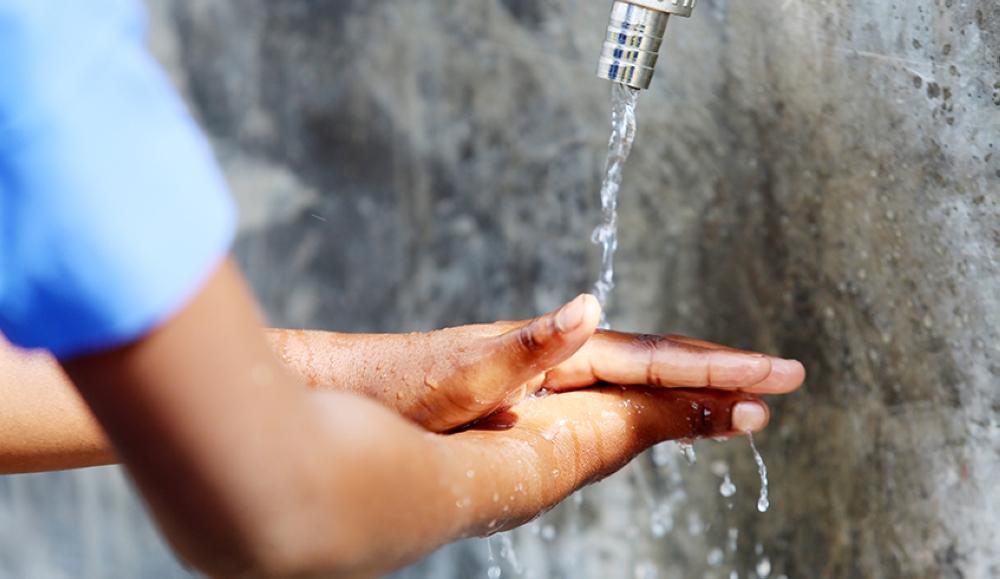
Africa-Press – Rwanda. Senators have launched a nationwide tour to look into the root causes of water scarcity and identify solutions.
The tour, which began on December 2 in Burera, Karongi and Kirehe districts, will cover multiple regions before concluding in Kigali on December 19.
It follows a series of reports, most notably from the Auditor General, that highlighted supply gaps, aging infrastructure, and increasing pressure on water systems.
Senator Fulgence Nsengiyumva said they are witnessing first-hand challenges that have left many households receiving limited or inconsistent water.
“We are seeing different challenges in Northern Province, including insufficient water from the Mutobo plant and other sources,” he told The New Times. “Many pipelines are outdated and often fail before water reaches households.”
He added that much of the water infrastructure is decades old and no longer aligned with current demand.
“Some networks were built to serve about 20,000 people, but populations have grown significantly whereby these pipelines can no longer meet today’s needs,” he said.
The committee plans to compile findings from district visits, and then submit recommendations to the government.
“We selected districts based on recent research and existing reports. We are visiting those with the highest and lowest access levels and our advocacy will be grounded in both data and what we see on the ground,” Nsengiyumva added.
The tour comes just days after the Water and Sanitation Corporation (WASAC) presented an ambitious five-year plan to nearly double the country’s daily water production.
Recently appearing before the senate, WASAC chief executive Asaph Kabaasha said Rwanda aims to raise national production from the current 343,736 cubic metres to 688,686 cubic metres per day by 2029.
“The plan is to significantly expand treatment capacity through the construction of 25 new water treatment plants with a combined daily capacity of over 359,000 cubic metres,” Kabaasha said.
He added that two plants, Ngororero and Sake, are already operational, producing a combined 14,084 m3 per day and three more facilities namely Kivu Belt I, Muhazi I and Volcano Belt Phase I with a total capacity of 68,000 m3 per day are expected to be completed in 2025-2026.
An additional five plants, including Karenge, Mwange, Kagaga I, Ngoma River and Muhazi II, will add 96,000 m3 per day once completed between 2026 and 2027.
“As construction progresses through 2027-2029, attention will shift to expanding transmission and distribution,” Kabaasha said. “Our pipeline network will grow from 35,001 kilometres to 39,639 kilometres, including 4,638 kilometres of new lines and 1,785 kilometres of rehabilitated sections.”
While acknowledging WASAC’s progress, senators urged the utility to ensure that the expansion remains affordable and sustainable.
Senator Laétitia Nyinawamwiza stressed that water prices must remain accessible.
“Water is a basic need. Expanding supply should go hand-in-hand with mechanisms that keep costs stable,” she said.
For More News And Analysis About Rwanda Follow Africa-Press