Africa-Press – Seychelles. “EU-Seychelles fisheries agreements have helped establish strong economic ties”
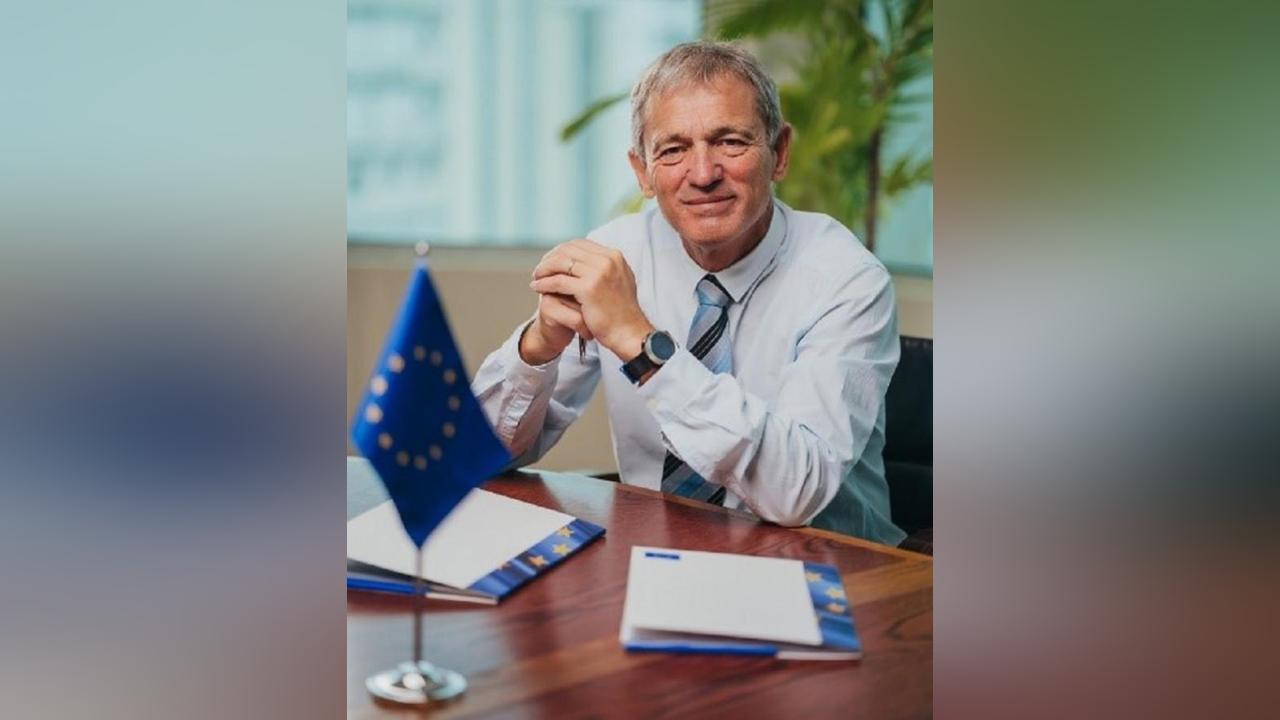
After a stint in the private sector, Vincent Degert joined the European Commission in 1987 and first worked in the field of regional policy. From 2000, he worked in favor of the enlargement of the European Union, successively becoming Assistant to the Director General for Enlargement and Head of Unit for the Coordination of Financial Instruments.
He then served as Ambassador and Head of Delegation in Croatia (2005-2009), then in Serbia (2009-2013), before heading the Russia Division within the European External Action Service at the height of of the Ukrainian crisis. From 2015 to 2019, he was Ambassador and Head of Delegation of the European Union (EU) to the Republic of Haiti. Since the end of 2019, he has been Ambassador of the European Union to the Republic of Mauritius and the Republic of Seychelles.
A French national, Vincent Degert is a graduate in political science, European affairs (Institut d’Etudes Politiques and Institut des Hautes Etudes Européennes de Strasbourg) and law from the University of Strasbourg.
During his official visit to Seychelles, newspaper did an exclusive interview with the Ambassador as he ends his contract in Seychelles this year.
How was your experience working with the Seychelles?
Ambassador Degert: A very good experience, on the one hand by the quality of the relations with my interlocutors, the President (Wavel Ramkalawan), the Minister of Foreign Affairs and Tourism (Sylvestre Radegonde), the Designated Minister and Minister of Fisheries and the Blue Economy (Jean-François Ferrari), the Minister of the Interior (Errol Fonseka), as well as several other members of the Council of Ministers and other partners. On the other hand, by the kindness of the Seychellois people and the incredible beauty of the land and underwater landscapes. Only one regret: not having been able to travel to the Seychelles more often due to the Covid-19 pandemic. I also feel privileged to have witnessed the democratic transition from one government to another in very good conditions; the first time I met the current President, Mr. Wavel Ramkalawan, he was the leader of the opposition.
What are the most relevant projects that have been carried out under your mandate?
Ambassador Degert: Despite the challenges that have marked my mandate, I am thinking first of all of the coronavirus pandemic and then of the consequences of the aggression of Ukraine by Russia, these 4 years have allowed us, in my opinion, to achieve a number of key results. In October 2021, the European Union removed Seychelles from its official list of non-cooperative tax jurisdictions in recognition of the authorities’ commitment to good tax governance. Thanks to our strong relationships, we were also able to obtain a support package of 2 million euros for the period 2021-2027, which would not normally have been possible given that Seychelles has high-income country status. . This program focuses on two priorities, namely the environment and the fight against climate change on the one hand, and good democratic and financial governance on the other. We continued our cooperation in the field of sustainable fishing with the successful negotiation of a new fishing agreement, the inauguration of several facilities for artisanal fishermen as well as the organization of the first BlueInvest event outside of Europe, BlueInvest Africa which Seychelles hosted in September 2022.
We have also strengthened our trade partnership. The EU and Seychelles, along with four other East African countries, have launched negotiations for a renewed trade agreement, the Economic Partnership Agreement (EPA). The implementation of the current EPA is accompanied by very significant support (10 million euros per country) to improve the ease of doing business through digital transformation and to diversify the economy (especially in the aquaculture) ‒ a goal that is all the more important when considering the disruptions to the supply chain during the Covid-19 pandemic.
Finally, we have made great progress in our cooperation on maritime security, an area in which the EU and the Republic of Seychelles clearly have a common interest. We have agreed to tackle the problem of drug and arms trafficking in this region by putting in place a legal solution. This means that criminals apprehended at sea by EUNAVFOR’s Operation Atalanta can be transferred to the Attorney General for prosecution in Seychelles courts. Indeed, we managed to finalize an exchange of letters following fruitful discussions with the government which would extend the ‘legal finish’ ‒ which covers piracy ‒ to drug and arms trafficking as well, with the support of the Member States of the EU participating in Operation ATALANTA. Seychelles acts as a decisive player in promoting maritime security in this region. We hope that the leading role played by the Seychelles will help bring other countries in the region to strengthen the regional maritime security architecture to deal with the scourge of drug trafficking which negatively impacts the socio-economic fabric of many countries in this region.
You experienced the political transition in the Seychelles, describe this experience to us?
Ambassador Degert: Such a transition, which took place calmly and respectfully on both sides, is quite remarkable. The Seychelles are also considered in Africa as a model of stability, democratic governance and political transition. In other countries, such a transition would not have been possible without clashes and violence. Respect for democracy is a fundamental value for the European Union; it is a strong value that we share with the Republic of Seychelles.
In terms of project funding, some Seychellois have complained about the challenges encountered in accessing it, has this really been the case?
Ambassador Degert: The procedures for accessing European Union grants, following calls for proposals, are both transparent and open but also strict and regulated, because it is public money that comes from European taxpayers. As authorizing officer, I have an obligation to report on the proper management and use of funds and their impact. These procedures are clearly established in the guidelines of any call for proposals. One of the elements of our calls for proposals is the need to have a certain percentage of co-financing provided by the organization itself to encourage ownership of the action by the project leader. Last October, during my last mission to the Seychelles, in the presence of representatives of civil society and the media, I launched a call for proposals in the areas of climate action, good governance, gender equality men and women and the empowerment of women and girls. My colleague, who is a team leader in the section in charge of operations, made a detailed presentation of the modalities required to submit a proposal. Organizations wishing to submit a proposal also had the opportunity to ask questions in case of doubt. The proposals received by the submission deadline are then evaluated by an independent committee on the basis of criteria already defined and published in the call for proposals – therefore known to all participants. The whole process is governed by the Financial Regulations of the European Union to ensure transparency and fair treatment for all participants. When an organisation’s project is selected and a contract is drawn up with the EU, the implementation of the action begins, which must comply with the contractual and financial procedures of the European Union. My team provides the necessary support to our partners, both by organizing information meetings during the call for proposals period, and during the implementation of the projects that have been selected.
The Seychelles are working in collaboration with the EU and there have been dissatisfactions over the fisheries agreements, what is your view on this subject?
Ambassador Degert: I think it’s normal for an agreement of this magnitude to generate reactions, whether positive or sometimes negative; this is normal and I would even say that it is healthy and that it is proof that the information around the fishing agreement is transparent. I remind you that the agreement is available to any citizen who wishes to consult it on the European Commission website and that the Seychelles government has made it available to the FisheriesTransparency Initiative (FiTI). The current agreement that we signed in 2020, the result of discussions with the Seychelles authorities, contains provisions and technical annexes that serve common objectives, including sustainable fishing, preservation of tuna stocks, control measures and oversight and ultimately our mutual economic interests. The agreement includes a number of innovations: the strengthening of measures to control the activities of the EU fleet through joint EU-Seychelles inspections and the electronic declaration system; clear provisions on the use and management of Fish Aggregating Devices (FAD) and support vessels; closer cooperation and dialogue between the parties also on regional issues; the role of at-sea observers which also remains a key surveillance tool; the EU shipowner’s fishing authorizations which now include, for the first time, a specific contribution to a dedicated fund managed by the Seychelles to improve the environmental management of the marine ecosystem.
Last but not least, the protocol clearly aims to contribute to the social and economic development of Seychelles by also providing financial support for the construction of infrastructure necessary for local fishing activities. In July, I had the honor of inaugurating in Praslin, with the President (Wavel Ramkalawan) and the Designated Minister, Minister of Fisheries and the Blue Economy (Jean-François Ferrari) a new infrastructure for artisanal fishermen . I would like to add that our fisheries agreement takes into account the creation of marine spatial planning zones in Seychelles waters – with no-take zones – as well as future Seychelles legislation and regulations. This is something that I think is important to remember. If we take stock, over the past decades, EU-Seychelles fisheries agreements have helped to establish strong economic ties in the fisheries sector. Fishing in the Seychelles has proven to be one of the most resilient sectors during the coronavirus pandemic, especially thanks to the partnership with the EU. In 2021, nearly 60% of Seychelles canned tuna exports were destined for the European market.
Have you had the opportunity to visit the Seychelles and how do you find our islands?
Ambassador Degert: I had the chance to visit Mahé, Praslin and La Digue. Unfortunately, I did not have time to visit other islands. But the three islands I saw amazed me with the beauty of the landscape and especially the beaches, the cleanliness of the environment and the friendliness of the inhabitants. I particularly enjoyed my scuba dives and I will keep excellent memories of the delicious bourgeois dishes that I had the pleasure of tasting. In addition, I had the opportunity to participate in two awareness-raising actions on the protection of the oceans for the youngest, the first time in La Digue and the second time in Mahé. It is important to continue to educate young people about environmental protection; I am always amazed by their enthusiasm and their ideas. What I take with me from my experience in the Seychelles: a wonderful archipelago of 115 islands with an always smiling and warm population that has a small but efficient administration.
Source: Seychelles NATION
For More News And Analysis About Seychelles Follow Africa-Press