Africa-Press – Uganda. Prime Minister Robinah Nabbanja has outlined what she described as significant economic and social gains under the ruling National Resistance Movement (NRM), revealing that 87% of the party’s 2021–2026 manifesto commitments have been implemented or are on course.
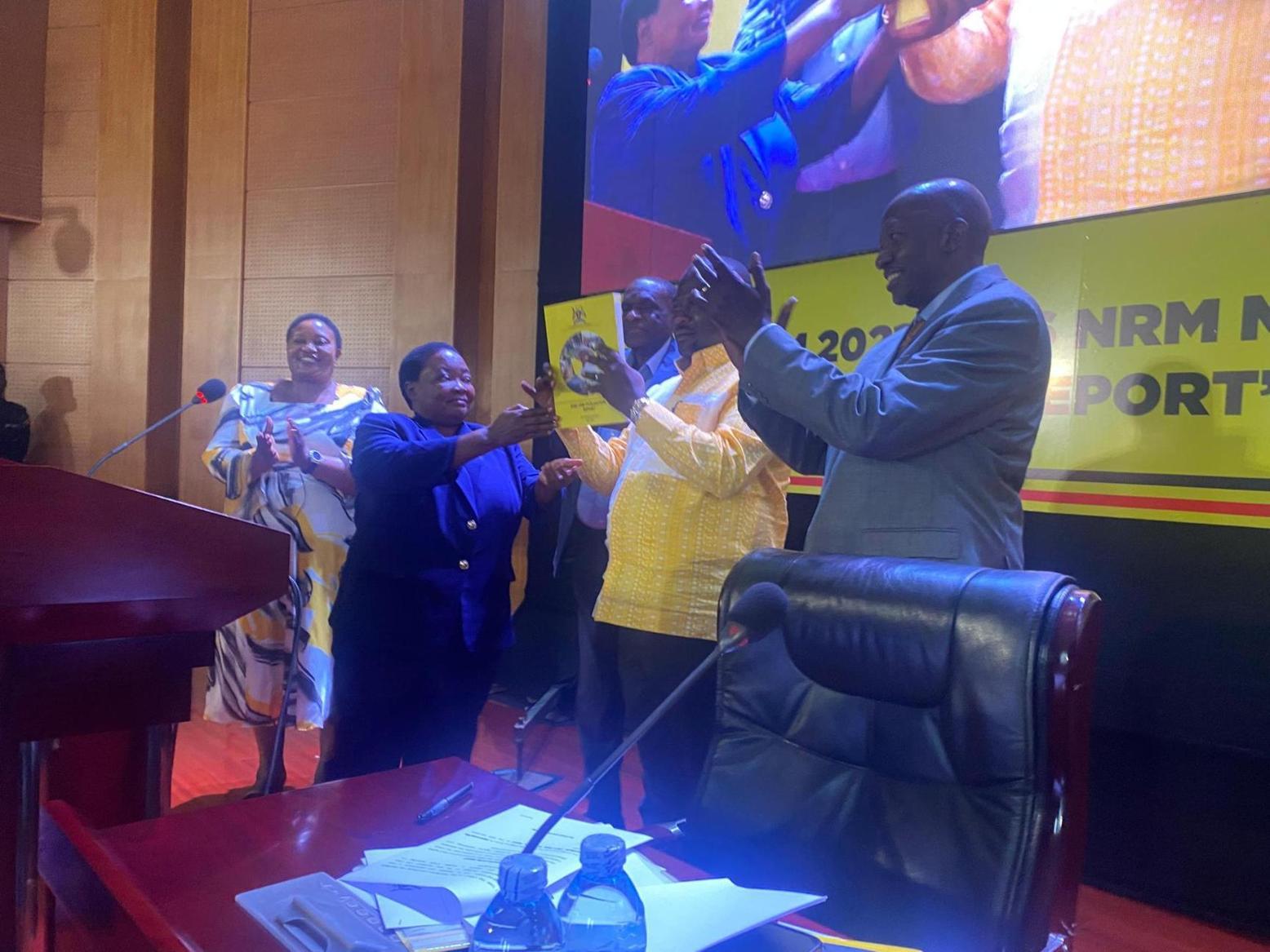
Nabbanja made the remarks while handing over the manifesto implementation report to the NRM Secretariat led by Secretary General Richard Todwong, ahead of the end of the current political term on May 12, when President Museveni is expected to be sworn in for a new term.
According to the report, 54% of the commitments have been fully achieved, while 33% are ongoing and expected to be completed by June 2026.
The remaining 13% are yet to be implemented.
Nabbanja said Uganda’s economy is on track for accelerated growth, with projections indicating expansion to $68.4 billion (Shs251.4 trillion) by June 2026, partly driven by the anticipated start of commercial oil production.
She noted that Uganda has already crossed into lower middle-income status, with Gross National Income per capita rising to $1,278 as of June 2025—above the $1,136 benchmark.
“This milestone means Uganda has met the criteria for graduation from the category of Least Developed Countries,” Nabbanja said.
On poverty, the Prime Minister reported a decline from 21.4% in 2016 to 16.1% in 2025. However, she acknowledged that the labour market remains heavily informal.
Employment in the informal sector increased from 9 million in the 2019/2020 financial year to 10.5 million in 2024/2025, accounting for more than 85% of the workforce and contributing 51% of GDP. Public sector employment also rose modestly from 300,296 to 366,574.
Nabbanja attributed industrial growth to increased investment in industrial parks, noting that the number of factories has expanded to about 50,000 from 7,559 in 2020.
Uganda’s export earnings reached $16.25 billion in 2025, driven by commodities such as gold, coffee, cocoa, steel products, fish, iron, and sugar. She added that the country is diversifying into manufactured goods, ICT products, refined gold, and cocoa-based products.
“In the last 15 years, Uganda has added 31 new products to its export basket,” she said.
On the external sector, Uganda recorded a balance of payments surplus of $2.37 billion in the year ending October 2025—the highest in 15 years—supported by export growth and increased foreign direct investment.
Exports to the East African Community rose to $3.16 billion in the 12 months to January 2025, reflecting stronger regional trade integration.
The report also highlighted infrastructure gains, including expansion of paved roads from about 1,000 kilometres in 1986 to 6,306 kilometres by June 2024, with an additional 1,135 kilometres under construction.
Electricity access improved to 60% of the population in 2024, up from 51% in 2019/2020, supported by projects such as Karuma Hydroelectric Power Station and Isimba Hydroelectric Power Station.
Government wealth creation programmes, particularly the Parish Development Model, were credited for reducing the proportion of households in subsistence farming from 68% in 2014 to 30% in 2025.
Nabbanja said Shs3.3 trillion has been disbursed under the programme, benefiting more than 2.1 million people.
On oil development, progress on the East African Crude Oil Pipeline stands at 75%, with ongoing engineering and procurement works expected to support Uganda’s oil export ambitions.
The Prime Minister also pointed to improvements in social indicators, noting that life expectancy has risen to 68 years from 43 years in 1986. Malaria incidence has declined by 24% over the past five years, with deaths dropping by 42%.
Access to safe water has expanded to 81% of villages nationwide, reflecting broader gains in public service delivery.
The government says the progress reflects sustained policy implementation, although challenges remain in areas such as job formalisation and full delivery of outstanding commitments.
For More News And Analysis About Uganda Follow Africa-Press