Africa-Press – Uganda. Grassroots football in Lango is getting a renewed boost as Rosemary Alwoch Ogwal continues the legacy of her late mother, Cecilia Atim Ogwal, through community sports empowerment.
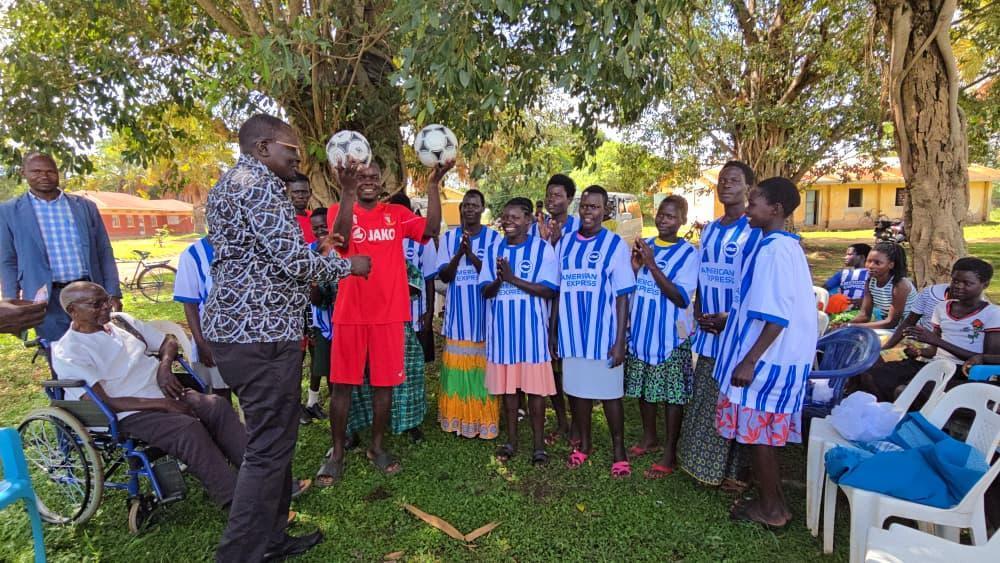
Under the Cecilia Ogwal Foundation, Dr Alwoch has rolled out a sports support initiative targeting youth in Dokolo District and Kole District, providing football kits and reviving grassroots tournaments.
“This initiative is actually not mine. It was started by my late mother, and I am just continuing her legacy,” Dr Alwoch said. “She believed in building the capacity of the youth through sports—whether football, netball, or any other discipline.”
The programme traces its roots to the famed Owiny Manasi Cup, a tournament inspired by Uganda’s historic football triumph over the 1966 World Cup winners—a moment that cemented belief in local talent.
Dr Alwoch says the foundation is now expanding that vision into a broader socio-economic model, supporting young athletes not only with kits but also with medical care for sports injuries and pathways to financial stability.
“We see sport as a way out of poverty,” she explained. “Young people can earn scholarships, study, and even build careers that support their families.”
A key focus of the initiative is inclusivity, particularly for girls and young mothers who are often left out of sports programmes.
The foundation is registering female teams to participate in national competitions under the Federation of Uganda Football Associations, while also extending support to their children.
“When supporting female teams, we also think about their children. It’s about empowering the whole family,” she added.
Samuel Opip Acuti welcomed the initiative, describing it as timely in addressing pressing social challenges in the region.
“In Kole, teenage pregnancy rates are as high as 28 percent in some areas, and school dropout rates can reach up to 80 percent,” Acuti said. “This intervention, especially for the girl child, is very critical.”
He noted that sports groups are evolving into platforms for both social support and economic activity, with some teams engaging in piggery, poultry, and crop farming.
“These are not just teams—they are community groups supporting each other economically and socially,” he said.
Acuti added that similar initiatives targeting boys in the past have already yielded results, with some beneficiaries securing bursaries for secondary education through sports.
The new focus, he said, is to ensure girls from rural areas also access such opportunities.
“We want Kole to become the first rural constituency to field competitive female teams at national and regional levels,” he said. “This is just the beginning.”
For players like Dorcus Nam, team captain of Owanadilo Women FC in Alito Sub-county, the support has renewed hope for nurturing sporting talent in the community.
“We have been playing without proper kits for a long time, and it has not been easy to compete. This support motivates us to work harder and believe that we can also reach higher levels in football. For many of us, this is more than a game—it is an opportunity to change our lives and support our families,” she said.
The foundation maintains that its work is strictly non-political, aimed at building youth potential across Lango and beyond.
Cecilia Atim Ogwal was one of Uganda’s most respected and long-serving political figures, widely admired for her courage, independence, and commitment to public service.
Born in the Lango sub-region, she rose to national prominence in the 1980s and became a key figure during Uganda’s political transition.
She served in various leadership roles, including as a Member of Parliament for decades, most recently representing Dokolo District.
Over the years, she built a reputation as a fearless advocate who often spoke her mind on governance, accountability, and human rights—regardless of political pressure.
Ogwal also served as Leader of the Opposition in Parliament in the early 2000s, where she was known for holding government to account while maintaining respect across the political divide.
Her political journey saw her work across party lines, reflecting her strong belief in national unity and inclusive leadership.
Beyond politics, she was deeply rooted in community development, especially in Lango.
She championed initiatives aimed at empowering youth, supporting women, and improving access to education and health services.
One of her notable contributions was promoting sports as a tool for youth engagement—an idea that has now evolved into initiatives like the Owiny Manasi Cup and the ongoing work of the Cecilia Ogwal Foundation.
She was also a Pan-Africanist at heart, believing in collaboration beyond borders and the potential of African communities to thrive through unity and shared purpose.
Cecilia Atim Ogwal passed away in January 2024, leaving behind a strong legacy of principled leadership, grassroots connection, and advocacy for the ordinary Ugandan.
Today, many of the programmes being implemented in Lango—especially those targeting youth empowerment—are seen as a continuation of her vision and life’s work.
For More News And Analysis About Uganda Follow Africa-Press