Africa-Press – Uganda. Mr Philip Amule’s endurance and resolve is commendable.
Amid the uncertainties further complicated by Covid-19, and the restrictions instituted by government to contain the spread of the pandemic, Mr Amule has persevered.
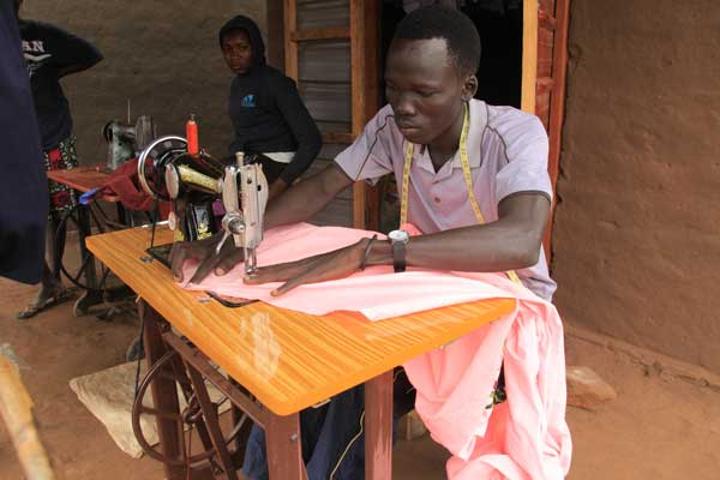
The South Sudanese is among the 1.4 million refugees in Uganda. Mr Amule, who lives in Rhino Camp in Arua District, is also one of the refugees whose businesses were stifled due to the restrictions.
Coupled with drastic drop in demand for goods and services, most micro and small businesses in refugee camps and host communities are either struggling or on the verge of closure.
Hard times“Life became unbearable after I depleted my savings just within weeks of lockdown of the economy and resultant introduction of restrictive measures announced by the government early last year,” Mr Amule told Daily Monitor recently.
“I couldn’t operate my barber shop because it was one of those businesses that were closed. By the time the restriction was lifted, I was out of business after spending every penny I had saved to feed my family,” he added.Mr Amule’s situation is just one out of the thousands being experienced by refugees, majority of whom are women and children. A survey conducted between September and October last year to assess the impact of Covid-19 on micro and small business, labour markets, jobs and livelihood of refugees and host communities in West Nile and western regions showed a reduced purchasing power and disruption in supply chains.
The survey done by International Labour Organisation (ILO) and Federation of Small and Medium Enterprises – Uganda (FSME) also revealed that seven out of 10 micro and small businesses operated by refuges are facing difficulties in maintaining enough cash flow.
The findings also indicated that lockdown affected businesses at both operational and revenue levels.
For example, transportation limitations, unstable prices of supplies and food items as well as the cost of implementing the Ministry of Health SoPs were beyond the reach of most micro and small businesses. As a result, ILO has partnered with FSME to launch a cash grant programme of $50,000 (Shs176.7 million) that will benefit at least 100 micro enterprises in refugee and host communities.
“The cash grant will be complimented with business skills and training packages. This will contribute to resuscitation and eventual recovery of businesses hit by the effects of the pandemic,” Ms Grace Rwomushana, the national programme coordinator of Enterprise Development and ILO’s Partnership for Improving Prospects for Forcibly Displaced Persons and Host communities (PROSPECTS) programme, said.
Relatedly, a Sauti za Wananchi survey conducted by Tuwaweza, an NGO, between May and June last year indicated that Covid-19 had dealt a heavy blow to livelihoods.
For instance, agriculture was heavily affected yet half of households (49 per cent) generate some income from cultivating crops, fruit and/or vegetables, and 38 per cent of them use this as the main source of income.The impact was further witnessed among Ugandans in the formal sector. The survey said three out of 10 households (30 per cent) earn some income from casual or occasional work, including two out of 10 (23 per cent) where this is the main source of income.
Under the grant, Shs700, 000 will be made available to about 100 owners of micro and small business in the refugee camps in West Nile. This partnership (PROSPECTS), funded by the government of the Netherlands, brings together four other global agencies, including World Bank, IFC, Unicef and UNHCR.
Together with ILO, they are charged with devising approaches that create jobs and skills suitable for refugees, let alone developing interventions to improve livelihood of host communities and refugees.Mr Amule is one of the beneficiaries of the grant. He has already taken on 15 youth to equip them with barber skills.
Ms Rita Oba, another beneficiary, said she was able to stock more grain for her business, while Ms Alice Okwero has been able to resume her catering business.
Mr John Walugembe, the FSME executive director, said more than 3,000 enterprises in refugee camps were affected by the Covid-19.The grant will be extended to micro and small business that employ less than five people. Enterprises with annual turnover below Shs5 million will also be considered.
“This is only a starting point for small businesses. We are going to be more active in refugee camps starting with Rhino camp and Arua. Soon we will roll out to Madi-Okollo, Terego, and Nakivale settlement in Isingiro [District],” Mr Walugembe said.The office of the Prime Minister has been charged with the effective supervision of the grant. [email protected]