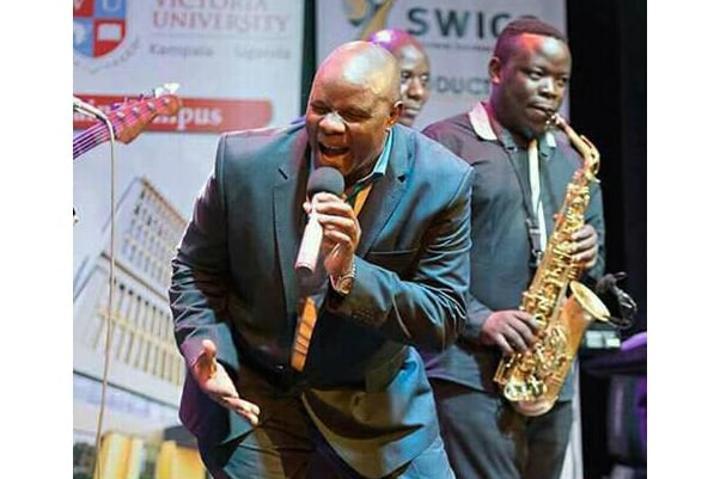
Africa-Press – Uganda. Sooka Omunoonye watudde, loosely translated, first look for him, are words that baritone Diplock Ssegawa spoke to himself when his music funder whom he had escorted to a banana plantation in Lwanume-Masaka took long to return.
“I had visited my music funder, Mr William Lugobe, and he asked me to escort him to his banana plantation,” he recalls, adding: “As I waited for him in his car, something came to my mind that I get out and look for him and suddenly I spoke to myself: Sooka omunoonye.”
Diplock says as he embarked on his quest, the words he used sounded like music as he kept mentioning them to himself.
He recalls writing sol-fa syllables of the song as Mr Lugobe drove him back to Kampala. By the time they reached Busega, he had a chorus for a song. A few days later, he wrote the verses, referring to the kindness and love of Mr Lugobe who had encouraged him to do music.
“He was patient and loving. My song was literally celebrating him,” he explains.
While the baritone intended the song to celebrate Mr Lugobe, little did he know that his words would birth a song that has for years proved to be an anthem at traditional weddings in Buganda otherwise known as kwanjulas.
Mr Lugobe was not the only well-wisher that gave Diplock a nudge when his music career was in its infancy. There was also Yakobo Ssekungu, the late Ssebaana Kizito, Francis Kitaka as well as Pastor John and Milly Kakembo’s family.
It was in 1985 that Sooka Omunoonye became part of Diplock’s catalogue. The song was first sung at a wedding on June 30, 1985 in a semi acoustic performance with a Kidayo choir pianist only identified as Kasozi. This was at the Public Libraries’ Board on Buganda Road.
By 1986, Diplock had established himself as a celebrated wedding performer. He was often over-booked.
While performing at Pope Paul memorial centre, one of his band member—Maria Nakyagaba, whose day job is now an architect—suggested that the song be performed or played when a couple changes outfits.
“More often, after changing the attire, the groom would hide and the bride attempts to look for him amidst music, dance and cheers,” Diplock told Sunday Monitor, adding, “ Nakyagaba suggested that we use the song at that particular segment, which later became a norm.”
Much as Diplock was performing the song, it—remarkably—had not yet been professionally recorded. Those who loved it had to wait for him to perform it at a wedding.
It wasn’t until 1987 that the song was recorded in a studio at Andrew Crawford Studios, State House Road in Nairobi.
The song was later re-recorded at Nice Recording Studios in London in 1992, Lucky Studios, Sweden in 1997 and lastly at Seven Sister Recording Studios, London in 2007.
When Sooka Omunonye was recorded, Ssegawa’s friend John Ssemondo—who was then working with State Wide Insurance—convinced the company’s marketing team that a musical advert would stand the company in good stead. There are no prizes for guessing who got the gig to execute the ad—Diplock.
In 1987, Diplock recorded Uganda’s longest radio advert at Andrew Crawford studios. The ad spanned nine minutes, with Diplock getting Shs2,000 for his troubles. He still records the advert at a fee after every 10 years.
Unplugging Diplock
Together with the Wrens band, Diplock got an opportunity to perform at international festivals, including the Euro Cross Festival in Leicester and Greenbelt Festival in Cheltenham, both in the UK.
While celebrating 150 years of YMCA at Framingham College in Ipswich, Diplock attended a reception hosted by Her Majesty the Queen at her Lambeth Palace, where he was introduced to her as the youth representative from Uganda.
He had musical tours in the UK, Sweden and performed at more festivals and other European countries.
Biography
Diplock Ssegawa Katumba, alias Uncle Diplock, is a son of the late Benjamin Katumba and Aidah Nantumbwe of Kababbi in Wakiso District.
Like their parents, Diplock’s nine siblings are teachers. They organised themselves under one outfit called Mirembe Family choir.
Diplock notes that he grew up in a loving Christian home, where their parents introduced them to music. He, however, says much as his siblings sing, they have professional jobs. A few of them are retired.
Diplock has tucked a few music albums under his belt. These include Tuzimbe eggwanga recorded in 1987, Friendship, among others.
A family man married to Norah Katumba, Diplock takes great pride in his oldest daughter, Flavia Nantayiro, who is speech impaired. Nantayiro has grown up to become a professional banker. Diplock says she loves his music even when she has never listened to it.
For More News And Analysis About Uganda Follow Africa-Press