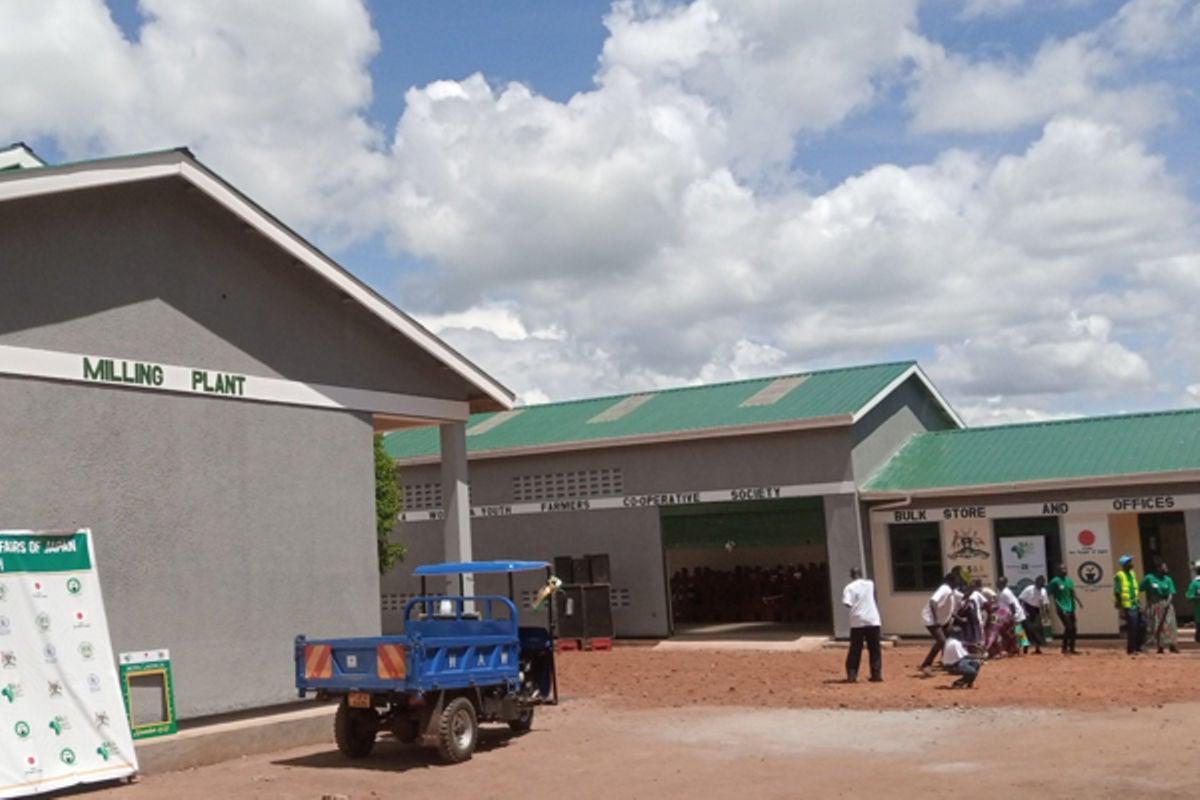
Africa-Press – Uganda. Persons with disabilities, women and youth on Wednesday sang and danced as they celebrated the launch of their newly constructed one-stop centre located in Bala sub-county in the northern district of Kole.
Local leaders say the centre, the first of its kind in the entire Lango sub-region, will enable farmers to “improve their ability to make money and to improve their nutrition and food security status”.
This centre, constructed at a cost of over Shs800 million, has essential facilities such as a grain bulking store, a maize mill, input shop space, an office, a water harvesting tank, a pit latrine, and a solar-powered irrigation system.
It was constructed this year by Sasakawa Africa Association (SAA) in collaboration with the Ministry of Foreign Affairs, Japan, under a project dubbed “Revitalization and Digitalization of Multipurpose Agricultural Cooperatives (OSCAs) in Uganda.”
The main objective of this one-year intervention is to reduce rural poverty and food insecurity by promoting market-oriented agriculture through the strengthening of multi-purpose agricultural cooperatives in Kole and Napak districts.
The facilities in Kole were commissioned by the Ambassador of Japan, His Excellency Fukazawa Hidemoto, and handed over to the Bala Women and Youth Farmers’ Cooperative Society. Currently, this cooperative has 3,177 members (1,872 women, 986 youth, 67 PWDs and 252 men) from the Kole, Oyam, Kwania, Apac and Lira districts.
“I’m so happy to see these newly constructed facilities. This project was signed this year in March with Sasakawa Africa Association and the total amount was around Shs2.5 billion…And the purpose is to improve the profitability of agriculture, farmers’ income generation through one-stop centre association,” said the ambassador.
Mr Ande Okiror, SAA’s project coordinator, said the maize mill at Bala one-stop centre has the capacity to process 1,300 kilograms per every hour. The Bala group already has more than 500 acres of maize which they have started harvesting.
“So, instead of selling maize, they are going to be selling finished products like posho (maize flour), a maize brand. The new enterprises of piggery and poultry are now coming on board,” he said, noting that the group is not starting from zero.
“This cooperative is already in production. So, Sasakawa has just come to put in a hand to make sure they reach their full potential.”
Ms Aida Abia, the chairperson of Bala Women and Youth Farmers’ Cooperative, when they started growing vegetables using the Sasakawa principle, “people were saying you are wasting your time and energy”.
“They have picked so much interest in what we are doing because they see there is money. So, when they come, we give them training. We are not giving the training to the community only, even students from various universities in Uganda also come to our group here to do their internship,” she said.
“The stressing challenge is that we don’t have a farm tractor that can enable us to boost production. At the moment, we are using ox-plough and hand hoes, but if the government could help us with a tractor it will at least help to increase our production,” she added.
Mr Daniel Etem, the centre manager, said instead of driving to Lira City, about 30 kilometres to buy inputs, farmers in Kole and neighbouring districts are now going to have inputs closer to them.
“Instead of going to Lira to process their maize, they are going to process their maize here and this machine also processes both maize and rice,” he said.
“We are also going to be able to expand rice production to increase their incomes,” Mr Etem added.
Mr Gilbert Kato of Export Trading Group (ETG) bragged that Bala women and youth are reaping big because of their support.
“By the time we closed the second season of 2022 – that was December – farmers were happy to harvest as far as 25, 29, 30 bags from one acre,” he said.
“We provide farmers with fertilizers, crop protection products and seeds and our vision is to see farmers improve productivity out of the unit given area they have.”
Mr Joseph Paschal Bbemba, SAA’s deputy country director, said as an organization, they are happy this time round that they are giving farmers an option to be able to make money throughout the year without having to depend on rain.
He urged farmers to utilize the opportunity to increase production.
“The facilities we have put [in Kole and Napak] are big. They require increased production. So, they need to adopt good agronomic practices, they need to work on the issue of post-harvest handling,” he said.
“Farmers need to work together to aggregate volumes that are worthy for an off-taker to come and buy or those that are needed for the milling facilities we have put in place.”
Mr Maclean Otim, Kole District agricultural officer, said: “We are all aware of the Sustainable Development Goals number one and two, which talk about “no poverty; zero hunger and good health and well-being. In the context of Kole and Uganda, agriculture still plays a very big role in achieving these targets.”
Ms Josephine Omara Olili, Kole Resident District Commissioner, thanked the Japanese government for the initiative.
“As the government of Uganda, we have given genuine partners a good enabling environment to support our people and by coming to Bala I’ve seen that Japan is with us,” she said.
Mr Godfrey Ojuka Acuti, senior agribusiness officer at the Ministry of Agriculture, Animal Industry and Fisheries, said Sasakawa’s is in line with Uganda’s agro-industrialization agenda under NDPIII.
The goal of this plan is “commercialization and competitiveness of agricultural production, processing with respect to job creation, increased household incomes and reduction in post-harvest losses, among others.”
For More News And Analysis About Uganda Follow Africa-Press