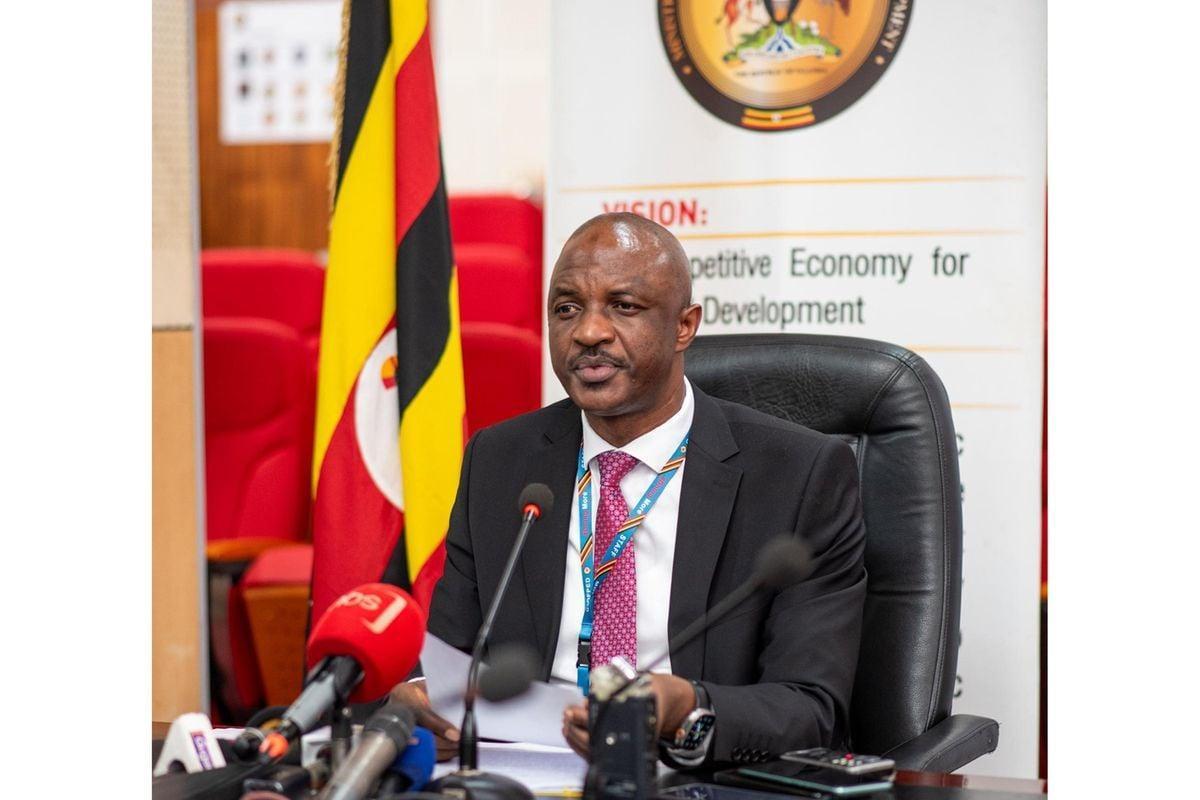
Africa-Press – Uganda. The Ministry of Finance, Planning and Economic Development Monday released Shs4.974 trillion for the third quarter for Ministries, Departments and Agencies (MDAs) to cater for wages, non-wage recurrent expenditure and development, which covers the period January to March 2024.
“I want to start by reminding the country of the government’s commitment to fiscal consolidation. This entails three key objectives: boosting revenue collection by closing the gaps in tax administration, widening the tax base and rationalizing tax exemptions/expenditures to ensure they meet the intended objectives,” the Permanent Secretary/Secretary to Treasury, Mr Ramathan Ggoobi said.
“Rationalising government expenditure particularly that which doesn’t contribute significantly to growth of the economy and export performance and controlling government borrowing by limiting it to critical needs the fiscal consolidation agenda guided the determination,” he added.
Mr Ggoobi said the fiscal consolidation agenda guided the determination and issuance of quarter three expenditure limits and the release therefore prioritized salary, pension and gratuity, security related expenditure, social sectors of health and education and critical capital expenditures. He said Shs1.912 trillion or 26.2 percent of the wage budget has been provided, based on payments made in the first half of the financial year.
“I wish to inform all stakeholders that this Ministry has received the Audit report on Wage payroll. Going forward this shall be our basis of providing funds for wages, as a first step in the government’s implementation of the OAG’s recommendations,” he said.
Mr Ggoobi said non-wage recurrent expenditure Shs550.859 billion has been released for operations of the security institutions which includes Shs403.082 billion for Ministry of Defence, Police Shs71.374 billion, Prisons Shs41.427 billion, Internal Security Organisation (ISO) and External Security Organisation (ESO) Shs34.975 billion.
He said Shs230 billion has been released for statutory votes; Parliament Shs150.962 billion, Electoral Commission Shs9.459 billion, Judiciary Shs44.88 billion among others.
Computed figures indicate Shs296.578 billion has been released for pension and gratuity for quarter three. This includes the requirement for pension and gratuity for Local Governments. Shs249.294 billion has been released for Local Government grants including a capitation grant of Shs136.5 billion to ensure timely opening of the first school term.
In regards to education, Shs117.567 billion has been provided to education Institutions including the Ministry of Education and Sports that has been allotted Shs28.076 billion to cater for instructional materials, students’ loan scheme and examination bodies. In this category, Public Universities, Uganda Management Institute (UMI) and Law Development Centre (LDC) together have been given Shs84.537 billion, and UBTEB Shs4.594 billion for supervising, conducting and management exams.
To ensure that there are no drugs in the government health institutions, Mr Ggoobi said Shs90.211 billion has been provided to National Medical Stores to meet the obligations for purchase of essential drugs and medicines, She57.955 billion to referral hospitals, cancer and heart institute.
Development expenditure
Shs336.3 billion has been released under the development expenditure, of which Shs 192 billion has been provided to kick start the process of ensuring renewal of National IDs project, and Shs144.3 billion for purchase of tablets that will be used in the National Population Census.
Also Shs20 billion has been provided to Kampala Capital City Authority (KCCA) for road rehabilitation and payment of compensation for land (RAP) for the ADB projects.
On how the revenue performance has been since this financial year began, Mr Mr Ggoobi said the cumulative revenue collections for the period July to December 2023 amounted to Shs13.301 trillion against a target of Shs14.169 trillion. This implies a revenue shortfall of Shs867.91 billion.
Mr Ggoobi said the shortfall was mainly on account of lower than expected collection on customs duties (on account of less imports and disruptions in supply of petroleum products) and VAT. “We shall step up efforts to cover the gap,” he said.
Speaking about general economy, Mr Ggoobi said the economy is recovering well from the external and internal shocks that started in FY 2019/2020, pointing out that the size of the economy has expanded to Shs184.89 trillion ($49.5 billion) by end of June 2023, growing at a rate of 5.2 percent.
He explained that the drivers of this expansion were: services growing at 6.2 percent (especially in trade tourism, education, ICT, and arts and entertainment), agriculture at 4.8 percent, (particularly fisheries activities at 8.6 percent, livestock at 8.8 percent, and food crops growing at 4.7 percent).
The Executive Director of Civil Society Budget Advocacy Group (CSBAG), Mr Julius Mukunda, said declining inflation and the general improvement in the economy provides confidence in the economy.
However, on the other hand, he said in the auditor general report for financial year 2021/2022 the domestic arrears was at Shs4.6 trillion and in the FY 2022/2023 at Shs7.55 trillion which he said would take the government a very long time to clear.
“The allocations for arrears of Shs217 billion is far below and it would take the government 35 years to clear,” he said.
The Executive Director of Advocates Coalition for Development and Environment (ACODE), Dr Arthur Bainomugisha, said while the economy has recovered and is growing, citizens are still crying over lack of money in their pockets.
Dr Bainomugisha said Uganda is still faced with the problem of high level of corruption and the rate at which Uganda’s public debt has grown over years has also been very high.
For More News And Analysis About Uganda Follow Africa-Press