Africa-Press – Uganda. Security forces have launched relentless and crashing operations against terror cells after the June 1 attempted assassination of Works and Transport minister, Gen Katumba Wamala and killing of his daughter Brenda Nantogo and driver, Pte Haruna Kayondo .
Some four gunmen riding on boda boda attacked the former army chief in Kisasi, a Kampala suburb, leaving him shot in both arms.
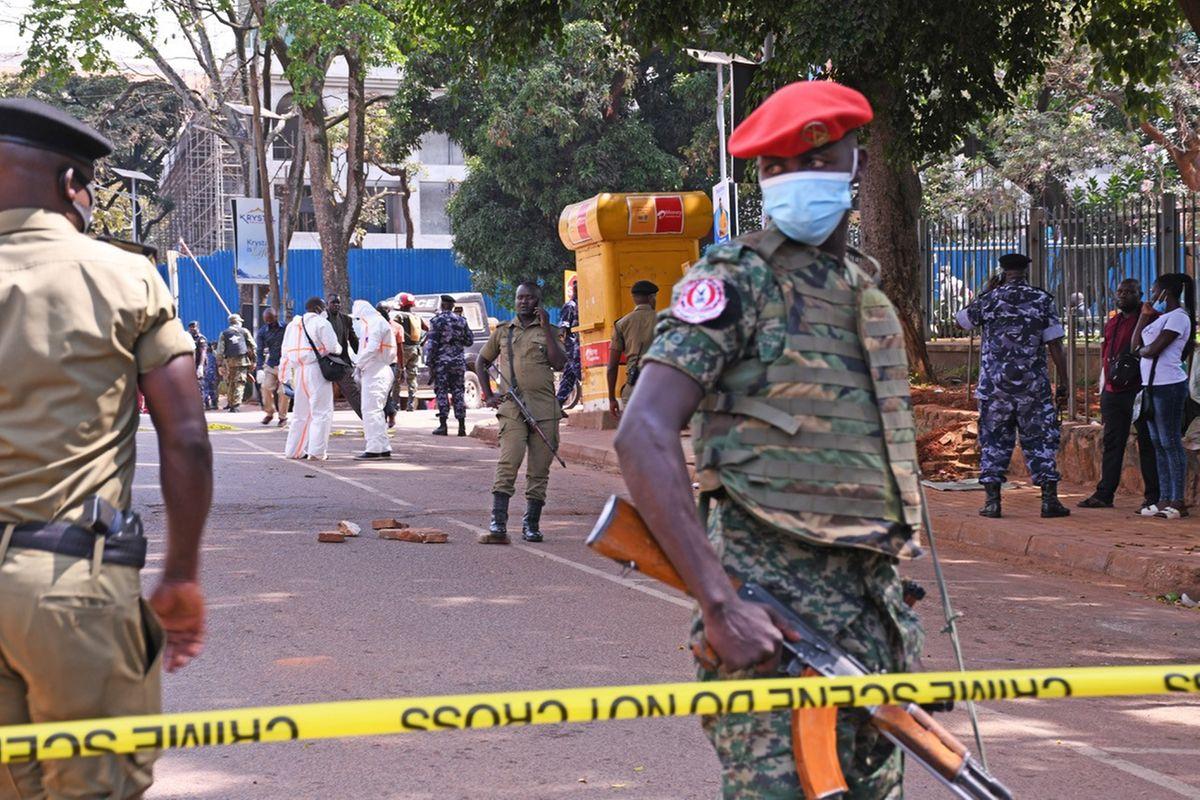
Wherever the crack raids have occurred, the security forces have deployed up to 30 agents, all heavily armed.
In cases where the suspects have been delivered back to reconstruct scenes or search their homes, they come handcuffed with legs chained.
On Tuesday, President Museveni said seven such suspects have been killed while resisting arrest.
He also said a total of 81 suspects have been arrested and three have been killed by the bombs they carried.
In the latest such operations on Thursday, Sheikh Mohammad Kilevu, his children say, was handcuffed inside his house and led out, but the official account by police says Kilevu resisted to be handcuffed and attempted to flee before he was shot dead on his compound or thereabout.
Early this month, one Adam Matovu, alias Malijaani, was also gunned down at Naguru in Kampala as he reportedly tried to flee as he was being transported by police to their Special Investigations Unit at Kireka on the outskirts of Kampala.
The deal-a-blow operations are seemingly becoming habitual after three bomb blasts, the latest being on Tuesday November 16 in Kampala. This was preceded by Komamboga bombing on October 24 and the Lungala Swift Safari bus blast on October 26.
One suspect Musa Mudasiri, aka Moze, was shot during what security personnel called an attempt to flee and this position is backed by some residents of Katooke B where he resided. But other witnesses claimed Mudasiri was shot as soon as he opened the door of his house.
A bomb was recovered and detonated at his home.
In July, Hussein Lubwama, alias Christopher Kinene, alias Master, a resident of Kabulengwa – Kyebando in Nansana Municipality, who had been arrested on the Nansana-Nabweru road for allegedly masterminding the Gen Katumba Wamala incident, reportedly put a stiff resistance and attempting to grab a gun from officers. He was shot dead.
On July 1, three more suspects in the Gen Katumba assassination attempt, were shot dead in Kanyongoga slum, Yoka Zone in Namuwongo, Makindye Division, in a an operation where two guns were recovered. On that day, in a police statement Sheikh Abudin Hubaida Taheel Bukenya, an ex-ADF combatant on amnesty, was identified as the man behind reactivating terror cells in Uganda.
Also killed this week in Ntoroko District and said to the 5th in command in the ADF structure killed on Wednesday included Yassin Atindya aka Dan Senabulya, Musa Byaruhanga Bahemuka, Joshua Mathias Turikimanya and Joseph Bagonza.
Reactions
But security and human rights analysts say the bloody thread running through the cases could be pointing to a new modus operandi of “finishing off the suspects” and avoiding courts which may not do as desired.
They warn that killing of suspects already arrested may leading to both killing of evidence and missing out on vital security leads.
Mawokota North MP and lawyer Yusuf Nsibambi says extrajudicial killings are unconstitutional as the Constitution guarantees right to life and can only be taken away after due process and in execution of a court sentence.
“Police have no right to shoot and kill suspects. The world, and in particular the country, is silent about this conduct because it targets minorities, entire families are arrested, including women and their children,” Nsibambi says.
Stephen Lwetutte, a human rights practitioner, says: “To seasoned observers, the latest summary execution on of handcuffed Sheikh Muhammad Abbas Kilevu, is not at all surprising. For the National Resistance Movement (NRM) regime, investigating human rights and governance concerns, such as torture, killings and corruption is an exception to the rule.”
But on Thursday, police spokesperson Fred Enanga and his army counterpart Brig Flavia Byekwaso said Sheikh Mohammad Kilevu, who was killed in Katereke, was linked to ADF.
Enanga said a 26-year-old man Musa Abdallah Ayebare, who was intercepted this week with 12 others, including an 8-month baby at Karugutu B Village in Ntoroko District, were intercepted as they were being transported to DRC, pointed to Kilevu’s involvement.
He reportedly told security officials that he was recruited by Sheikh Kilevu in Gangu, Wakiso district, where both resided and he led them to Katereke where Kilevu was killed.
Other alleged accomplices of Ayebare, all residents of Karugutu in Ntoroko District, include Edith Kahindo, 34, Shakira Munubi, 26, Mariam Ainembabazi, 21, Natukunda Muhaiminu, 8, Tahad Seluwu, 23, and Fahad Seluwu, 21, from Katale, Kajjansi; Nassanga Sumaya, 18, and from Kasana Luweero.
Others all from Kasana Luweero include Imran Ssesanga,12, Ayibi Kikomeko, 9, and children aged 1, 5, 18 months.
Police believe that Sheikhs Suleiman Nsubuga of Kajjansi who is still at large and Imam Abbas Kilevu of Lukhan Mosque in Gangu, who was killed on Thursday, were the coordinators, conspirators, facilitators and recruiters of ADF.
The police say their works had created cells of operatives and coordinators from the ADF cells that had been established in Mpererwe, Lweza, Luweero, Ntoroko and Bundibugyo.
Expert voices
But Dr Muhammad Kiggundu Musoke, the director of communication, research and international relations in the Office of Kibuli-based Supreme Mufti, says security forces must be revamped to instill professionalism.
“An unarmed person with so many people surrounding him is killed? People will see no justice and although we are fighting terrorism, security forces also risk being viewed as terrorising suspects and this is dangerous in building public confidence. Another Pandora of cover up is being opened. Security is sending a bad signal.”
Charles Rwomushana, a former Internal Security Organisations operative (ISO), says the current problem has two levels including the pressure the President is facing on his claims as the indefatigable general or Sabalwanyi.
He said the nation is faced with danger in such circumstances and that like it was during the anti-robbery Wembley operations to crackdown on violent thugs, even innocent people could be killed now.
The secretary general of the National Unity Platform, Lewis Rubongoya, said it is unfortunate to see the killing of suspects without following the due process of the law.
“Security agencies always claim that these people are killed while trying to run away or to fight back. In the case of Kilevu, his son told the press that his father was placed in handcuffs immediately after arrest. How could a man in handcuffs impose a threat big enough to necessitate his execution?” Rubongoya said.
He said in the case of the Katumba murder suspects, the lawyers were told that actually some of the suspects were killed during investigations.
“Is there anything being hidden or this is the new modus operandi? We are all concerned about terrorism and the safety of our nation. But the fight against terrorism must not be used to further clump down on rights and freedoms,” Rubongoya asked.
Human rights lawyer Stephen Lwetutte says the regime has since been unmasked for what it is, and there is now a clear pattern of abuses with impunity.
“Worryingly, extrajudicial, summary and arbitrary executions are now so ubiquitous, they have come to be accepted as a hallmark of this regime. The fact that many suspects in recent terrorist acts have been summarily executed while in official custody, some even handcuffed, perfectly demonstrates this point,” he says.
“There are even no pretences of investigations, to allay fears of impunity, beyond chest-thumping justifications for their actions. In the UK, any fatal shooting by police or shooting that leads to serious injury is referred to the Independent Office of Police Conduct and handled by the Special Crime and Counter-Terrorism Division, which must independently and thoroughly conduct an investigation that is capable of leading to the identification and punishment of any person that may have been criminally responsible for the death.”
“In Uganda, in the very rare cases where investigations are announced, they either don’t materialise or their outcomes are never published. Exactly a year after several dozen unarmed demonstrators were indiscriminately executed by the security forces following the arrest of presidential candidate Robert Kyagulanyi on 18 November 2020, there is no sign of the report from the investigations of those events, repeatedly demanded by Ugandans and the international community, and promised by none other than President Museveni himself, that we were told was ready,” Lwetutte says.
Museveni warning to police on shooting to kill as first option
President Museveni on September 8, 2020, ordered Martins Okoth Ochola, the Inspector General of Police (IGP), to put an end to what he termed as “random shootings”, citing some incidents that had occurred.
“I am writing to direct you to stop the random shootings by the LDUs and Police, all under the command of the Police,” Mr Museveni wrote in a letter to the IGP, which was also copied to top government and security officials.
The President cited incidents in Katakwi, Isingiro and Bugiri where four people were shot dead under conditions that could have been avoided. The President then warned: “However, shooting to kill, should not have been the first option,” the president advised.
The President directed that Each Police Post, must have a copy of these procedures and all the Police personnel and LDUs, attached to policing areas, individually, must be conversant, to the last letter, of those procedures.
“UPDF Units, in case they need to support the Police, must first be educated about these procedures. Nobody should ever be deployed to deal with the Public if he/she is not first sensitized about these procedures.”
That being said, the President has given the IGP up to October 15,2020 to produce a booklet showing how armed officers should use guns when dealing with the public.
For More News And Analysis About Uganda Follow Africa-Press