Africa-Press – Uganda. Covid-19 has by far been the toughest hurdle businesses, especially small and medium enterprises throughout the world ever had to face.With their consumers under lockdown, shops shut, cash flow drying up and their staff on furlough, many enterprises across the different sectors wondered how they would survive whereas others tumbled to their collapse or hibernated.While the lockdown immediately became a ‘sink or swim moment’ for many businesses, it was a moment Geoffrey Ocakacon swallowed all the risks and threats to invest Shs65m in poultry farming.
Starting
“Aware of the unprecedented economic misery brought by the pandemic, especially for those in the agricultural sector, it provided a jolt to me, starting the E-Organic Farm was somehow a way to take back a measure of control – and provide a sense of hope,” says Ocakacon.The stark reality contained in Ocakacon’s description of the impact of Covid-19 containment measures that forced him to start working from home besides his contract that was near ending is what bred in him a notion to delve into farming.At the beginning of the pandemic, it was literally typical gambling for the 36-year-old graduate from Makerere University to put up the farm located at Awich village, in Gulu City.
“When the lockdown came I knew my contract at my workplace would not be renewed and the immediate thing was to quickly establish a fall back,” says Ocakacon.The eight-acre piece of land on which he established the farm had been acquired way back in 2018.Poultry project His first idea in mid-March last year was to grow maize for seed breeding for a seed company in Gulu although he says it was quickly frustrated by agronomists at the company who abandoned the project albeit planting two acres of maize. With the maize in the ground and feeling stranded, Ocakacon, with no background in poultry rearing decided at once to go for poultry-keeping since the maize in the gardens would be translated into their feeds.
“After consultation, I decided to rear chicken. Construction of the poultry house started in April and the stocking of the farm happened in July,” says Ocakacon.His thought was to initially have a simple structure but he decided to consider a permanent structure to enable his farm serve as a learning centre in the village.“With the advice of a neighbour, I did set up a 15×10 metre structure to settle the first batch of birds,” he says.
On average, Ocakacon picks about 20 trays of eggs daily from his poultry farm
Getting the birdsBecause he knew there was a huge fraction of the market that did not like broiler chicken, Ocakacon says he was faced with a hurdle to decide whether to go for the local birds or kuroilers.
Having kept the local chicken at home and realised they were not viable, he then settled for a mixture of varieties because he wanted to meet the demand in the market.“I studied and surveyed our market in the region and realised that there is a huge vacuum in the market that needed to be filled, the demand for organic birds raised on free range with better quality meat is very high in Gulu,” says Ocakacon. “I zeroed down on Sasso because it is ideally a dual-purpose bird that is local, resilient and suitable to be raised within the local environment (free-range),” he says.
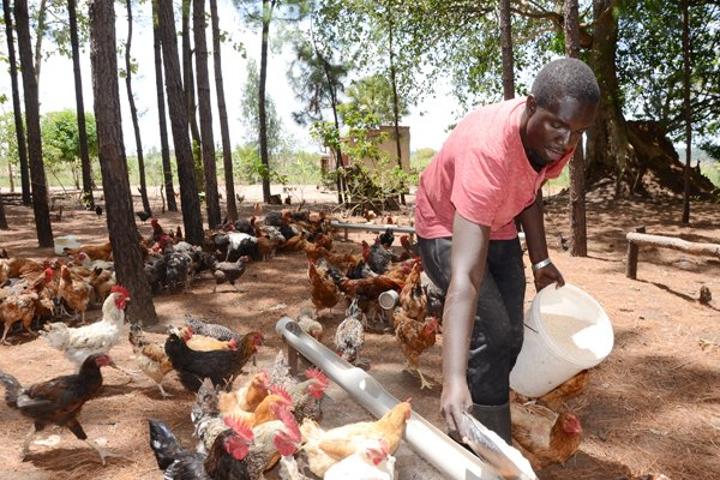
In the first month of rearing Sasso birds, an idea came. Ocakacon thought that because the birds were single-coloured, the market would mistake it to be hybrid, prompting him to introduce kuroilers and Kenbro varieties.At the farm, the birds fit very well. The pine tree plantation on his compound provides both shade and protection against prey as they move around the compound.“We have just realised that they fit in very well, overall, it has been a good reception and people buy them off in the market like they are buying local chicken. We keep them on free-range because if we do deep liter, there would be no difference with the broilers,” he said.
His first batch of Sasso birds was bought from Rwanda while the Kenbro and Kuroilers were sourced from Kampala. “I got them from Rwanda, the supplier crossed with it to Kamwenge and then I drove from here to pick them up from there. They were 100 Sasso birds at 28 days old since I did not want to go through the hustle of brooding them from day-olds as I was new in the trade and that has been our practice here.”Once the 28-day-old birds are delivered to the farm, they are bred indoors for the next 30 days before they are released to survive on free-range.
“We release them out on a free-range because the idea is to keep them organic by minimising the use of antibiotics and other drugs in treating them and boosting their growth while treating them since we wanted to distinguish ourselves as organic in our trade,” he says.Lessons Meanwhile, Ocakacon has learned a lot of lessons. Of the several varieties of birds he keeps at the farm, he has realised that the Sasso birds have proven to be more resilient than the rest once subjected to the same conditions. “They are disease-resistant, although their growth rate is slightly slower than the Kuroilers and the Kenbros,” he says.
Management
It cost him Shs57m to build the 23×10 metres structure and establish the solar lighting system to house the birds. He used the money to buy materials such as cement, nails, iron sheets and bricks. Since he stocks birds every month, Ocakacon spends between Shs4.5m and Shs6m on feeds, transport, vaccines, labour, and other associated costs.
While paying for the birds, he spreads the cost by depositing in bits to enable him to take better records. He says his rate of returns are still low currently since most costs he injected were majorly capital investments.“Our birds sell between Shs30,000 and Shs40,000 and people buy them all,” says Ocakacon. Ocakacon, however, t says that his success in penetrating the poultry industry during lockdown was due to innovation, consultation and keeping at the farm.
Hurdles
Just like any other farmer, Ocakacon faces several challenges ranging from the high costs of feeds, financial constraints to enable expansion and the unreliable drugs available on the market. “The cost of the feeds are very high and I learned that you cannot rely on feeds in the open markets to feed the birds on a commercial basis and break-even, right now I ration my own feeds and only spend on concentrates which cost more than Shs230,000 a bag,” says Ocakacon.According to him, the attitude of the buyers who thinks that he has to sell his birds at the same rate as broilers has always affected his market.
Vision
The farm has positively influence how Ocakacon’s society operates. Through the farm’s core operations, he has been able to induce learning among the local community who come to the farm to work on a daily basis. “More than 10 people from around the community come here to work every day, although I used to pay them with money, now they demand chicken instead so that they can go and cross with their other breeds,” says Ocakacon.According to him, demystifying a narrative that hybrid chicken cannot thrive in free-range has been a huge success for him.
“Most people who come to the farm get surprised that the exotic birds are being raised on a free range basis. Such statements mean a lot for us. Besides, selling to the local community fertilised eggs means that our birds are now being recycled within our own community,” he said.In February, he started selling fertilised eggs. Every week, he harvests between 40 and 70 trays selling at Shs22,000 per tray.
HousingFor better production, make sure that you follow the recommended housing requirements for traditional chicken. Sasso chicken can be raised either in deep litter, semi free-range or full free-range systems. The house for Sasso chicken should protect them from adverse weather while providing security for them.