Africa-Press – Uganda. A Supreme Court judge has said that a newly developed manual on human rights will ease the determination of family disputes in the law courts.
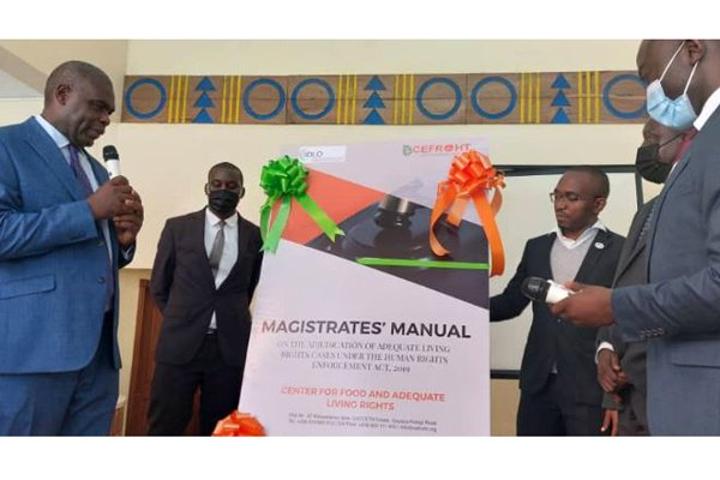
The Magistrates Manual on the determination of adequate living rights cases seeks to equip justice actors with tools on procedures and redress mechanisms.
Justice Mike Chibita said that the manual will ease access to justice in Uganda especially limited to the vulnerable and those who cannot read or write.
“Whenever I go to my small village in Butalejja, I get about 20 people asking for legal aid, people do not know that you are a judicial officer, and you are not supposed to give them advice. Women and children are the most affected and yet they can access justice,” he said.
Justice Chibita made the remarks at the launch of the manual at the Golf Course Hotel in Kampala on Friday.
The manual seeks to familiarise justice actors especially magistrates with adjudication of human rights under the Human Rights Enforcement Act of 2019.
According to Justice Chibita, the act has helped people to express their cases in the languages they understand other than English which according to the law is the official language.
“I want to thank International Development Organization (IDLO) for supporting the Center for Food Adequate Living Rights (CEFROHT) to create awareness of this act. The manual is critical for promoting human rights like the right to food, health, own property, and other economic rights,” said the judge, appealing to the organization to spread the manual throughout the country to enable magistrates to benefit from the information.
READ:
Judiciary gets 47 new magistrates
The first beneficiaries are the vulnerable communities living in Buyende, Kiboga, and Kyakwanzi.
Grade one Magistrate in Kiboga, Mr Michael Mbosa stated that the lower courts initially did not have the powers to handle cases of human rights. However, with this, it has now been fixed with minimum writing of the litigants.
Mr Mbosa explained that the manual will go a long way in easing cases related to adequate living rights
“This will help especially those in the villages since most of the people in town know the law. One is free now to come and talk to the clerks without a lawyer and they are worked on so fast in any language they understand,” he said.
According to the executive director of CEFROHT, Mr David Kabanda the enactment of the Human Rights Act 2019 operationalised Article 50 (4) of the 1995 Constitution by laying out the procedure for human rights adjudication that expressly grants Magistrates’ Courts competent jurisdiction to handle such matters.
“The manual will act as a guiding document for training of the judicial officers, appointed court mediators and also detail the procedures of framing adequate living issues as a human rights issue, and redress mechanisms of solving adequate living rights perspective,” Mr Kabanda said.
[email protected]
For More News And Analysis About Uganda Follow Africa-Press