Africa-Press – Uganda. Although government confirmed that new variants of the coronavirus, which greatly affect young people are circulating in the country, violation of prevention measures is on the increase and more learning institutions are reporting cases of infection.
Mr Emmanuel Okello, a second year Law student at Kampala International University, decided to remove and pocket his facemask immediately after accessing the university premises through the main gate.
Hand washing and wearing of facemasks are the unnegotiable requirements for students and visitors to enter the institution premises in Kansanga, Kampala.
“I have the mask and I can wear it anytime. But wearing it [all the time] can be a bit inconveniencing. The biggest challenge we have is adhering to social distancing because if you are in the class, you will want to talk to your colleagues and sit near them,” Mr Okello told this newspaper yesterday.
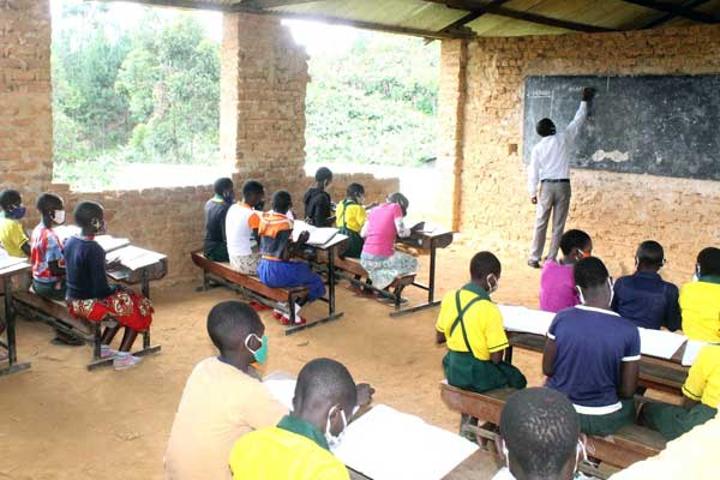
At the university, in a classroom for law students with around 40 learners, there was no social distancing and the few learners who cared to wear their face masks, most of them were below the chins.
When this reporter approached the office of the vice chancellor for a comment, he was asked by an official, who identified himself as Moses, to write an official letter to the administration, seeking to conduct an interview. This could not be done by press time.
But lack of adherence to Covid-19 prevention measures was also witnessed at Makerere University and Nakivubo Blue Primary School when Daily Monitor visited yesterday. The Uganda National Teachers Union (Unatu) said the vice is widespread in learning institutions.
Prof Rhoda Wanyenze, the dean of Makerere University School of Public Health and a member of Ministry of Health Scientific Advisory Committee (SAC), admitted that they are having issues where their learners deliberately violate the measures but that they are taking action.
What govt says“We enforce the Covid-19 prevention measures for our students. If they are not wearing face masks properly, we don’t allow them to come in, right from the front desk [of the school],” Prof Wanyenze said.
She added: “Even when I am walking, sometimes the students cover [their noses and mouths by wearing masks]. But when they reach a corridor, they pull it off. When I meet them, I ask them to wear the masks properly.”
Prof Wanyenze appealed to leaders of institutions to lead by example through observing the measures, reminding the learners about the importance of wearing masks and making sure the learners oblige.“Behaviour can’t be changed overnight and you know most people feel uncomfortable when they wear masks. I am leading by examples,” she said.
But Mr Filbert Baguma, the Unatu general secretary, said social distancing is largely impractical in most learning institutions in the country.
“Adherence to Covid-19 prevention measures is a bit tricky in most schools in the country, especially when it comes to social distancing. The infrastructure in most schools doesn’t accommodate the recommended spacing of learners,” Mr Baguma said.
He added: “Even the desks, which are there, the way they designed and the numbers cannot accommodate the new normal [of Covid-19 pandemic]. If you try to do spacing, you may fail to reopen most schools.”
For secondary and tertiary institutions, all classes have been reopened by the government, but in primary schools, P.1 to P.3 are resuming on June 7, according to Unatu general secretary.
The country registered its first case of Covid-19 infection on March 22 last year, and by yesterday, 44,281 cases and 359 deaths had been reported in the country. The Ministry of Health announced a few weeks ago that the second wave of the pandemic is underway, and that more young people are being affected.
More schools report Covid-19 cases
Mr Alex Kakooza, the permanent secretary in the Ministry of Education and Sports, said they are registering more schools with cases of infections, but declined to give numbers and names.“The cases of infections have been in secondary schools, but there were also cases in tertiary health institutions. We handled the cases along with district Covid-19 taskforces,” Mr Kakooza said.
He added: “When schools were reopening, we gave out Covid-19 SOPs and we continued monitoring. But we have not found widespread violation of measures, the few issues are isolated cases.”Dr Nathan Onyaci, the director of Masaka Regional Referral Hospital, revealed to this reporter last week that the health institution affected is in Masaka and that 46 learners reported ill.
He said the affected people were undergoing home-based care in the isolation centre in the institution. He declined to reveal the name. Mr Baguma said there are no clear statistics on Covid-19 infections in schools because there is no specific testing programme or database there.