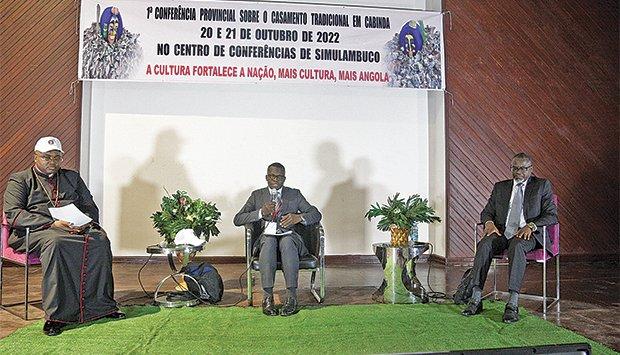
Africa-Press – Angola. Several individuals from the different fringes of Cabinda society, with emphasis on traditional, religious, academic authorities, judicial magistrates and the Public Prosecutor’s Office, have been meeting since yesterday, in Cabinda, at the first provincial conference on traditional marriage.
The event, which takes place in the Simulambuco conference room, under the motto “Traditional marriage and its contours among the Cabindas”, aims to provide conditions for an open discussion on traditional marriage, given the context in which the ceremony in recent years, as well as seeking to influence the main social actors, with emphasis on families, on the set of goods that should constitute the dowry, according to the reality of each region of Cabinda.
The event also aims to contribute to canceling bad practices that have nothing to do with the customs and customs of the region, to seek mechanisms to avoid the imitation of practices that do nothing to guarantee the good name and prestige of the culture of the peoples of Cabinda, as well as discuss the delegation of traditional powers in accordance with the existing structure, to validate the list of assets that will be delivered by the groom to the intended family at the traditional wedding ceremony.
The meeting that ends today brings to the discussion various topics on the traditional subject, respectively “traditional, civil and religious marriage: their interconnection in the constitution of the family”, lectured by the bishop of the diocese of Cabinda, Dom Belmiro Chissenguenti, as well as the ” the importance of traditional marriage in stabilizing the family and society”, “interculturality in traditional marriage ceremonies in Cabinda and regional authenticity” and the “problem of dowry or alembamento in traditional marriage in Cabinda”.
The deputy governor of Cabinda for the economic and productive sector, who opened the meeting on behalf of the provincial governor, Mara Quiosa, said that, given the changing times and the effects of modernization, there is an urgent need to reflect, to dialogue and define the basic elements that should characterize the traditional wedding materialized through the alembamento, so that this ceremony takes its place again, earns respect and prestige within the local community.
“It is with this responsibility that the government of the province of Cabinda has closely followed the most varied manifestations of the cultural phenomenon, with emphasis on traditional marriage that in recent times has been a major concern among young people who want to start a family”, pointed.
According to Macário Lembe, the difficulties that many young people and families face are evident, due to the fact that some relatives understand the dowry as the list of goods to be delivered to the bride’s family, as if the woman were an object of exchange, whose opportunity serves to meet the pressing needs of the family.
Due to the importance of the constitution and stability of the family, the ruler defends the need to promote cultural values, where traditional marriage ends, so that these are transmitted responsibly by the elders, sobas, regedores and other authors so that the culture preserves the your traits.
For Macário Lembe, lecturers should give primacy to traditional authorities and elders as they have a lot to say about true alembamento, and it will be up to academics and other intellectuals to find a common standard of dowry within the uses and customs of the region.
According to Ernesto Barros André, provincial secretary for Culture, the institution that promotes the conference, the meeting was motivated by the individual and collective complaints of people who want to form families but are discouraged by the dowry because they do not know where to start, so find easier and more dishonorable ways to start a family.
“It is not our reality to include in the dowry items that do not touch our marital culture, such as generators, land, sand carts and other materials, as well as products that cause astonishment and sadness to the groom’s family and not only”, lamented Ernesto Barros André .
For More News And Analysis About Angola Follow Africa-Press