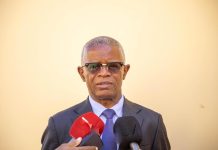
Africa-Press – Angola. The director general of the Action for Rural Development and Environment (ADRA), Carlos Cambuta, highlighted Wednesday, in Cunene, the importance of institutionalizing local authorities in Angola, aimed at meeting the basic needs of citizens.
During the II ADRA Regional Conference, he declared that “The institution of autarchies constitutes an opportunity to accelerate the satisfaction of the basic needs of the population and the formulation of public and administrative policies, adequate for each municipality in the country”.
He explained that the social and economic challenges, the country’s territorial extension and excessive dependence on State bodies, should elevate Angola to a model of decentralization.
He referred that the implantation of the intervention of the traditional power in the local authorities and other modalities, requires the participation of the citizens, for the strengthening of the sectors.
He made it known that it was in this spirit that ADRA created this space for civic and municipal education, to contribute to access to information and in this way every Angolan may have his right to participate in public life safeguarded.
He recalled that his organization has been defending the institutionalization of local power in Angola for more than 20 years and that it has scheduled in its 2023-2027 strategy to contribute to improving dialogue between rural communities and Angolan State institutions, through various local platforms. existing.
During the regional conference, topics on local authorities as development poles in the southern region of Angola were discussed, as well as lessons from the exchange on local authorities in Mozambique.
Carlos Cambuta said that the conference, which brought together representatives from the provinces of Cunene, Huíla and Namibe, is a space for development, promotion of knowledge and experiences, among different social actors and aimed to identify the main challenges of institutionalizing local authorities in Angola.
ADRA in Cunene began its intervention in 1996, in Manquete, Mucope commune, in the municipality of Ombadja, with the implementation of a project to support the development of communities in the fields of Agriculture and Education and in 2006 it implemented the Impact of HIV/AIDS, financed by UNICEF, aimed at 500 families in Ombadja, through cash transfers.
With antennas in the provinces of Benguela, Cunene, Huambo, Huíla, Namibe and Malanje, ADRA was created in 1990, as an Angolan non-governmental organization, dedicated to promoting democratic and sustainable, social, economic and environmental development, as well as national reconciliation.
For More News And Analysis About Angola Follow Africa-Press