Africa-Press – Angola. he President of Brazil, Lula da Silva, ended, Saturday, the State visit that brought him to Angola on Thursday with the seal of strengthening bilateral cooperation, inaugurated in 1980, with the Economic, Scientific and Technical Cooperation Agreement .
During the stay of the Brazilian statesman in Luanda, the private meeting with his counterpart João Lourenço, the signing of cooperation agreements, the Angola-Brazil Economic Forum, and the speech he gave in the National Assembly, in a special session, constituted “high cash” , all these events occurred on Friday.
At the opening of official talks between delegations from both countries, Lula da Silva heard from the Angolan Head of State that in addition to infrastructure, the country offers a good business environment and the appeal to Brazil for the creation of a fund to support private investment in the areas of commerce, culture, industry and services.
João Lourenço considered it important to promote a high-level meeting between the Southern African Development Community (SADC) and the Common Market of the South (MERCOSUR), to analyze forms of economic cooperation and development.
In response, Lula da Silva stated that his country is the ideal partner to help leverage the Angolan economy’s diversification strategy, especially in the food industry sector and announced the implementation of an action plan between the two Ministries of Agriculture.
He noted that a program was already being developed in the Cunene Valley, with 25 actions, with the aim of promoting agricultural development on the African continent, particularly in Angola.
Signature of Agreements
Another high point of the visit of the Brazilian statesman was the signing of seven new agreements for the reinforcement of bilateral cooperation, one of which is related to the exercise of professional activities of remuneration of dependents of the diplomatic, consular, military, administrative and technical personnel of the diplomatic missions and consular offices, as well as sustainable tourism cooperation.
A Memorandum of Understanding was also signed in the field of Agriculture, namely in agriculture and livestock, while in Health the agreement was reached on a Cooperation project for the Diagnosis and Treatment of Hansen’s disease/leprosy (early detection and treatment of the disease).
There was also room for agreement in the area of Special Education, with the project called “Escola para Todos”, focused on school inclusion.
A Memorandum of Understanding was also signed between the National Institute of Support for Micro, Small and Medium-Sized Companies (INAPEM) and the Brazilian Support Service for Micro and Small Companies (SEBRAE), focused on entrepreneurship and the inclusive and sustainable development of small businesses in both countries.
Since the signing of the first memorandum, in 1977, two years after the proclamation of Angola’s independence, in 1975, there have been around eighty agreements between the parties.
After witnessing the signing of the legal instruments, João Lourenço stated that the Angolan Government wants Brazil to take advantage of Angola as a “gateway” to the southern and central regions of Africa, and also wants to have Brazil as a “gateway” to Angola to the Mercosur region.
Lula da Silva underlined that his Government must work harder to clearly show what Brazilian businessmen can gain by investing in Angola and the opposite for Angolans in Brazil.
Cunene Valley _
As part of Lula da Silva’s visit to Angola, the two countries signed the action plan, 2023/2025, within the scope of technical cooperation and the development of irrigated regions and policies to support family farming in southern Angola.
The plan is part of the “Programa do Vale do Cunene”, an initiative that will benefit the population of Vale do Cunene, a semi-desert region, an experience similar to that lived by the population of Vale de São Francisco, in Brazil.
The program responds to a request from President João Lourenço, who guides the authorities of the two countries (Angola and Brazil) to work together in the diversification of the agricultural production base in that region (Cunene Valley), in the path of not depending on oil as the main product of export to raise foreign exchange.
Speech in Parliament
At another time, speaking at the National Assembly, the Brazilian president considered that with the visit to Angola, “Brazil is back in Africa” and expressed his country’s commitment to inaugurate a new robust agenda with Angola that will serve as a model for other countries .
“Our common interests are much broader. We seek true development that requires combating poverty, promoting social inclusion, quality education and health care for our populations”, he pointed out.
The President of Brazil underlined that cooperation between the two parliaments will help to further strengthen the bilateral relationship.
The president of the National Assembly, Carolina Cerqueira, said that President Lula da Silva’s visit to Angola, in his first year in office, clearly demonstrates his priorities, esteem, proximity policy and non-negotiable commitment to development, sustainability and respect for sociocultural heritage.
In another aspect, after the Brazilian statesman praised the fact that the African Union (AU) had awarded João Lourenço the title of “champion for peace and reconciliation in Africa”, he announced that he had invited him to the next G20 Summit that will take place in Rio de Janeiro (Brazil) in November 2024.
In his opinion, it will be a very important occasion to discuss issues such as economic coordination and global governance reform.
Economic Forum
At the close of the 1st Angola-Brazil Economic Forum, President João Lourenço emphasized that Angola relies on Brazilian direct private investment to transform Angola’s economic potential into real wealth, create jobs and prosperity.
At the event, which brought together 500 businessmen, 170 of them Brazilians, the Angolan Head of State reiterated his invitation to invest fearlessly in the Angolan market.
By the way, Lula da Silva stated that Brazil has no idea of how many things it can do with African countries.
“We are back (to Africa) for real” by providing financing for African countries, and investments for Angola, as a “good payer”, he underlined.
Lula da Silva noted that while he was out of government, China, India, Turkey and other countries invested in Africa and South America, while his country stopped doing so.
Tributes and decorations
On Friday morning, the Brazilian Head of State, Luiz Inácio Lula da Silva, honored the first President of Angola, António Agostinho Neto.
Lula da Silva laid a wreath on the national hero’s sarcophagus and recorded, in the Memorial’s honor book, adjacent to “Praça da República”, his admiration for the vision and work of Agostinho Neto, considering him “a notable politician, poet and hero”.
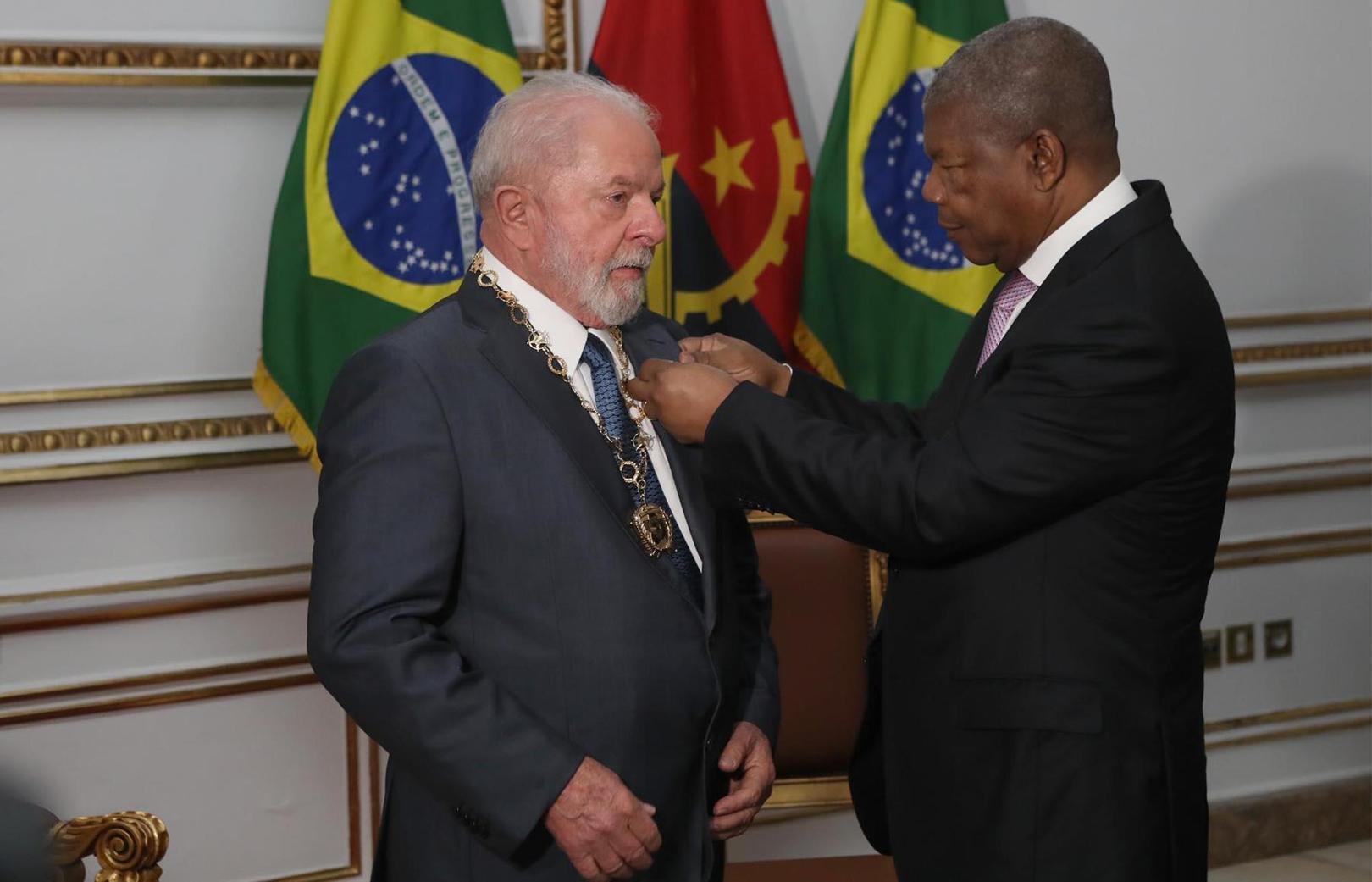
Later, the Brazilian Head of State was decorated by his Angolan counterpart with the “Ordem António Agostinho Neto”, first President of Angola, the highest distinction of the State.
After the distinction, the Brazilian president said it was very honorable in 50 years of politics, and at the age of 77 to receive “the most important order in Angola”.
At the same ceremony, the Brazilian President decorated his Angolan counterpart with the “Ordem Nacional do Cruzeiro do Sul”, which honors notable foreign personalities.
The Angolan Head of State considered the distinction special and said he received it “with humility and (…) great joy”, dedicating it to the people for the sacrifices consented to in the fight for freedom.
The last day of the visit, Saturday, was less intense, in which Lula da Silva held meetings with representatives of the approximately 30,000 members of the Brazilian community, with former Angolan students in his country and announced the opening of a general consulate in Luanda.
It was also the occasion to inaugurate the Ovídio de Melo gallery, at the Guimarães Rosa Institute/Centro Cultural Brasil-Angola, in honor of that Brazilian diplomat whose career was marked by his role at the time of Angola’s independence, where he was a representative of the established transitional administration by Portugal after the Carnation Revolution.
Brazil was the first country in the world to recognize Angola’s independence, proclaimed on November 11, 1975, by then President António Agostinho Neto.
angop
For More News And Analysis About Angola Follow Africa-Press