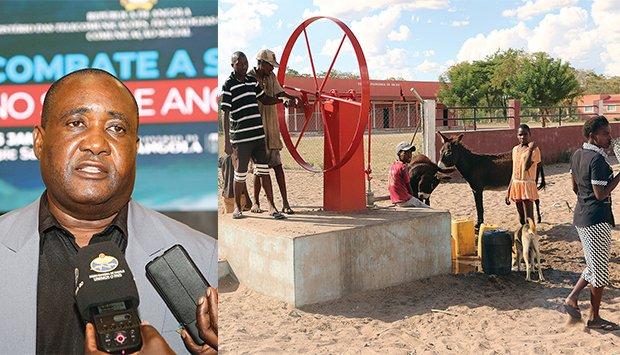
Africa-Press – Angola. Investigations into the phenomenon of drought in the south of the country, to be carried out by the US academy of the Massachusetts Institute of Technology (MIT), within the scope of the project “Support System for Policies to Combat Drought”, based on space technology, should be shared with Angolan universities and technicians, defended, in Luanda, Fabião Tulukeni, deputy dean of the Faculty of Engineering of the Agostinho Neto University (UAN).
The professor, who was speaking during the launching ceremony of the project based on space support, which will reinforce the Government’s actions to alleviate the effects of the drought in the south of the country, said that it was in the interest of the Angolan engineering universities that the occasion also serves , an opportunity to exchange experiences on space technology.
“Who will win, above all, is the country itself, which will have better trained staff on matters related to space technology”, said Fabião Tulukeni, and then added that space engineering is a matter of “great interest” of the Angolan Academy.
Fabião Tulukeni therefore considered it essential to provide Angolan technicians, students and teachers from the country’s universities with a meeting with researcher and professor Danielle Wood, from the Massachusetts Institute of Technology (MIT) in the United States of America (USA), so that more knowledge about the technology can be absorbed.
He highlighted, on the other hand, the fact that the project is of “very high standard”, for incorporating a system of systematic supply of data on the state of the water resources, location of the population settlements most vulnerable to the effects of the drought and the location of the ideal places for the application of structuring projects.
Also according to the professor of the Agostinho Neto University, it is necessary and imperative to establish cooperation between the American university and the national ones, “so that our staff understand the process and the advantages very well” with the use of the space technology in combating drought in the south of the country.
The collection of data from the earth’s surface, through space technology, said the deputy dean, needs to be interpreted by different specialists, citing, as examples, geologists, hydrogeologists, environmentalists and services linked to the security of our country.
In view of this, he defended the collaboration of technicians from American and Angolan universities, in the process of data collection and in-depth studies, with a view to ending the drought.
“An eventual cooperation would give the possibility for our institutions to evolve and also reach the necessary levels and the American university needs some data that it can only find in Angolan universities”, he concluded.
It should be recalled that the project “Support System for Policies to Combat Drought in Southern Angola”, launched in Luanda by the Ministry of Telecommunications, Information Technologies and Social Communication (MINTTICS), has the partnership of the National Space Program (GGPEN) and the Massachusetts Institute of Technology (MIT) of the USA, and is funded with 550 thousand dollars by the North American Space Agency (NASA).
The execution period is three years, and all the work must be coordinated by Danielle Wood, North American researcher and director of the Space Enabled Research Group, MIT Media Lab.
The American leads the research group that uses satellites to solve complex problems on Earth, designing innovative systems that take advantage of space technology.
Pascoal Alé Fernandes, Secretary of State for Telecommunications, Information Technologies, said, on the occasion of the launch of the project, that it will serve as a platform for collecting, organizing and sharing information, aimed at mitigating the effects arising from the occurrence of drought situations, which have affected thousands of citizens for several decades.
For More News And Analysis About Angola Follow Africa-Press