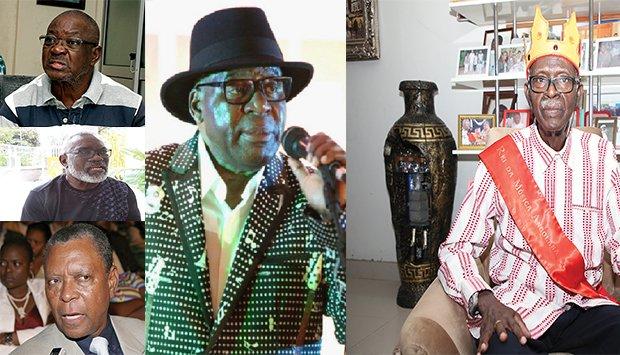
Africa-Press – Angola. Santos Júnior, Dionísio Rocha and Manuel Claudino “Manuelito” are Angolan music references who shared moments with the Immortal Guide of the Angolan Revolution and were available to remember some moments spent with the Founder of the Angolan Nation.
Being all people connected to rhythms and melodies, in the final part of our conversation they made available a small inventory of songs inspired by the poems of Neto and others that were based on the teachings and deeds of the Father of the Nation.
Santos Júnior
“He was a de facto President”
The author of the hit “Estrangeiro”, among other themes inspired by the slogans of President Neto, who also celebrates his birthday on the 17th of September, began by talking about the first poems he set to music. Santos Júnior said that “when the MPLA arrived in 1974, we were integrated into the JMPLA, we went looking for people who were already playing and we created the Kissanguela musical group. , before independence, he liked it and then we walked to many provinces and abroad”.
As for tours abroad, Santos Júnior fondly recalls his trip to Maputo in July for the celebrations of Mozambique’s Independence, São Tomé and Príncipe and Guinea Conakry. In the latter country, he recalls that the trip was to toast a conference of African Heads of State and the members of Kissangeula were hosted at the Palace of the legendary President Sekou Toure and played with the local group made up of old libraries of local music. Santos Júnior details what happened in Conakry. “When we finished the performance we went to our rooms. To our amazement, later Carlitos, Presidente Neto’s bodyguard, arrived, knocked on our door and said that the President was calling us. Minutes later we found Neto, who told us that he felt proud, because his counterparts liked our participation. Then we talked about the country and he encouraged us to continue studying and promised that some of us would go to Cuba. She also spoke about Bonga and at the time said that we should do everything to make him stay with us, because Bonga is Angolan like any other”.
Speaking of other particularities of Neto, he stressed that “he was very fond of telling scenes, he was a deeply human person, a great patriot and he was very fond of young people. He talked to everyone and there was no sign of cynicism in him. crystal clear. He didn’t like separation, he was a de facto President”.
Santos Júnior says that after Neto’s death, unfortunately, some musicians were ostracized by political power, but it all started before at JMPLA. “They tried to accuse us of being fractionists and we only didn’t die because Neto intervened, sending Comrade Mbinda to take care of us.
Always attentive to Neto’s slogans, this is how “I took ‘every citizen is and must necessarily feel like a soldier’ to mobilize Angolans to fight against the invading troops of the then racist regime in South Africa. Artur Adriano also transformed in music the slogan ‘Angola is of its own volition the firm trench of the revolution in Africa, and that ‘in Zimbabwe, Namibia and South Africa is the continuation of our struggle’. order and turn into music”.
He recalled that in the past, citizens really felt like soldiers of the Fatherland, different from the current situation, where everyone wants to have a leading role and take personal advantage. And in this perspective “I remember going to the coffee harvest campaign, in Gabela and Uige, in the sugarcane campaign, in Bengo, at Fazenda Tentativa. When Neto said that ‘agriculture is the basis and industry the decisive factor’ we made music out of it to mobilize people for production and these are things that we should take advantage of at this time of global food crisis. Look, I even made a song with the title agriculture. It doesn’t play anymore and I don’t know why At this stage, there is a lot of talk about agriculture. It could be an incentive for citizens to go to the countryside”.
Manuel Claudino “Manuelito
“Grito da Independência is a tribute to Neto”
Manuelito starts along the same lines as Dionísio Rocha. “When at my young age the elders talked about Agostinho Neto, a doctor who had an office, a wooden house on Brigada Road, I met Mr. Zito, the nurse who accompanied him. Then he went to jail and at that time he had no fixed your face”.
The voice of the “Grito da Independência” recalls the days that preceded the 25th of April 1974, when Portuguese soldiers began to hand over their weapons and, in conversations inside the barracks of the colonial troops, they spoke of Agostinho Neto as leader of the MPLA. of the relationship with the Immortal Guide on February 4, 1975. “This was the triumphant return of Dr. António Agostinho Neto, we were at JMPLA and within the framework of scheduling an activity, we Kissanguelas traveled by car to Benguela. We stayed in the houses of comrades who provided rooms and others in the MPLA committee, including myself, Calabeto and others. I remember that we were sleeping when Neto arrived in the company of Commander Kassanji, who opened the door to explain the serious situation we were going through, we got ready and we didn’t go back to sleep. In that meeting, I remember that in the field activity he guided security to move a white man who was in a lighting tower in the field, at a strategic point, for an imminent attack. He had a telescopic weapon and identified himself as a member of the FUA-United Front of Angola. This statement was to talk about the first direct contact we had with Neto”.
Manuelito talks about yet another moment. “We went to Ndalatandu and stopped at Dondo, but as there were some skirmishes here, they killed Valódia, Nelito Soares and that’s when Neto declared ‘generalized popular resistance’ and we immediately had to return to Luanda. so we went to enlist in the army”.
It makes a relationship between the reach of the bullets and the messages of the intervention songs. “We were creating songs with the President’s slogans, there were people who said that we were a pamphleteering group, but what we were doing was a way of making the people aware of the struggle and in this aspect we were successful. A fighter’s bullet could perhaps reach five kilometers, but the music reached the entire Nation”.
Of Neto’s directives turned into music, he spoke of the theme dedicated to literacy, a composition by José de Piedade Agostinho, coordinator of the JMPLA at the time. “This song is still current,” he says.
Attending the proclamations of the independence of Mozambique and São Tomé and Príncipe, Manuelito also has unforgettable moments. “In Maputo, seeing the raising of the Mozambican flag, after the withdrawal of the Portuguese, had a special flavor. In São Tomé and Príncipe we were received by Manuel Pinto da Costa, in the delegation was David Zé, who had just married a Santos Júnior, who has children whose godfather is Pinto da Costa. There was an episode during the activity. A group from Sáo Tomé was playing and Neto asked them to put the Kissanguela group, saying ‘comrade Pinto da Costa put my We laughed, because we were in someone else’s space and I think he only accepted it because Neto was the oldest”.
Another incident experienced was in Cape Verde. “We went for a walk and then we realized the time of our activity and as we were in liberal attire, protocol did not allow us to enter the activity. A member of our delegation went to inform comrade Hermínio Escórcio, responsible for the President’s ceremonial, and only so we entered.” With Neto, he also recalled his trips to Algeria, Concari and Bissau.
Speaking of the theme “I want to dedicate a poem to you”, performed by Calabeto, he clarified that “after Neto’s death, one of our comrades, Mário Jorge Fernandes, who was linked to refereeing in football, wrote the composition and gave it to Calabeto. to the studio and we recorded it with great sadness, at a time when other themes were emerging, such as Matadidi, Tabonta and others”.
“Grito do Independência is a tribute to Neto, because he was the one who proclaimed our sovereignty, he fought, freed and was the one who assumed the responsibilities for independence, on November 11, 1975. The Grito came to remember that there was an independence of fact and that we were not going to destroy it for anything in the world. As there was a need to preserve and fight for our independence with all our strength, then the ‘Cry for independence’ in Popular Angola emerged”.
Dionísio Rocha
Had a “Samba Arrived” when he played ‘A hora da partir’
The musician Dionísio Rocha surprised by revealing a little-known side of Negoleiros do Ritmo. “Look, after the end of the relationship with Kissanguela, they called us to play. We don’t know what happened, but for restricted moments we were invited and I think it’s the first time I talk about it publicly. Culture, but at lunches and dinners we had the advantage, because there were five of us and sometimes Neto didn’t want too much noise. We usually played songs by Ngola Ritmos, some sambas that we reserved for the beginning, at dinner time, and there was a theme ‘Chegou the time of departure’, which when he realized that he had to finish, he would make a sign. These meetings took place in the protocol house number two, after the old DEFA”.
Our interlocutor recalls the following: “the last time we were with Neto was when he received journalists, I don’t know if British or Americans, and he gave a memorable interview. inert body, where each vulture comes to peck its morsel’. Dionisio Rocha recalls the passages through Cunene, Malanje and Uige, by the way the last ones before President Neto went to the Soviet Union, where he died on 10 September 1979 “I remember that phase when Neto said that ‘some of us may fall at the next corner, but the revolution will continue its triumphal march alongside the peoples who follow the same path'”.
For this statement, Dionisio Rocha also relives his first contacts with the young doctor who had returned from Lisbon, with an office in the São Paulo area and in Marçal, close to the Giro Giro. “At the time, there was a circus where Pipof appeared and he went with his family to watch the variety shows. Then I learned that the political police had arrested him in the São Paulo office, in an operation directed by the PIDE director himself in Angola, São Paulo. Jose Lopes”.
Matadidi Mario talks about “A Minute of Silence”
“I was on the plane on the way to Bié, when the commander announced that Comrade President Agostinho Neto had died. It was on a Saturday and I wanted to go back to Luanda, but I couldn’t. managed to board to Luanda, Neto’s body was in the current Noble Hall of the Provincial Government, but I didn’t have credentials to go in. On Monday, I went into the street that goes to the Ministry of Defense, because the funeral procession left the Mutamba to the Palace and when I arrived, I saw all the people crying. This was the second time that I made a theme without repetition, the words came out at the moment. The music was made in Prenda, where I lived. While Lúcio Lara was talking, I was creating”.
Interpreted Poems
Ruy Mingas was one of the pioneers, when even before Independence he gave voice to ¨Adeus à Hora da Largada¨. This poem has a replica in Kimbundo, in the voice of Dom Caetano, an artist who at the beginning of his career became famous as a troubadour with his companion Zeca Sá and they sang poems by Neto.
Zé Kafala was happy, turning “Renúncia Impossível” into a real success. In order to understand the impact of this song, it won political song festivals and won several other musical contests and also consecrated Zé Kafala as the winner of the Top dos Mais Queridos.
Duo Canhoto, with “Departure for the contract” also marks this appropriation of Neto’s poems. This group is one of the most daring in retrieving Neto’s poetry for music.
Another name that has become famous and continues to be a reference, when it comes to turning Neto’s poetry into music, is Armando Carvalho, with the chilling ‘Assim clamava exhausted’, known as ‘Não sei nada’, a poem that addresses nostalgia , love and feeling of freedom. Belita Palma also lent her voice to Neto’s poetry, when interpreting ‘Caminho do Mato’. In the early 1980s, a group of pioneers took up ‘Aspiration’.
From this phase of recovery of poems by Neto, it is also important to talk about translations that conquered the Angolans and, at this point, Mito Gaspar made a perfect bridge, marrying traditional rhythms to more modern sounds.
The translation into Kimbundo of the poems “Havemos de Voltar” and “Renúncia Impossível” in “Hadia Tu Vutuka” and “Eme Nzambi Muenhu” confirm this facet and great merit of the Malanjino Mito Gaspar. “Hadia Tu Vutuka” marks the trajectory of Mito Gaspar, as in the distant year of 1983 he won the First Festival of Political Song. At the time he was part of the Trio Henda, representing the province of Huila.
Look, younger singers also recovered Neto, I think it was not by chance that Kizua Gourgel passed by, because he sang “Velho Negro”, a song that we can hear on the album ‘Vozes para Nguxi’, produced by the António Agostinho Neto Foundation and coordinated by Matias Damásio, who sings ‘Um Bouquet de Rosas para Ti’. On this record we also find ‘Meia-noite na Quitanda’, with Gabriel Tchiema, ‘Para Emfeitaros teu Cabelos’, in the voice of Sandra Cordeiro, ‘Confiança’, with Kanda, and other poems sung by Tonicha Miranda and Father Mak.
Several poems read in the works Sagrada Esperança and Renúncia Impossível can be heard in the voices of national and foreign musicians such as Manu Dibango in ‘Havemos de Voltar’.
Grandson as Inspiration
The Conjunto Nzaji where “Dr. Neto left his contribution in the late 60’s in one of the first records”.
Once again the Kafala Brothers, José and Moisés, are called in ‘Nguxi’, a striking theme that has the choir “Welela Wele”. most productive: the late 70’s and early 80’s was the most productive, as a result of the current context: Liberation Struggle, National Independence and the death of Neto.
Elias dya Kimuezo has the songs “Agostinho Neto” and “Dipanda Didi Diolo Kuiza”. Jones Manuel and Santos Júnior resume the slogans, respectively in “Vamos Produzir” and “Cada Cidadão”. Matadidi also did the same in “Comrade President Said”, in an appeal to vigilance, production and other goals that were outlined in the First Congress of the MPLA, in 1977 criticism of the system at the time, was Pedrito in “Militante”.
The Poet, the people and freedom by Uassunga Jones and “President” by Mário Gomes are other themes that musically paint Kilamba in the Angolan sound imagination. Cape Verdeans were not left out. It is known that Agostinho Netp while in prison practiced medicine in this archipelago and the recognition is in the voice of Tonccas Marta. Urbano de Castro also sings “Comarada Presidente”, in a multilingual Kimbundu and French song, extolling the revolution.
Calabeto is not out of it, with “I want to make you a poem”, a song that addresses the teachings of the Poet, and in “Comarada Presidente”, where he makes a duet with Belita Palma. This lady has “Kilamba” and “Kalakaleno”, known as “Nguxi”, which gained a new audience in the Banda Nguxi version. In “Kilamba”, Dina Santos is another female voice that donates to Neto.
Tonito Fortunato, Voto Gonçalves, Prado Paim, Lito Júnior, Artur Adriano and Tino dya Kimuezo, in “Tala Banza Presidente Neto”, “Kilamba Neto”, “Povo Angolano is crying” and “President” bring moments of great suffering for death of grandson.
To close, Matadidi Mário and Tabonta, in “Minuto de Silêncio”, and “Wele Neto Tuna Yandi”, surely managed to transport the moment of the President’s death to several generations. In fact, they are mandatory topics in September.
For More News And Analysis About Angola Follow Africa-Press