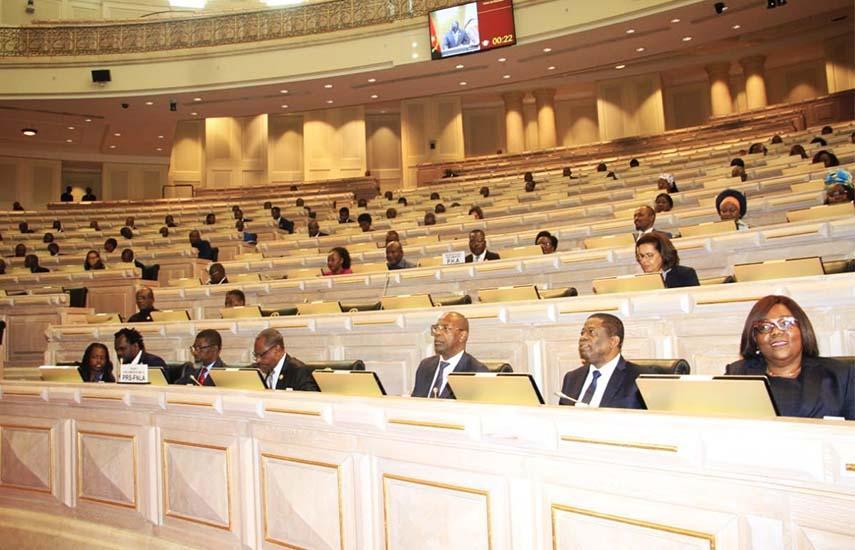
Africa-Press – Angola. The National Assembly (AN) approved, this Monday, in general, the Proposal that changes the Code of Value Added Tax (VAT) on foodstuffs from 14 percent to 7 percent.
The diploma was approved with 113 votes in favor (MPLA, PHA and Mixed Parliamentary Group PRS/FNLA) and 76 abstentions from UNITA, in the 8th Ordinary Plenary Meeting of the 1st Legislative Session of the V Legislature.
The Legislative initiative of the President of the Republic, as holder of the Executive Power, aims to adapt it to the current context of the country in the economic and social aspects, as well as to the economic and financial challenges faced by families and companies.
The diploma aims, among others, to reduce the VAT incidence rate on all foodstuffs from 14% to 7%, with the exception of the province of Cabinda, which will now have a single VAT incidence rate of around 1% , taking into account the Special Regime in force in that region.
The Law Proposal also aims to introduce a set of procedures to provide greater flexibility, efficiency and fairness to the tax, within the scope of the process of assessment, declaration, payment and reimbursement of VAT credits.
The Minister of Finance, Vera Daves, who presented the document in the hemicycle, highlighted, within the scope of this Bill, which will be discussed in the specialty, the treatment given to the province of Cabinda due to geographical discontinuity, with a rate of 1 percent for VAT.
He said that the Executive is also allowing the payment of VAT in installments for those who invest in industrial equipment with a view to freeing up the treasury and companies engaged in industrial activities.
He made it known that a reduced VAT rate is also foreseen for the import of agricultural inputs, having underlined that all this is part of a logic of, on the one hand, relieving families and, on the other, creating a favorable environment to stimulate national production .
The minister referred to the capitalization of the Credit Guarantee Fund and the transformation of Recredit’s Organic Statute, to allow its participation in the process of reducing bad debt in the system.
Vera Daves stated that the aforementioned measure also aims to encourage banks to make more loans, as well as other capitalization of funds and public financial institutions that will give strength to this initiative to grant more credit to the economy, especially to agribusiness.
The minister clarified, however, that everything that is an additional tax reduction is reflected in less availability for other ongoing financial initiatives, namely the capitalization of funds and the realization of expenses in the case of some investments in the social and infrastructure area.
“Therefore, taking from one side (revenue) is also taking from the expenditure side and what we are going to advocate during the debate in the specialty is this, so that we are all aware that the further we go, through tax reduction, the less space we have to act on the expenditure side, under penalty after increasing the public debt”, he stressed.
For the minister, sacrificing income also means sacrificing expenses.
Explanations of vote
Deputy Paulo Pombolo, from the MPLA, said that his party voted in favor of the proposal because it is in line with the spirit of solidarity, which is imperative for social well-being and with the Executive’s strategy for strengthening economy and improving the living conditions of the population.
According to the deputy, adjusting VAT rates for essential products such as food is a strategy that aims to mitigate the burden on the income of families and other economic agents.
“By optimizing the purchasing power of families, due to the reduction in VAT, consumption is increased and, consequently, the importance of the productive sector and domestic production is increased”, he pointed out.
On the other hand, UNITA voted to abstain from the Diploma for having “the notion of the need to simplify, rationalize and harmonize the National Tax system, boost national and foreign investment, increase the capacity to collect non-oil tax revenues through VAT and, on the other hand, to understand that more than half of the Angolan population belongs to the lowest income class, completely turned towards consumption”.
For deputy Navita Ngolo, the
general rate of 14% prevailing in the proposed revision, on imports and transactions of goods and services “will not alleviate the cost of living of populations already exposed to a constant monthly income in nominal terms and devalued in royal terms and the high prices of goods and services traded in the market”.
ANGOP
For More News And Analysis About Angola Follow Africa-Press