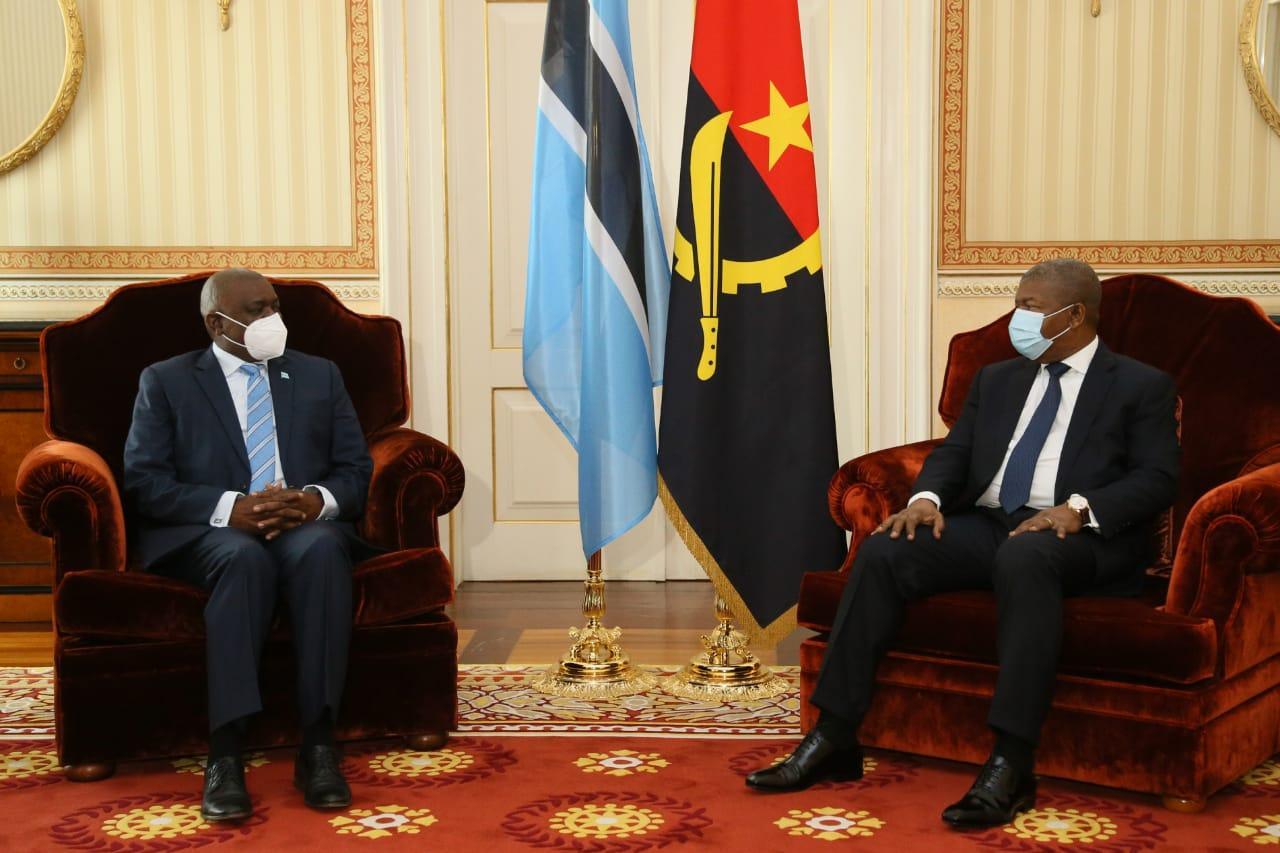
Africa-Press – Angola. Angola and Botswana intend to reinforce bilateral cooperation, focusing on the sectors of diamonds, agriculture, education, health and the environment, within the framework of the three-day State visit of the Angolan President, João Lourenço.
Political-diplomatic relations between Angola and Botswana were established on February 18, 1976. In February 2006, they signed a General Cooperation Agreement in the areas of agriculture, energy and water, industry, commerce, hotels and tourism, geology and mines, environment, territorial administration, technical and professional training, petroleum, telecommunications and business cooperation.
Botswana is a major producer of diamonds worldwide and Angola seeks the experience of that country, a member of SADC, in extraction and cutting.
Currently, Botswana’s diamond production accounts for around 60 percent of its exports.
On average, between 2002 and 2016, 26 million carats were produced per year, making Botswana the second largest producer of diamonds in the world, after Russia.
Another important source of income for Botswana is ecotourism. This country has the largest concentration of elephants in the world (more than 50,000). The country occupies 581,000 square kilometers, 17 percent of which is reserved for national parks. It also has immense virgin savannas.
Data from 2015 indicate that around 1.5 million international tourists visited Botswana.
Located in Southern Africa, the territory of Botswana has no access to the sea and is limited to the North with Zambia, to the East with Zimbabwe, to the South with South Africa, to the West and Northwest with Namibia.
In turn, Angola, which was in fourth place in terms of production worldwide, represents around 5% of that market, occupying the 7th position in the Ranking led by Russia.
The country’s main diamond mining areas are in the provinces of Lunda Norte and Lunda Sul, in northeastern Angola.
Sociedade Mineira de Catoca, the fourth largest mine in the world, operated in the open, is responsible for more than 80 percent of the country’s diamond production. With 26 years of existence, Catoca is responsible for more than 5,000 direct and indirect jobs.
In the agricultural domain, Angola has an abundance of arable land and a diversity of climatic conditions that are suitable for the production of a variety of agricultural products. The country was once a leading producer and exporter of agricultural products, including coffee, cotton and bananas.
Currently, only 10% of the 35 million hectares of arable land in the country are under cultivation.
regional integration
Angola and Botswana are members of the Southern African Development Community (SADC).
The two countries are also part of the Okavango/Zambezi project, which also includes Namibia, Zimbabwe and Zambia, covering a total of 278,000 square kilometres.
The Okavango Basin is a region rich in biodiversity, with more than 400 species of birds, mammals and other animals typical of the African fauna.
Angola has the second largest plot of the project, with 87,000 square kilometers, behind Zambia, with 97,000 square kilometers of land.
For More News And Analysis About Angola Follow Africa-Press