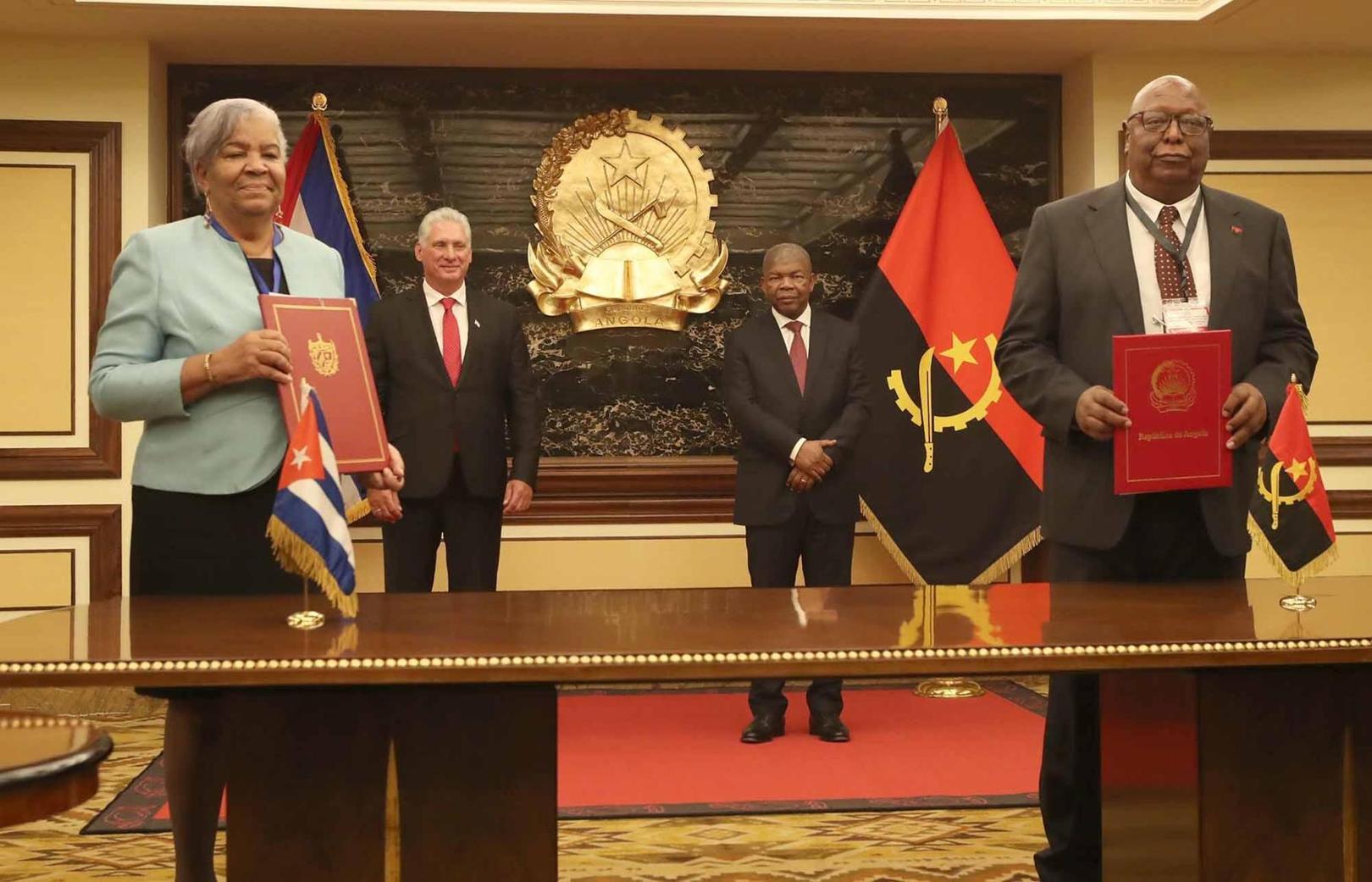
Africa-Press – Angola. With given proof of solidifying their friendship ties, Angola and Cuba recently decided to further catapult their bilateral relations, in search of a balance between the different levels of cooperation.
As announced during the recently ended State visit to Angola by the Cuban President, Miguel Mário Diaz-Canel Bermúdez, the two countries now want to place the citizen and the private sector at the center of attention.
The two Governments expressed their determination to continue to deepen historic ties, with a new focus on raising the reach of socio-economic relations to the same level as “excellent political relations”.
Ensuring the generational transmission of the legacy of genuine brotherhood and solidarity between these two geographically distant peoples is another facet of the new paradigm proposed for the future of relations
Bermúdez was in Angola, from the 20th to the 22nd of August this year, on his first State visit to the country and the third by a Cuban leader, after those of his predecessors, respectively, in March 1977 (Fidel Castro Ruz) and February 2009 (Raúl Castro Ruz).
In one of his interventions, Miguel Bermúdez, who has been directing Cuba’s destinations since April 2018, said that the current political leaders of both countries have the responsibility to continue and strengthen the historic bonds of friendship that unite the two peoples
.
According to the statesman, from the conversations he held in Luanda with his Angolan counterpart, João Lourenço, it was concluded that everything must be done so that the new generations perpetuate the feeling of deep friendship already rooted in the current representatives of both Nations.
To this end, he said, members of the current generation must ensure that new generations are born, grow, develop and also multiply this feeling of friendship, so that it is truly indestructible, as everyone aspires to and as it has been up until now, he said
. .
He stated that the continuous deepening of the historic ties between the two countries involves raising the scope of economic, commercial and financial relations to the same level as their “excellent political relations”.
In the same vein, João Lourenço revived the recent past in which Angolans and Cubans wrote together “indelible pages of the history of Africa, particularly of Southern Africa”, merging in a common effort.
According to João Lourenço, the two peoples shed sweat, blood and tears to guarantee the Independence, sovereignty and territorial integrity of Angola, free the African continent from the Apartheid regime and restore freedom and dignity to the peoples of the region.
In the most difficult moments in the history of the Angolan people, he recalled, Cuba was predisposed to welcome and train young Angolans in different areas of knowledge.
As a result, he said, Angola now has national staff “quite well prepared”, trained in Cuban schools, universities and military academies, or in the country by Cuban instructors and teachers.
In the view of the Angolan Head of State, now is the time to introduce a new model of bilateral cooperation adjusted to the new national and world realities and in which the private sector and citizens play a dynamic role within the framework of free initiative.
According to João Lourenço, it is about giving bilateral cooperation a new paradigm aimed at high-level specialized exchange in critical areas of knowledge, through practical mechanisms that facilitate complementarity.
The Angolan statesman recognized that Cuba has been ingenious in the fight against the economic blockade
to which it has been subject for decades.
Despite this blockade, he said, Cuba has shown “an impressive level of resilience” and capacity to find solutions for the survival of its people and the preservation of Independence and national sovereignty.
First ambassador on Angolan soil
Cooperation between the two countries dates back to the Cold War era, even before Angola’s independence.
After the proclamation of Independence, on November 11, 1975, Cuba was the first country to dispatch to the Angolan capital, Luanda, its diplomatic representative with full powers, in the person of Ambassador Oscar Oramas.
Four days later (November 15, 1975), Ambassador Oscar Oramas initialed with José Eduardo dos Santos, then Minister of Foreign Affairs, the agreement through which the two countries established their diplomatic relations.
This was followed by the signing, a year later, of the General Cooperation Agreement, in February 1976, the year of the first State visit to Cuba by the first President of Angola, António Agostinho Neto, thus formalizing the technical-military collaboration between the two countries. .
Before that, Angola had already received the first Cuban military instructors to help face the foreign invasion that threatened the scope of national sovereignty in competition with the dispute for power by the three liberation movements at the time (MPLA, FNLA, UNITA).
The first Cuban specialists arrived in Angola in October 1975. It is estimated that at least 450,000 Cubans, including soldiers, doctors, teachers, engineers and other professionals, were in the country for 16 years.
That is, in the midst of the struggle for Independence and the post-independence war against the invasion of foreign forces, Cuba was already showing the first signs of approximation and solidarity for the defense and maintenance of Angolan sovereignty.
This was part of the so-called “Operation Carlota”, which ended in 1991 with the departure of the last Cuban soldier, under the 1988 New York Accords, which led to Namibia’s independence in 1990 and the end of Apartheid in Africa. do Sul, four years later (1994).
With the easing of military tension in the country, the cooperation model was reconfigured, giving priority to the education and health sectors, before also encompassing the fields of energy, defence, security and industry.
In the field of diplomacy, the two countries exchanged State visits on several occasions in both directions, since the first trip by Agostinho Neto to Cuba, in 1976.
This was followed by the trips of José Eduardo dos Santos, in 2007 and 2014, and João Lourenço, in 2019.
In turn, the first visit by a Cuban head of state to Angola was carried out by Fidel Castro Ruz, in March 1977, and the second by Raúl Castro, in February 2009.
Training of Angolan teachers
The training of Angolan teachers in Cuba dates back to the 1980s, with the arrival of the first 845 professionals at different levels and educational institutions.
Data from 2020 reveal that, of the 2,556 Angolan scholarship holders undergoing training in Cuba, 77 are doing pedagogy at a higher level, in various specialized establishments.
Until 2017, according to official information, Cuba received an average of 40 Angolan students for training in the areas
of exact sciences and at a pedagogical level, in specialized centers in Cienfuegos and Santiago de Cuba.
Currently, data show that there are 1,105 Cuban professionals in various parts of the country.
Over several decades, Cuba also received hundreds of Angolans, either individually or through government scholarships, in search of scientific knowledge in that Central American country.
Currently, of the 2,556 Angolan scholarship holders undergoing training in Cuba, 700 are being trained in sciences linked to medicine, including 50 in cardiology, cardiac surgery, internal medicine and general surgery.
Data from the Angolan Government indicate that, in 2018, 133 staff trained in Cuba,
in the specialties of medicine, computer engineering, electronics, biology, pedagogy, electronic telecommunication, law and others, returned to the country.
In light of the General Cooperation Agreement, it is estimated that more than 40,000 Angolans were trained in Cuba in the specialties of agriculture, health, civil construction, social communication, education, military, defense and security, transport and political science, music and theater.
The National Health System has 2,644 health units, 15 of which are national, 25 provincial, 45 general, 170 municipal, 442 health centres, 67 maternal and child centres, 1,880 medical posts and 37 other infrastructures.
It is ensured by 69,816 workers, of which 6,400 are doctors, 35,458 nurses, 8,780,000 diagnostic and therapist technicians, 11,329 hospital support workers and 11,576 administrative staff.
For More News And Analysis About Angola Follow Africa-Press