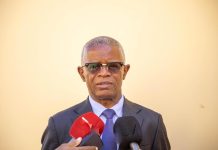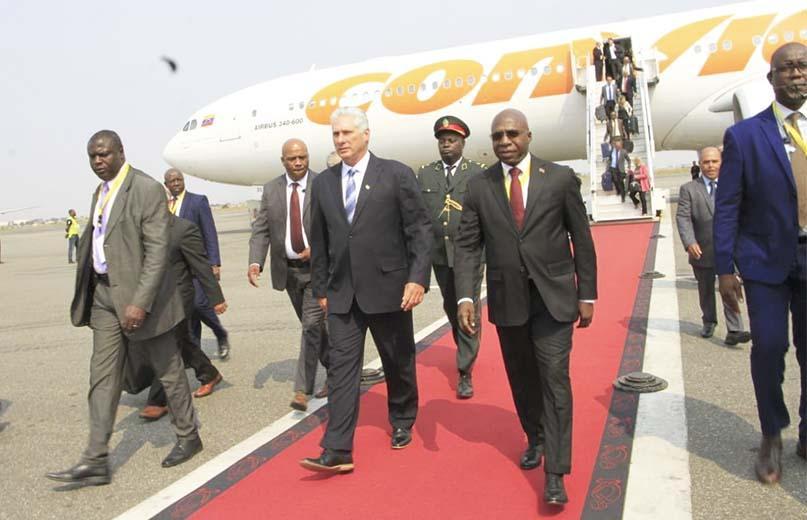
Africa-Press – Angola. The Angolan head of state, João Lourenço, receives his Cuban counterpart, Miguel Mário Diaz-Canel Bermúdez, this Monday in Luanda, to review the state of cooperation relations between the two countries, united by historical bonds of friendship and solidarity.
Bermúdez arrived in the Angolan capital on Sunday for a 48-hour state visit, dedicated to strengthening bilateral cooperation, through the signing of partnership agreements in various fields of common interest.
According to an official note, the Cuban leader begins his program with a morning visit to the Memorial Dr. António Agostinho Neto, where he proceeds to sign the Book of Honor in honor of the founder of the Angolan Nation.
The meeting with his Angolan counterpart will be followed by official talks between the delegations of both countries, before the signature of the proposed legal instruments and joint statements to the press.
In the afternoon, Bermúdez will speak at the National Assembly (Parliament), in Luanda, in a solemn session to honor his first visit to Angola as President of the Republic and the third by a Cuban head of state.
Among other activities, Miguel Bermúdez will also lay a wreath of flowers on the tomb of Cuban commander Raúl Diaz Arguelles Garcia, at Cemitério Alto das Cruzes, in Luanda, before meeting with former Angolan students in Cuba.
The Cuban statesman leaves Luanda on Tuesday night, bound for Mozambique in the continuation of his tour of the African continent which should also take him to South Africa.
In the latter country, the Cuban leader will participate, as a guest, in the summit of Heads of State and Government of the bloc of emerging economies of Brazil, Russia, India, China and South Africa (BRICS).
The first visit by a Cuban head of state to Angola took place with Fidel Castro Ruz, in March 1977, just over a year after the visit to Cuba by António Agostinho Neto, the first Angolan President.
Fidel Castro visited Angola shortly after the proclamation of national independence, on November 11, 1975.
This was followed by the one in February 2009, carried out by Raúl Castro Ruz, Fidel Castro’s brother who directed Cuba’s destinations, from February 24, 2008 to April 19, 2018, following the latter’s withdrawal from political life.
Born on August 3, 1926, Fidel Alejandro Castro Ruz died on November 25, 2016, at the age of 90.
47 years of brotherhood and solidarity
Through an agreement initialed by the then Angolan Minister of Foreign Affairs, José Eduardo dos Santos, and by the first Cuban ambassador to Angola, Oscar Oramas, the two countries established diplomatic relations on November 15, 1975, four days after Independence.
The bilateral relationship is based on a strong brotherhood and solidarity forged, from the Independence then threatened by internal disputes supported by foreign forces.
The Angolan authorities recognize that Cuba played a crucial role in the proclamation of this independence, as thousands of Cuban soldiers shed their blood, fighting alongside the Angolans against foreign invasion and for the integrity of the borders.
The first Cuban military instructors arrived in Luanda in October 1975, almost on the eve of the proclamation of Independence, whose dispute by the three liberation movements then in existence (MPLA, UNITA and FNLA) plunged the country into a civil war that would end 27 years later.
It is estimated that at least 450,000 Cubans, including military doctors, teachers, engineers and other professionals, were in Angola during the 16 years of Cuban presence in national territory under the designation of “Operation Carlota”.
This operation ended in 1991 with the withdrawal of the last Cuban soldier from Angola under the New York Accords, signed in 1988 between Angola, Cuba and South Africa, which also led to Namibia’s independence in 1990.
Available estimates point to at least 10,000 Cuban casualties, including dead, wounded and missing, in the different phases of the Angolan civil war, including the famous Battle of Cuito Cuanavale, in the southern province of Cuando Cubango.
Angola and Cuba yesterday maintain a privileged collaboration, with emphasis on the areas of defense and security, health, education, science and technology, the result of a General Cooperation Agreement that has been in force since 1976, within the framework of their diplomatic relations established the previous year.
After the end of the war, more than four thousand Cubans continued to collaborate in the country in different sectors, especially in health and education.
Meanwhile, Cuba continues to train hundreds of Angolan staff at undergraduate, masters and doctoral levels, contributing to reducing gaps in the field of staff.
Recently, the two countries signed an agreement to guarantee the more regular dissemination of research on the life and work of their political leaders.
The document, signed in March 2023, in Luanda, between the António Agostinho Neto Memorial and the Fidel Castro Cultural Center of Cuba, aims at greater collaboration with publications of works, lectures and conferences, to publicize the historic revolution of Agostinho Neto and Fidel Castro the new generation.
Training of Angolan teachers
The training of Angolan teachers in Cuba dates back to the 1980s, with the arrival of the first 845 professionals at different levels and educational institutions.
Data from 2020 indicate that, of the 2,556 Angolan scholarship holders in training, in Cuba, 77 do pedagogy at a higher level, in various specialized establishments, while 700 follow medicine, including cardiology.
Until 2017, according to official information, Cuba received an average of 40 Angolan students, for training in the areas of exact sciences and at a pedagogical level, in specialized centers in Cienfuegos and Santiago de Cuba.
Over several decades, Cuba has also received several hundred Angolans, either individually or through government scholarships, in search of scientific knowledge in this Central American country.
Data from the Angolan Government indicate that, in 2018, 133 staff trained in Cuba, in the specialties of medicine, computer engineering, electronics, biology, pedagogy, electronic telecommunication, law and others, returned to the country.
In light of the General Cooperation Agreement, it is estimated that more than 40,000 Angolans were trained in Cuba in the specialties of agriculture, health, civil construction, social communication, education, military, defense and security, transport and political science, music and theater.
The National Health System, which comprises 2,644 health units, is provided by 69,816 workers, including 6,400 doctors, 35,458 nurses and 8,780 diagnostic technicians, among others.
For More News And Analysis About Angola Follow Africa-Press