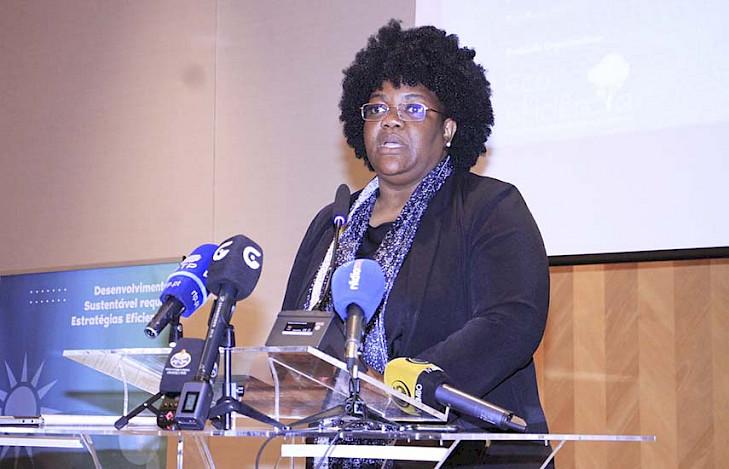
Africa-Press – Angola. The country will have, later this year, its first seedling factory for the recovery, reforestation and development of the agroforestry sector, in order to mitigate the effects of attacks on the ecosystem, said in Luanda, the Secretary of State for the Environment, Paula Coelho.
According to the Secretary of State, these are sustainable plants that are not included in the list of endangered species, but that can contribute to the energy sector.
Speaking to journalists, on the sidelines of the first edition of the “International Conference on Renewable Energies and Clean Development Mechanisms”, Paula Coelho said that this is a private project, with an opinion from the Angolan Government.
In this regard, the official reiterated the Angolan Government’s commitment to the national strategy on climate change, which is based on the pillars of mitigation and adaptation to programmed targets.
“At this time, the Angolan Executive is looking at financing mechanisms for related projects, as well as signaling the carbon market, aligning with environmental legislation”, asserted the Secretary of State
In turn, the director of the seedling factory project, Carlos Padre, from the business group Angola Particle Board Group, said that the factory is being set up in Malanje province, in an area of 5,800 hectares, next to the Agro- industry in Capanda.
The said project, adds the official, is estimated at around US$9 million and in a first phase will create more than 250 jobs.
According to Carlos Padre, the project is being financed by the Angolan Development Bank (BDA).
According to the project’s creator, the objective of the factory is to recover the degraded forest, reforestation and the development of the agroforestry sector.
“This is a project that will help mitigate environmental degradation, given the increase in logging, mining, hunting and other activities, which have caused enormous wear and tear on the fauna and flora”, he argued.
Carlos Padre understands that the factory is an alternative to the erosion of the ecosystem, with the production of forest seedlings, in the sense of restoring some vitality to the ecosystem.
Regarding the technical chapter, the official added that, in a first moment, the seedling factory will create plants, through the system of seed and cloning techniques and, in the second phase, plant throughout the country.
Regarding the first edition of the International Conference on Renewable Energies and Clean Development Mechanisms, held in Angola, “Clean Development Mechanisms”, “Climate Changes – a Reality and a Challenge for Humanity” and a round table subject to the theme “Angola’s Adaptation Mechanisms to Climate Change”.
The American scientist Steven Flagg studied “Carbon Credits, Means and Compensation Mechanisms – Opportunities and Challenges”, having considered carbon credits as a fundamental instrument for reducing the emission of greenhouse gases.
“World governments need to understand that the balance of the ecosystem is produced with emissions and reductions, hence the crucial role of markets”, he asserted.
The Portuguese Assunção Cristas, specialists in Environmental Law, pointed to the production of legislation on the voluntary carbon market, by governments around the world, as crucial for reducing the emission of carbon gases.
In this perspective, Assunção Cristas indicated certification, rules and procedures, registration, double sale and additionality as primary materials for the development of the voluntary carbon market.
The aim of this international conference is to promote an approach on clean development mechanisms, renewable energies, as well as the use of technical information in decision-making.
The event is organized by the national company Eco-efficiency.
For More News And Analysis About Angola Follow Africa-Press